
Money & Values

The supermarket request, the birthday list that keeps growing, the first pocket money. These articles cover what the research on “pester power” actually shows, how children work out what things cost, and how to hold a line on spending without turning every shop into a negotiation.

4 articles

An illustrated scene shows a young boy with light brown hair, wearing a striped shirt, sitting on a teal sofa and holding a pink piggy bank with both hands. A woman with long, dark wavy hair, wearing a mustard yellow knit sweater, sits next to him on his right, looking at the piggy bank with a gentle smile. Her right hand is extended towards the piggy bank, as if guiding or touching it. On a small table in the foreground to the right, there is a small dish containing a few coins. The background features a bookshelf filled with books to the left, a potted plant on top of the bookshelf, and two framed botanical art prints on the cream-colored wall above the sofa. The overall style is a clean, flat vector illustration.
pocket money

Pocket Money Dilemmas: What Research Says Actually Works

The system matters less than the consistency. Real research points to a surprisingly simple answer.

An illustrated scene shows a man with a beard, wearing a green sweater and jeans, sitting in an armchair and holding a clipboard. He is pointing with his other hand toward a chart on the wall. A young boy, wearing a patterned sweater, is sitting on a pouf opposite the man, looking at the chart with his hand to his chin. The chart is divided into two columns: "Chores (Unpaid)" with checkmarks next to a bed and a person sweeping, and "Extra Jobs (Paid)" with checkmarks next to two toy cars and a person with a rake. The background includes a window, framed botanical prints, and an open view into a garage with a car, cleaning supplies, and a hose.
kids earning money

The Difference Between a Kid Wanting to Earn and a Kid Being Bribed

A kid asking to earn money isn't the same as a kid being bribed, and the research treats those two situations very differently.

An illustration shows a woman with dark, wavy hair sitting in an armchair, holding up a smartphone that displays a receipt or payment screen, while pointing at the phone with her other hand. Next to her, a young boy with dark hair sits on a pouf, holding a tablet. The background shows a home setting with a window, a plant, and a bookshelf.
in-game purchases

Why Your Kid Didn't Realize They Were Spending Real Money

Your kid probably didn't understand what they were buying, and that's not an accident of game design.
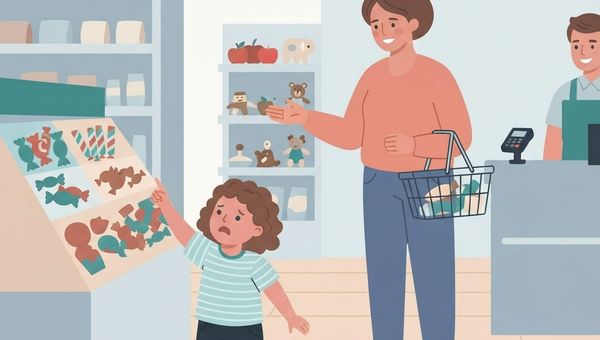
An illustrative vector scene in a grocery store. A young child with curly brown hair, wearing a striped shirt and dark pants, is kneeling on the light wood floor, crying and pointing towards a brightly colored candy display on a shelf. The mother, wearing a peach sweater and blue pants, stands behind the child, smiling gently and gesturing with her open hand. She holds a wire shopping basket containing a few items. Behind a checkout counter to the right, a male cashier in a blue apron is smiling. In the background, there are shelves stocked with various products and apples. The overall style is flat vector art with a muted color palette.
pester power

Endless Requests to Buy Things: What "Pester Power" Research Actually Shows

Nine repeated requests before you give in isn't your imagination. It's the documented average.

Your subscription could not be saved. Please try again.
Your subscription has been successful.

Weekly parenting insights you'll actually use.

No spam. Just thoughtful ideas, expert tips, and stories that make a difference.

Protected by reCAPTCHA. Google's Privacy Policy and Terms of Service apply.