Your kid announces they want to "get a job," or start earning their own money somehow, and the instinct is to just start paying them for chores they already do. Research on motivation suggests that instinct, while well meaning, might work against what you're actually hoping to build.
The finding worth knowing before you set anything up
A major meta-analysis by researchers Edward Deci, Richard Koestner, and Richard Ryan pooled results from 128 separate experiments on rewards and motivation. Their core finding: tangible, expected rewards tied to an activity someone is already doing can measurably reduce their long-term interest in that activity, an effect researchers call the overjustification effect. Critically, this effect specifically applies to tasks a child was already doing willingly. It doesn't really apply to something they weren't motivated to do in the first place.
Why this matters specifically for a kid who wants to earn money
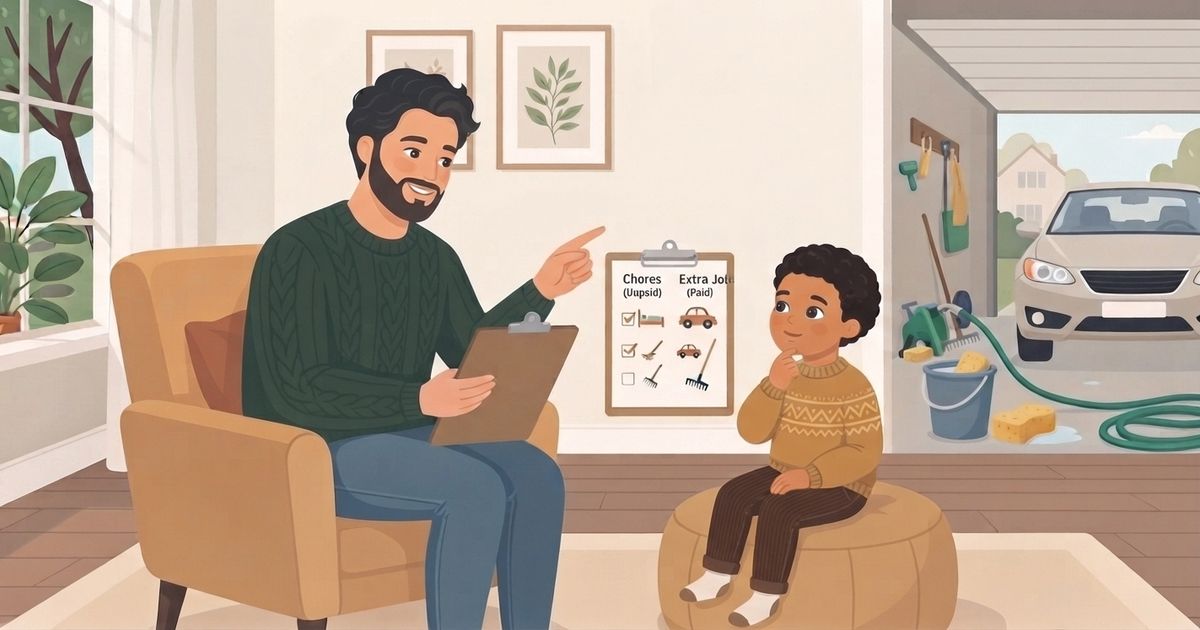
This is actually good news for the situation you're in. A kid who's asking to earn money isn't the same as a kid being bribed to do something they'd resent. If your child wants to earn extra money, the research suggests it works better to offer them tasks beyond what they already do as a normal part of the household, rather than retroactively attaching a price tag to helping out that used to be simply expected of them as a family member.
The distinction that keeps the motivation intact
Keeping baseline family participation, setting the table, tidying their own space, separate from paid opportunities protects two different things at once: the sense that helping the family isn't transactional, and the genuine chance to earn money through something extra, like a bigger one-time project or a task outside the normal routine.
What this looks like in practice
If your kid wants to start earning, look for tasks that fall outside their usual chores entirely, washing the car, organizing the garage, yard work, something that wouldn't have happened otherwise without the extra incentive. This gives them a real, concrete way to practice earning and managing money, without quietly turning "help your family" into "get paid or don't bother."
Frequently Asked Questions
At what age can kids realistically start earning their own money? This varies by family and task, but many kids can begin with simple extra jobs, beyond regular chores, around ages 6 to 8, with more independent options opening up as they get older.
Isn't paying for any chore always harmful to motivation? No, the overjustification effect specifically applies to tasks a child was already intrinsically motivated to do. Tasks they weren't doing anyway aren't at the same risk.
Should I still expect basic chores without payment? Many researchers and family finance experts recommend keeping baseline household participation separate from paid work, to preserve the sense that helping is part of being in the family.
What kinds of tasks work well for a kid wanting to earn extra money? Bigger, occasional projects outside the normal chore routine, like deep cleaning a space or seasonal yard work, tend to work well without undermining everyday cooperation.
Topics in this article
- kids earning money
- chores and allowance
- intrinsic motivation
- overjustification effect
- financial literacy
- Deci and Ryan research
- work ethic
- personalized book creation
- children's books
- positive parenting
QT
Quilloo Team
Bringing together child development research and thoughtful storytelling for parents.
Weekly parenting insights you'll actually use.
No spam. Just thoughtful ideas, expert tips, and stories that make a difference.