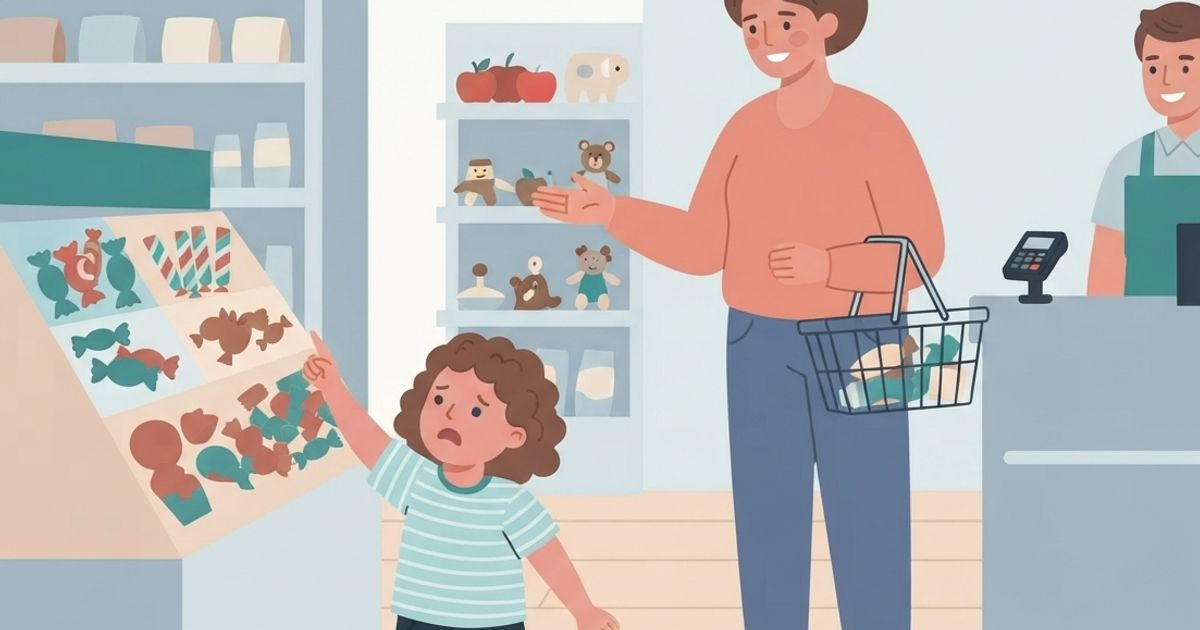
You're three aisles into the grocery store and your kid has already asked for cereal, a toy hanging near the checkout, and a candy bar, each time a little louder than the last. By the fifth ask, you're doing math in your head about whether saying yes is actually cheaper than the meltdown.
There's a name for exactly this
Researchers call this pester power, defined as a child's repeated, sometimes escalating requests aimed at influencing a parent's purchase decisions. It's been studied extensively enough to have its own research literature. One widely cited survey found that among kids ages 12 to 17, a child will, on average, repeatedly ask for an item around nine times before a parent gives in. Nine separate asks. Most parents aren't imagining the persistence.
The scale of how often parents actually cave
A large study following more than 13,000 parents and children across eight European countries over two years found that 63 percent of parents reported giving in to pester power. It's not a rare parenting slip. It's closer to the norm. The same study found something worth knowing beyond the checkout line: kids who frequently requested items they'd seen advertised were 30 percent more likely to become overweight over the following two years, largely because the most-requested items skew heavily toward sugary, heavily marketed food.
Why persistence works so well on parents
Part of what makes pester power effective isn't really about the child's tactics. It's about parental fatigue, and sometimes guilt, especially in busy households where saying yes can feel like an easy way to smooth over a rushed or distracted moment. Marketers know this too. A striking number of advertising and marketing professionals have openly acknowledged that campaigns are specifically designed to trigger this exact dynamic, banking on kids doing the persuading for them.
What actually helps
Research and practical guidance in this area converge on a few consistent strategies: setting expectations before you're in the store rather than negotiating in the moment, being specific about what's off the table ("we're not buying candy today") instead of a vague no, and giving kids their own small amount of money to manage, which shifts the conversation from "will you buy it" to "do you want to spend your own money on it."
A story that walks through a similar moment, a character wanting something in a store and navigating that want without a meltdown, can also give a child language for the experience before it happens for real, rather than only addressing it live, mid-request, under pressure.
Frequently Asked Questions
Is it normal for kids to ask for things this persistently? Yes, this is a well-documented and common pattern, not a sign of a particularly difficult child.
Does giving in occasionally undo any progress? Occasional inconsistency happens to every parent. What matters more is the overall pattern over time, not a single exception.
At what age does pester power typically peak? Younger children, particularly ages four to eleven, tend to make more frequent requests than teenagers, who often shift toward reasoned arguments instead.
Does giving kids their own money actually reduce requests? Many parents and researchers report that it helps, since it introduces a real tradeoff for the child instead of an open-ended ask.
Sources:
- Lambert, Plunkett, & Wotowiec. Survey research on children's repeated purchase requests, cited via GoHenry.
- IDEFICS study: two-year cohort study of over 13,000 parents and children across eight European countries on pestering, diet, and weight status.
Topics in this article
- pester power
- children requesting purchases
- onsumer behavior research
- parenting strategies
- grocery store meltdowns
- money and kids
- setting boundaries
- personalized book creation
QT
Quilloo Team
Bringing together child development research and thoughtful storytelling for parents.
Weekly parenting insights you'll actually use.
No spam. Just thoughtful ideas, expert tips, and stories that make a difference.