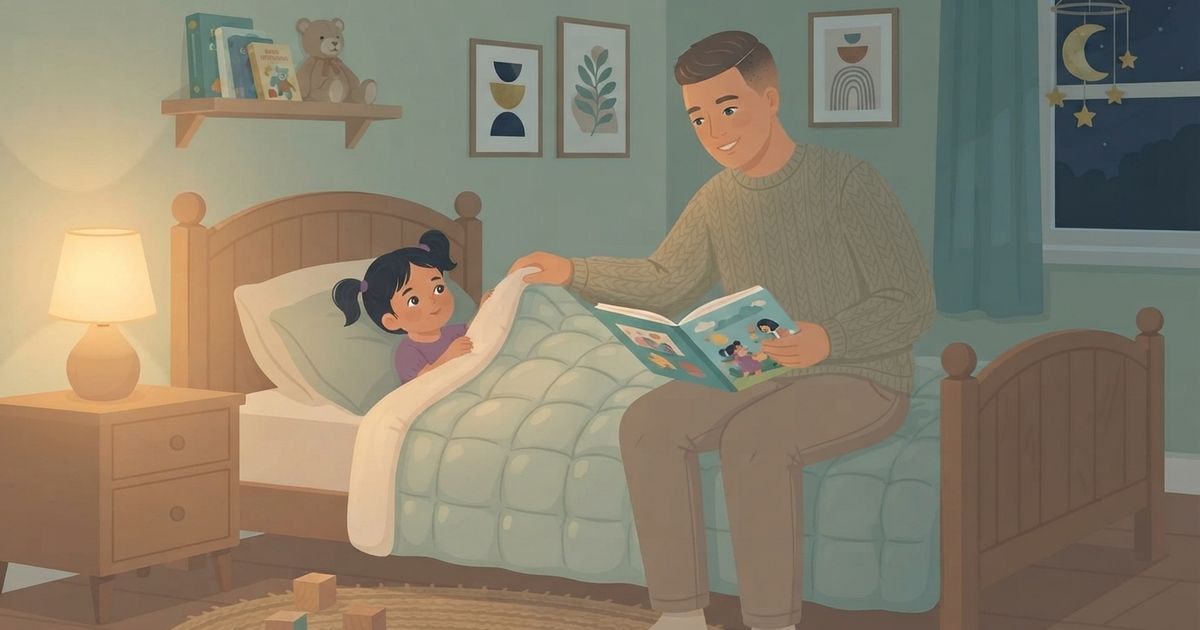
It's 7:48 p.m. You've already negotiated the pajama top, lost the toothbrush debate, and located the one stuffed rabbit that is acceptable tonight. Then your kid snuggles in, looks up, and says, "Tell me about when I was a baby." Suddenly the bedtime routine stops being a chore and becomes the best ten minutes of your day.
The quietest hour is doing the loudest work
A predictable bedtime routine is usually sold as a sleep tool, and it is one. In a study of more than 10,000 mothers across 14 countries, sleep psychologist Jodi Mindell and colleagues found that young children with a regular bedtime routine fell asleep faster, woke less at night, and slept more overall. The effect was dose-dependent: each additional night of routine per week was linked to better sleep. Doing it three nights is good. Doing it most nights is better.
But sleep is only half the story. In a 2018 review, Mindell and Ariel Williamson pointed out that a bedtime routine bundles together almost everything young kids need from us: physical closeness, calm talk, shared reading, singing, cuddling. They connected these routine ingredients to language development, emotional regulation, and parent-child attachment, while noting that more research is needed on exactly how it works. Translation: the same fifteen minutes that get your kid to sleep may also be quietly building your relationship.
Why kids suddenly open up in the dark
Every parent knows this one. You ask "How was preschool?" at pickup and get "fine." Then at 8 p.m., lights low, you hear about the friend who wouldn't share the blue shovel, the weird noise in the bathroom, and a detailed theory about where worms go on weekends.
There's a reason for the timing. At bedtime, the day's distractions are gone. No screens, no siblings grabbing things, nobody rushing to the car. Your child has your full attention, often lying side by side instead of face to face, which feels safer for tricky topics. And the routine itself signals safety: same bath, same book, same song. When the structure is predictable, kids have more emotional room to bring up the unpredictable stuff.
For toddlers, this closeness is mostly physical: the weight of your arm, the rhythm of your voice. Preschoolers and early grade-schoolers start using bedtime as a talking window, and yes, they will stretch it. At age five, "one more question" is basically an Olympic sport.
How to protect the golden hour without turning it into homework
The most common mistake is treating bedtime as a checklist to finish as fast as possible. Totally understandable, since the dishes and your show are waiting. A few small shifts keep it connected without making it longer:
- Keep the order the same, let the content wander. Bath, pajamas, teeth, book, song, lights. Kids relax into the sequence, and the conversation inside it can go anywhere.
- Leave your phone in another room. Your child notices the glance at the screen more than you think.
- Use a warm opener. Try "What was the best part of today?" or "Was anything hard today?" Then wait. Silence is allowed.
- Save discipline for daylight. If something from the afternoon needs addressing, handle it earlier. Bedtime works best as a no-lecture zone.
- Take turns. When both parents share bedtime, your child gets this close time with each of you, and nobody burns out by Wednesday.
On nights when everything goes sideways, and some will, a shortened version still counts. The research points to consistency over perfection.
How a story helps
A story is often the heart of the bedtime routine because it gives parent and child something to focus on together, side by side. Reading aloud slows everyone down, lowers the energy in the room, and creates a shared world you can both talk about afterward. Stories that echo your child's own life, like a new sibling, a first day at school, or a brave moment at the doctor, give them a safe distance to process feelings before sleep. Over time, the book becomes a cue: when this comes out, the day is winding down and a parent is fully here.
Frequently Asked Questions
How long should a bedtime routine be for a toddler? Short and predictable works best. Around 20 to 30 minutes is plenty for most toddlers, as long as the steps happen in the same order most nights. A longer routine isn't better if it turns into a stalling festival.
Is it normal that my child only wants to talk at bedtime? Yes, very normal. Bedtime is calm, private, and free of distractions, so kids often feel safer bringing up worries then. Listen first, and set a gentle limit if it becomes a way to delay sleep.
What to do if bedtime turns into a battle every night? Make the routine visual (a simple picture chart helps), keep the order identical, and offer small choices like which pajamas or which book. Handle conflicts from earlier in the day before bedtime starts, so the routine itself stays positive.
Sources
- Mindell, J. A., Li, A. M., Sadeh, A., Kwon, R., & Goh, D. Y. (2015). Bedtime routines for young children: A dose-dependent association with sleep outcomes. Sleep, 38(5). Link
- Mindell, J. A., & Williamson, A. A. (2018). Benefits of a bedtime routine in young children: Sleep, development, and beyond. Sleep Medicine Reviews, 40. Link
Topics in this article
- bedtime routine
- bedtime bonding
- parent-child connection
- bedtime stories
- toddler sleep
- preschooler bedtime
- Jodi Mindell
- reading aloud
- personalized book creation
- children's books
- positive parenting
QT
Quilloo Team
Bringing together child development research and thoughtful storytelling for parents.
Weekly parenting insights you'll actually use.
No spam. Just thoughtful ideas, expert tips, and stories that make a difference.