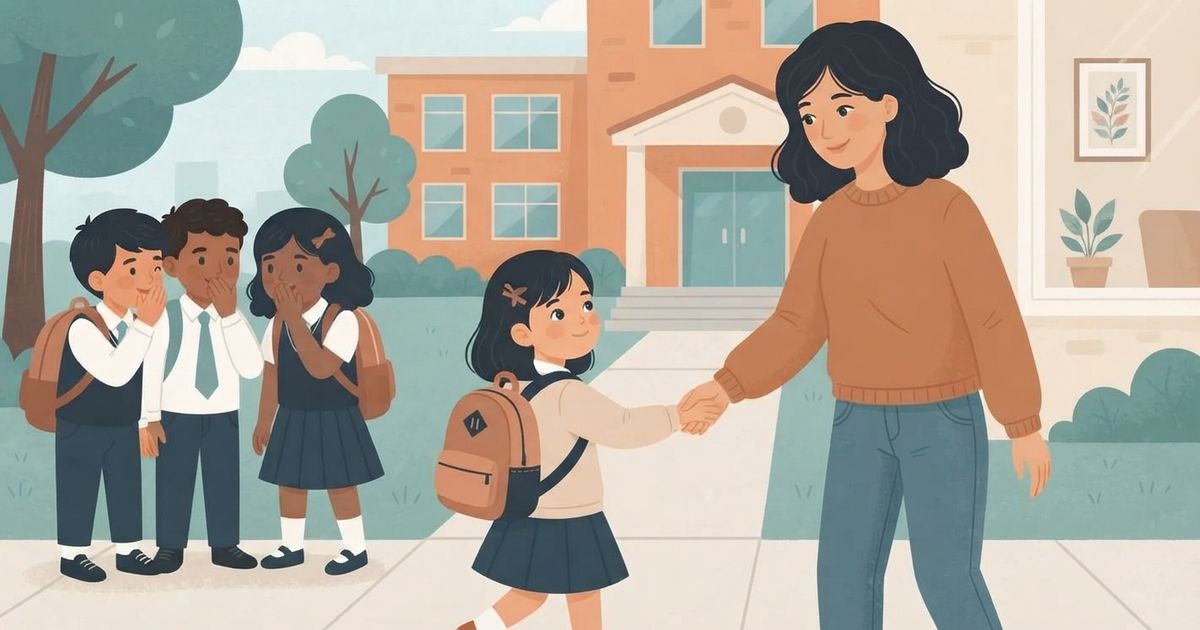
Your six-year-old walks out of school, spots a classmate, and the whole world shrinks to the two of them. By dinner she is repeating a phrase you never taught her, and tomorrow's outfit has to match her friend's. Nothing about this is wrong. It is a child tuning in to the people around her. The more interesting question, and the one Gordon Neufeld asks, is who she is tuning in to the most.
The idea, in one sentence
Children are built to orient toward someone, taking cues from that person about how to act, what matters, and who to become. Peer orientation is the term Neufeld and Gabor Maté use for what happens when that "someone" is a group of same-age kids instead of the adults raising them.
What Neufeld and Maté actually say
The idea comes from Hold On to Your Kids: Why Parents Need to Matter More Than Peers (2004), written by developmental psychologist Gordon Neufeld and physician Gabor Maté. Their starting point is the attachment instinct, the built-in drive to seek closeness with someone and to stay close once that closeness is found. Neufeld describes attachment as the pursuit and preservation of closeness.
When that drive is anchored in a parent, the authors argue, parenting gets easier in a very natural way. A child who feels close to you wants to be near you, wants to please you, and is open to being guided. In their words, the secret of parenting lies less in what a parent does and more in who the parent is to the child.
When the same drive attaches to peers, the authors suggest, a child begins taking direction from people who are just as young and just as much in progress. A parent's words carry less weight, and friends become the mirror the child checks to see what is cool, what is acceptable, and what is worth caring about.
What it can look like at home
The framework is about direction, not about any single behavior, but a few everyday moments show where a child's compass is pointing:
- Whose approval lights her up most, yours or a friend's?
- When something exciting or confusing happens, who does she want to tell first?
- Does she look at you to learn how to feel about something new, or look around the room at other kids?
Any child will answer these differently on different days, and that is perfectly fine. The point is simply to notice the pattern over time.
Where the idea comes from
Neufeld is a Vancouver-based clinical psychologist whose career spans more than four decades of work with children, youth, and the adults responsible for them. According to his own biography, his model of attachment was inspired by early attachment researchers such as John Bowlby, Konrad Lorenz, and Harry Harlow. He later founded the Neufeld Institute to teach his approach, and the book he wrote with Maté has been translated into more than 35 languages, according to the Institute.
One honest note about the evidence: this is a clinical and observational framework, not the result of a single controlled study. It works best as a lens for understanding children, and not as a guarantee about any one child.
Why it matters in the early years
Between ages 0 and 8, a child's world widens fast: preschool, school, birthday parties, the kid next door. Friendships in these years are a joy and an important place to practice sharing, negotiating, and empathy. The Neufeld lens adds just one thing to watch: the direction of the compass.
The early years are also the stretch when parents have the strongest natural pull on a child's attention. That makes it a good moment to deepen the connection, so that friendships can grow beside it and never in place of it.
What this does not mean
Peer orientation is not a call to limit friends, cancel playdates, or compete with other children. Friends are wonderful. The authors' argument is that children do best when friends are companions and parents are guides, each in their own place. The framework suggests that a child who feels secure at home enters friendships from a settled place, with less need to chase approval.
Three small ways to stay your child's first call
Think of these as ways of keeping home the warmest place in your child's day.
Keep a few traditions that belong only to your family. A Friday pizza night with a silly name, a secret handshake at drop-off, a bedtime phrase only the two of you know. Belonging is built from small, repeated, shared things.
Bring the friends into your orbit. Host the playdate at your place when possible, learn the friend's name and favorite snack, and get to know the friend's parents. A child who sees the adults and the friends sharing one world stays connected to both.
Be the first stop for big and small news. Try a bedtime "tell me one thing about today." Listen with curiosity, skip the fixing, and let your reaction say: this is the person who is glad to hear everything.
Frequently Asked Questions
What is peer orientation?
Peer orientation is a term from Gordon Neufeld and Gabor Maté's book Hold On to Your Kids. It describes children looking mainly to their peers, rather than to parents and other caring adults, for direction, values, and a sense of identity.
Is it normal for kids to prefer friends over parents?
Wanting friends is a healthy and normal part of growing up. The Neufeld framework focuses on balance: friends as companions, and a parent as the guide the child still turns to for comfort and direction.
At what age does peer orientation start?
There is no exact age. Neufeld and Maté discuss it most in school-age children and teens, and their advice is to strengthen the parent-child connection early, so it is well established as friendships become more important.
Does this mean I should limit playdates?
No. The idea is to keep your relationship warm and central while friendships flourish. Hosting playdates at home and getting to know your child's friends is one simple way to do both.
What is the Neufeld approach in plain words?
Neufeld's attachment-based developmental approach starts from the idea that children develop best when they feel close to the adults responsible for them, and that this closeness is what makes guidance possible.
Sources
- Neufeld, G. & Maté, G. (2004). Hold On to Your Kids: Why Parents Need to Matter More Than Peers. Knopf Canada. Publisher page.
- Neufeld Institute. Gordon Neufeld biography and overview of his work.
- Neufeld Institute. About the book and its translations.
Topics in this article
- peer orientation
- Gordon Neufeld
- Hold On to Your Kids
- attachment parenting
- attachment theory
- parent-child bond
- child development
- kids and friends
- parenting ages 0-8
- raising resilient kids
- personalized book creation
- children's books
- positive parenting
QT
Quilloo Team
Bringing together child development research and thoughtful storytelling for parents.
Weekly parenting insights you'll actually use.
No spam. Just thoughtful ideas, expert tips, and stories that make a difference.