
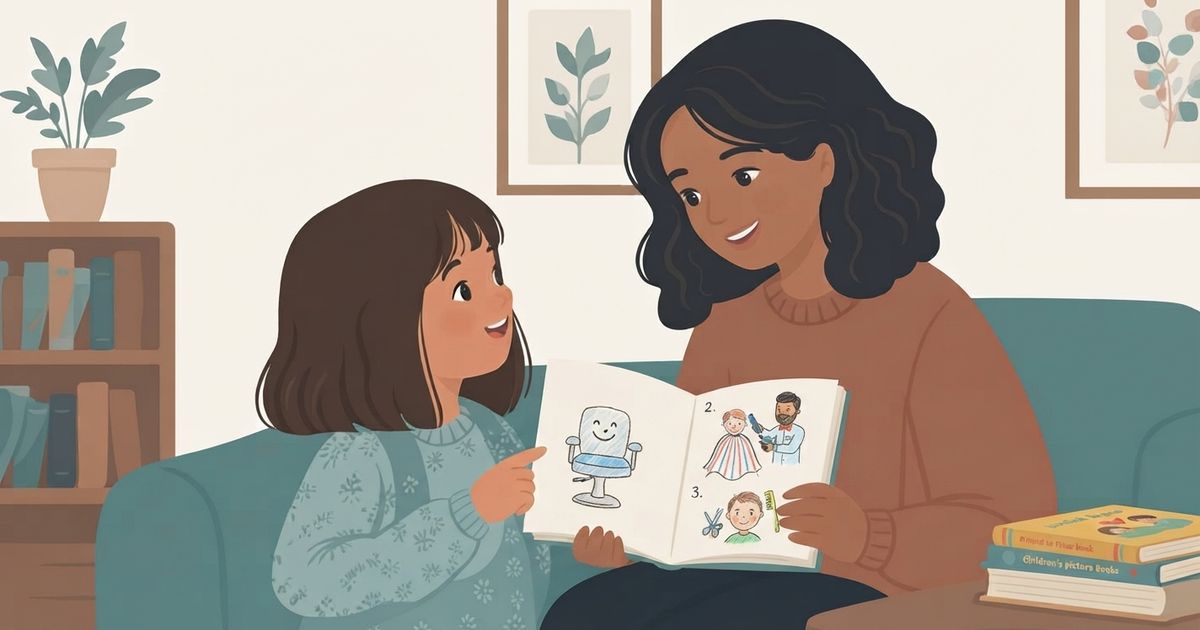
Your three-year-old has her first haircut tomorrow. She isn't autistic, she's just three, and the idea of a stranger with scissors near her head has already produced two meltdowns and one firm "NO HAIRCUT EVER." You've heard that social stories help autistic children with new situations. Could one help her too?
The honest answer: very likely, yes, though the research is thinner than for autistic children. A 2024 review that included typically developing preschoolers found that social stories helped young children learn expected behaviors, especially when the story was paired with practice. And the reasons stories help, predictability and understanding, apply to almost every toddler.
Why new situations are so hard at this age
Toddlers and preschoolers live in a world full of unwritten rules. Why do we sit still in the barber chair? Why does the doctor touch my ears? Why does everyone wait in line? Adults absorbed these rules so long ago that we forget they ever needed explaining.
On top of that, young children are still developing what psychologists call theory of mind: the understanding that other people have their own thoughts, beliefs and intentions. A large 2001 meta-analysis by Henry Wellman and colleagues, combining 178 studies, showed that a key part of this understanding goes through a real change between about ages 3 and 5. Before then, it is genuinely hard for a child to guess what the barber is thinking or why the nurse says "just a little pinch."
So the gap Carol Gray noticed in her autistic students, missing information about what others think and expect, also exists in every toddler. In most children it is simply temporary and developmental.
What the research says about children without autism
Most social story research has been done with autistic children, so it's important to be clear about what we know for the rest.
In 2024, Na Zhou and colleagues reviewed 21 studies on social stories with preschool children. The children included typically developing kids as well as children with autism, developmental delays, hearing loss and ADHD. Most of the studies reported better behavior after the stories, such as more of the expected behavior or fewer challenging ones. The review mentions earlier work using social stories to support peer play among typically developing preschoolers.
Two findings are especially useful for parents. First, in the two studies that could be combined statistically, children taught toothbrushing with a social story practiced more of the brushing steps than children taught the usual way. Second, the stories worked best with practice. In one study, the story alone didn't change behavior, while story plus practice did.
The caveat: these were mostly small studies, and only two could be combined into a meta-analysis. A 2022 review by Charis Wahman and colleagues, which focused on children ages 3 to 5 and included two studies with typically developing preschoolers, found that social stories improved prosocial behavior on average, but results varied widely and the effect on challenging behavior was uncertain. The authors concluded that for young children, social stories on their own can't yet be called an evidence-based practice. An earlier review by Anastasia Kokina and Lee Kern also found weaker results for preschoolers than for elementary-age children, though the groups compared were small. So for typically developing children, social stories are a promising and sensible tool, best used alongside practice, connection and other support, not a proven treatment on their own.
How to adapt a social story to your child's age
- Age 2: Four to six short sentences, one idea, a real photo on every page. "I sit in the big chair. The barber combs my hair. It tickles."
- Age 3 to 4: Add one sentence about feelings ("Some kids feel nervous. That is okay.") and one about what comes next.
- Age 5 to 6: Add the "why" behind things ("The cape keeps hair off my clothes."), and invite your child to help write or illustrate it.
When a story helps, and when connection comes first
A social story is a tool for calm moments, before a situation happens. It is not a tool for the middle of a meltdown. When your child is already overwhelmed, what helps first is you: your calm voice, your arms, your patience. Once things settle, the story can help your child make sense of what happened and prepare for next time.
Try this tonight: write it together
If your child is four or older, make them co-author. Ask, "What do you think will happen at the haircut?" and write down their words. Fill in the missing pieces gently: "And then the barber uses a little vacuum. It sounds loud but it doesn't hurt." Let your child draw the pictures. A child who helps create the story feels capable and involved, not just told what to do. Then act it out with a doll and a toy comb, and read it once more before bed.
FAQ
Is it okay to use social stories with a child who isn't autistic? Yes. Social stories were created for autistic children, but many parents and teachers use them with all young children. There is less research on that use, but the approach is gentle and low-risk.
At what age can I start? Many families start around age 2, with a few short sentences and real photos.
Will talking about the scary event make my child more anxious? For most children, calm, accurate information lowers anxiety. If your child seems more worried, keep the story shorter and read it closer to the event.
How is a social story different from a regular picture book? A picture book entertains. A social story describes one real situation your child is about to face, accurately and from their point of view.
Sources
- Zhou, N., Zhou, L., Ho, C. Y. T., McGrath, C., & Wong, H. M. (2024). Social story intervention for training expected behaviors among preschool children: A systematic review and meta-analysis. International Journal of Environmental Research and Public Health, 21(7), 940. Link
- Wahman, C. L., Pustejovsky, J. E., Ostrosky, M. M., & Santos, R. M. (2022). Examining the effects of Social Stories on challenging behavior and prosocial skills in young children: A systematic review and meta-analysis. Topics in Early Childhood Special Education, 41(4), 267-279. Link
- Wellman, H. M., Cross, D., & Watson, J. (2001). Meta-analysis of theory-of-mind development: The truth about false belief. Child Development, 72(3), 655-684. Link
- Gray, C. What Is a Social Story? Featuring Carol Gray. Undivided. Link
- Kokina, A., & Kern, L. (2010). Social Story interventions for students with autism spectrum disorders: A meta-analysis. Journal of Autism and Developmental Disorders, 40, 812-826. Link
Topics in this article
- social stories for toddlers
- social stories for preschoolers
- social stories
- theory of mind
- toddler anxiety
- first haircut
- preparing kids for new situations
- child development
- preschool behavior
- personalized book creation
- children's books
- positive parenting
QT
Quilloo Team
Bringing together child development research and thoughtful storytelling for parents.
Weekly parenting insights you'll actually use.
No spam. Just thoughtful ideas, expert tips, and stories that make a difference.