
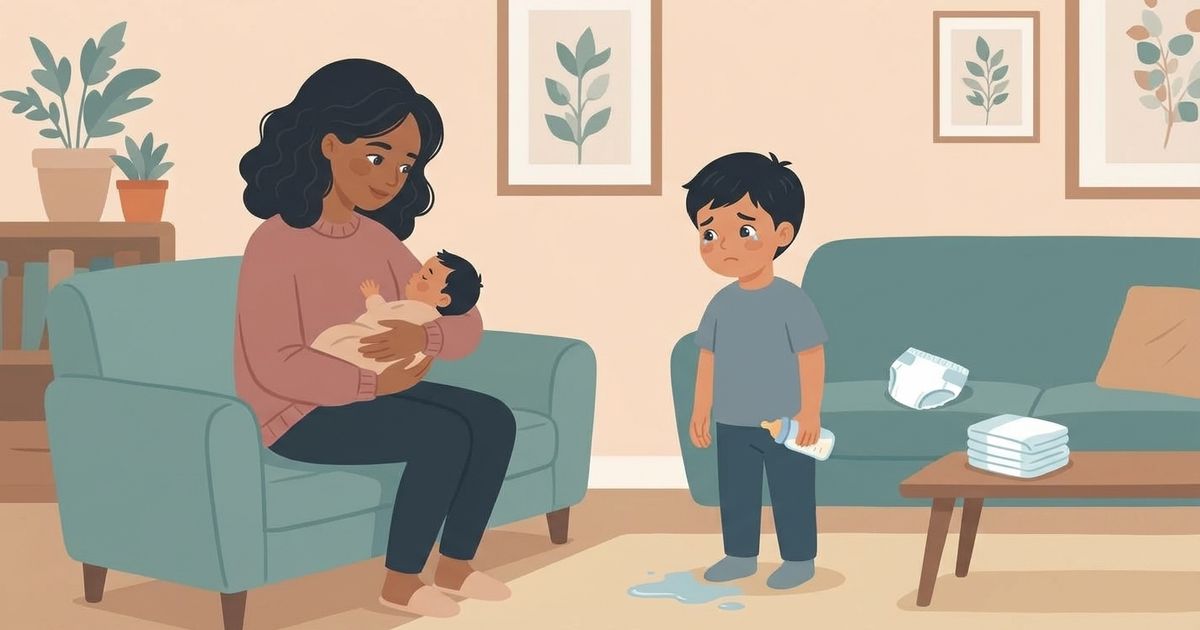
Three weeks ago your preschooler was proudly flushing and waving bye-bye to the pee. Then the baby came home, and now there are puddles by the couch, a sudden interest in the baby's bottle, and a request to "wear a diaper like the baby." If you're seeing regression after a new baby, you're far from alone.
Here's the short answer: it's common, it's usually temporary, and it is rarely about the potty itself. A new sibling is one of the most common triggers for potty training regression, according to the American Academy of Pediatrics. Most of these setbacks fade within days or weeks when the response is calm and connected, not punishing.
A step backward that's really a request
Regression means going back to younger behaviors for a while when life feels big. Potty accidents are the version parents notice most, but it can also look like baby talk, wanting to be carried, waking at night, or asking for a bottle or pacifier.
Developmental psychologist Brenda Volling reviewed decades of research on firstborns becoming big siblings in a 2012 paper in Psychological Bulletin. Across studies, some changes showed up again and again, including more clinginess and more toileting accidents. In one study, toileting accidents were most common among 2-year-olds after the birth, while none of the 3- and 4-year-olds had them. Another found more daytime accidents and bedwetting among children younger than about 40 months.
So the younger your child and the newer the potty skill, the more likely it is to wobble. A skill learned a few months ago is still fragile, and stress tends to knock over the newest blocks in the tower first.
The same review carries good news too. Volling concluded that a new sibling is not a family crisis for most children. Some kids go through a disrupted stretch, some barely change, and some even make developmental leaps. One honest caveat: many of these studies were small and older, and much of the data came from parent reports.
From your child's point of view, the logic is simple. The baby gets carried, fed, changed and cooed at all day. Being little looks like a pretty good deal. A toddler can't say, "I'm worried there isn't enough of you to go around." They show it.
What helps (and what usually backfires)
The AAP describes regression as a way children can meet their emotional needs, and its advice starts with not punishing accidents. Shame tends to add stress, and stress is what started the wobble.
What many parents find works:
- Keep your reaction small. "Oops, your body forgot this time. Let's get dry clothes." Then move on. A flat, friendly tone tells your child this is no big deal, because it isn't.
- Feed the need behind it. If your child wants to be babied, you can say yes in small doses: a cuddle wrapped in a blanket, a pretend bottle game, being carried to bed. Letting them be little for a moment often lowers the need to stay little all day.
- Make "big kid" worth it. Point out the things your child can do that the baby can't: choose a snack, climb the slide, help pick the baby's socks. Notice effort, not just dry pants.
- Keep potty routines predictable. Offer potty breaks at the same moments as before: after waking, before going out, before bath. Newborn chaos easily pushes these aside.
- Protect one-on-one time. Even 10 minutes a day, with you fully present and your child choosing the game, speaks directly to the worry underneath.
Try not to add a fresh round of potty training on top. If your child truly refuses, it's fine to put diapers or pull-ups back on for a short break, framed as a calm choice rather than a defeat.
When it's more than a new-baby wobble
Sometimes accidents have a physical cause. The AAP recommends checking in with your pediatrician to rule out things like a urinary tract infection or constipation, and to call if regression lasts more than a month. Talk to your pediatrician too if your child has pain when peeing or pooping, is holding poop, or seems unusually upset about the bathroom.
Constipation is especially sneaky. A busy household can mean fewer drinks, less fruit and rushed bathroom trips, and a child who has one painful poop may start holding it in.
And for you: managing a newborn and a big feelings toddler on little sleep is a lot. If you snapped over a puddle, that's human. A simple repair later, "I was tired and I got grumpy about the accident. That wasn't fair. I love you," teaches more than a perfect reaction would.
How a story helps
Young children process change through play and repetition. A story about a big sibling who has accidents after the baby arrives, and slowly finds their way back, lets your child see their own experience from a safe distance. It gives words to feelings they can't name yet, like "I want to be little too." Reading it together also opens a gentle conversation, and the story's ending quietly shows that being big comes back.
FAQ
How long does potty regression last after a new baby? For most children it lasts a few days to a few weeks. If it continues for more than a month, the AAP suggests talking to your pediatrician.
Should I put my potty-trained child back in diapers? A short break is fine if your child is very upset or refusing. Present it calmly, keep offering the potty, and avoid making it feel like a punishment.
Is it normal for my 3-year-old to act like a baby after a new sibling? Yes. Baby talk, clinginess and wanting a bottle are common reactions. They usually ease as your child feels secure that there is still plenty of you.
Should I give rewards to stop potty regression? Praise and small rewards can help, but connection usually matters more. Children often regress because they want attention and closeness, so extra one-on-one time tends to work better than a sticker chart alone.
Sources
- Volling, B. L. (2012). Family transitions following the birth of a sibling: An empirical review of changes in the firstborn's adjustment. Psychological Bulletin, 138(3), 497-528. Link
- American Academy of Pediatrics, HealthyChildren.org. Potty Training Regression (adapted from the AAP Guide to Toilet Training, 2nd ed.). Link
- American Academy of Pediatrics, HealthyChildren.org. Toilet Training Setbacks. Link
Topics in this article
- regression after new baby
- potty training regression
- new sibling
- toddler regression
- potty accidents
- big sibling
- toilet training
- Brenda Volling
- personalized book creation
- children's books
- positive parenting
QT
Quilloo Team
Bringing together child development research and thoughtful storytelling for parents.
Weekly parenting insights you'll actually use.
No spam. Just thoughtful ideas, expert tips, and stories that make a difference.