
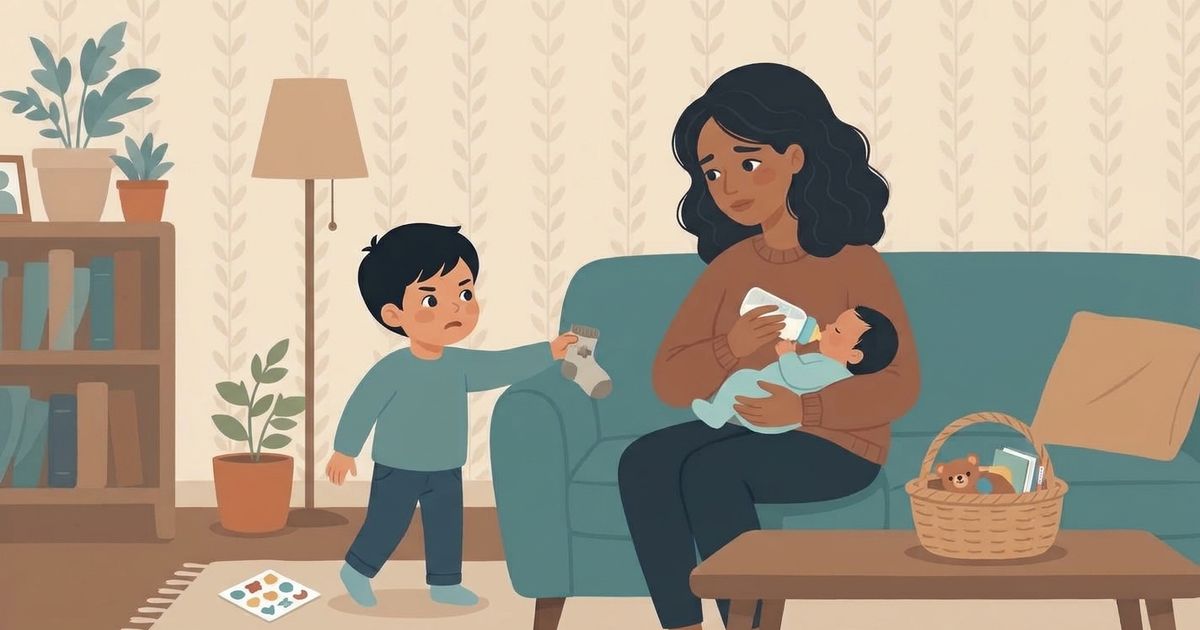
You finally sit down to feed the baby, and right on cue your preschooler needs a snack, a different snack, help with a sock, and to show you a very loud dance. Every single time. If your older sibling seems jealous of the newborn, the timing isn't a coincidence.
The first weeks home are often the bumpiest part of becoming a big sibling. Jealousy, testing limits and clinginess are normal ways for a young child to ask one question: "Am I still important here?" What helps most is answering that question with your actions: small daily moments of attention, a real role in the family, and calm limits when feelings spill over.
Why the hard part often starts at home
During pregnancy the baby is an idea. Once the baby comes home, the baby is a person who sits on your lap a lot. Your older child notices how much of you is now going elsewhere, especially during feedings, which can happen many times a day.
Researchers at the University of Michigan, led by psychologist Brenda Volling, followed 241 families through the arrival of a second child. In their 2017 report, most firstborns adjusted well over the first year, though some had a burst of behavior problems after the birth. That's worth holding on to on a rough Tuesday: a hard few weeks is not a sign of a hard future.
Give them a real job, not a pretend one
The American Academy of Pediatrics suggests inviting older children to help with the baby so they feel included rather than pushed aside. The key is that the job feels real.
A 2- or 3-year-old can fetch a diaper, choose between two onesies, or sing to the baby during a diaper change. A 4- or 5-year-old can hold the bottle with you, push the stroller, or be in charge of announcing when the baby wakes up. Then name what they did: "The baby stopped crying when you sang. You know how to help her."
Cooperation also depends on how parents work together. In a 2015 study in the Journal of Family Psychology, Jin-Hee Song and Brenda Volling observed 216 firstborns helping during a diaper change about a month after the birth. Children who had a harder time calming down were less cooperative mainly in families where the parents tended to undermine each other. When parents backed each other up, the effect was weaker. One caveat: the sample was mostly white, middle-class, two-parent families, and the helping task lasted only a few minutes. Still, the takeaway is practical. Teamwork between the adults helps the child who struggles most.
Feeding time: the daily flashpoint
Many families find that feedings are when a big sibling acts out the most. That makes sense. Your hands are full, and your child can see it.
A few things many parents find help:
- Make a feeding basket. Keep a box of special books, stickers or small toys that only come out while the baby eats. Your child gets something good from feeding time too.
- Talk across the baby. You can read aloud, tell a story, or play "I spy" while you feed. Your attention doesn't have to be all-or-nothing.
- Narrate the wait. "The baby is very hungry right now. When she's done, you and I are going to build the tower." Then follow through, so your child learns that waiting pays off.
Jealous feelings, safe hands
Your child may say "Take the baby back" or "I don't like her." Those words can sting, but they are honest. A response like "It's hard sharing me. You miss our time together" tells your child their feelings make sense, and feelings that are heard tend to settle faster.
The limit stays clear: all feelings are allowed, hurting is not. If your toddler pokes or squeezes the baby too hard, calmly move their hand and say, "I won't let you hurt the baby. You can squeeze this pillow instead." Then stay close. Young children often get rough because they don't yet know how much force is too much, not because they mean harm. Keep the baby out of reach when you can't watch closely.
Interestingly, life outside the family matters too. In a classic 1992 study of 30 firstborns aged 3 to 5, Laurie Kramer and John Gottman found that children who played well with a best friend, especially in pretend play, were friendlier with their new sibling months later. It was a small study, but it suggests that playdates and preschool friendships are not a luxury in these weeks. They are practice.
How a story helps
A story about a big sibling's first days home gives a young child a mirror and a map. Seeing a character feel left out, get grumpy at the baby, and then find their own special place in the family tells your child that these feelings are normal and survivable. Stories also give children words they can borrow ("I feel left out") instead of acting the feeling out. Reading it during a feeding turns the hardest time of day into shared time.
FAQ
How long does sibling jealousy of a newborn last? For many children, the most intense part is the first few weeks to months. If your child seems very distressed or aggressive for a long time, talk to your pediatrician.
What to do if my toddler hits the new baby? Calmly block the hit, say "I won't let you hurt the baby," and offer another way to show the feeling. Then reconnect with your older child, since hitting often means they need you.
Should visitors bring a gift for the older sibling? It can help. The AAP suggests asking visitors to spend time with the older child, and a small gift can make them feel included.
Is it normal for my older child to ignore the new baby? Yes. Some children show little interest at first. Interest often grows once the baby starts smiling and responding.
Sources
- Volling, B. L., Gonzalez, R., Oh, W., et al. (2017). Developmental trajectories of children's adjustment across the transition to siblinghood: Pre-birth predictors and sibling outcomes at one year. Monographs of the Society for Research in Child Development, 82(3). Link
- Song, J.-H., & Volling, B. L. (2015). Coparenting and children's temperament predict firstborns' cooperation in the care of an infant sibling. Journal of Family Psychology. Link
- Kramer, L., & Gottman, J. M. (1992). Becoming a sibling: "With a little help from my friends." Developmental Psychology, 28(4), 685-699. Link
- American Academy of Pediatrics, HealthyChildren.org. Preparing Your Older Child for a New Baby: How to Help Siblings Adjust. Link
Topics in this article
- older sibling jealous of newborn
- new baby
- bringing baby home
- sibling jealousy
- big sibling
- feeding time
- coparenting
- Brenda Volling
- Laurie Kramer
- personalized book creation
- children's books
- positive parenting
QT
Quilloo Team
Bringing together child development research and thoughtful storytelling for parents.
Weekly parenting insights you'll actually use.
No spam. Just thoughtful ideas, expert tips, and stories that make a difference.