
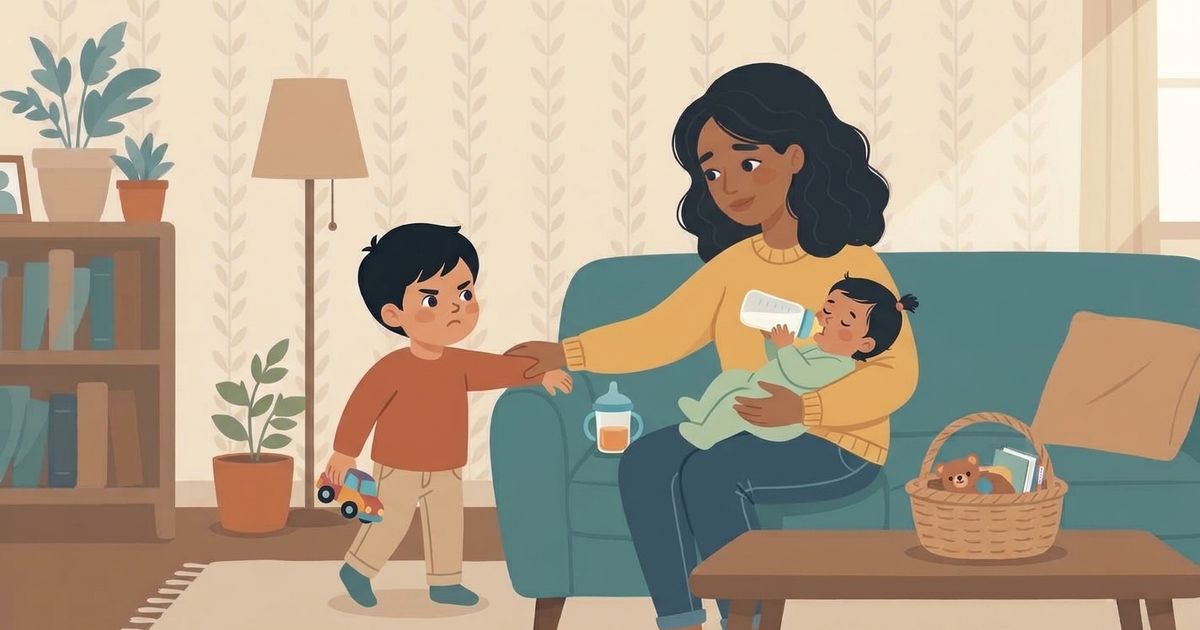
Your 18-month-old wedges herself between you and her brother on the couch. Your 4-year-old announces that his sister's cup has "more juice." Your 7-year-old keeps a running tally of who got the front seat. Same feeling, three very different costumes.
Sibling jealousy is the worry that someone else is getting the love, attention or fairness you need. It is normal at every age, and it shows up differently as children grow. Toddlers protest with their bodies, preschoolers with words and comparisons, and school-age kids with arguments about fairness. Knowing what the feeling looks like at each age helps you answer the need underneath it instead of just the noise on top.
Jealousy starts earlier than you'd think
For a long time, jealousy was considered a "complex" emotion that only older children could feel. Developmental psychologist Sybil Hart challenged that. In a 2002 study with Heather Carrington, 6-month-old babies grew more upset when their mothers lavished attention on a lifelike baby doll than when they read a book aloud. Hart's later work suggests that even very young babies expect a caregiver's attention to be theirs.
A caveat: these were lab studies with dolls, not real siblings. But they help explain why a baby or toddler might fuss, crawl over, or grab your face when you hold another child. It is not manipulation. It is an early, honest protest.
What it looks like, age by age
Babies and young toddlers (under 2). Crying, clinging, pushing between you and the other child, or suddenly needing to be held exactly when you pick up a sibling. What helps: an arm around them, eye contact, and narrating: "You want me too. I've got two arms."
Toddlers (2 to 3). More physical and more dramatic. Grabbing the sibling's toy, hitting, regression to baby behaviors, or the classic "Mine!" They have strong feelings and very few words. What helps: block the hurting calmly, then name the feeling for them: "You're mad that I'm helping Leo. It's hard to wait."
Preschoolers (3 to 5). Jealousy gets verbal. "You love her more." "Why does he get to?" Comparing cookies, turns and minutes on your lap. What helps: resist the urge to prove equality with a measuring cup. Instead, speak to the child in front of you: "You want to know I love you. I love you in exactly your size."
School-age kids (5 to 8). The theme becomes fairness. They notice rules, bedtimes and privileges, and keep score. What helps: explaining the reason behind differences. "Your sister needs help with buttons because she's 3. You stay up later because you're 7."
Why the reason matters more than equal portions
It's tempting to treat siblings identically to avoid jealousy. In practice, that's impossible, and it may not be necessary.
In a 1997 study published in Child Development, Ann Kowal and Laurie Kramer interviewed 61 children about times their parents treated them differently from a sibling. Most didn't see the difference as unfair, as long as they understood why. Children who saw their parents' different treatment as justified described warmer relationships with their siblings. The children in that study were 11 to 13, so younger kids may need simpler explanations, but the principle holds: a clear, honest reason softens the sting.
Family climate matters too. In a 2002 study of toddler and preschool siblings in Child Development, Brenda Volling, Nancy McElwain and Alison Miller found that older siblings handled jealous moments better when the parents' marriage was more positive. The younger siblings' jealous reactions were linked more to their temperament, their natural way of responding to the world. In other words, some kids are simply wired to feel things more loudly, and a calm home helps everyone.
What helps at any age
- Name it without shaming it. "You feel jealous" is not an accusation. It's a word that helps children understand themselves.
- Skip the comparisons. "Why can't you be calm like your brother?" tends to grow jealousy, not shrink it.
- Give each child their own time. Ten minutes of one-on-one attention a day, even split over the week, tells each child they have a place that isn't shared.
- Notice each child's strengths separately. "You figured out that puzzle" instead of "You're the smart one." Labels can lock siblings into competing roles.
- Repair after rough days. If you lost your patience or took sides too fast, coming back later to reconnect helps more than getting it right the first time.
How a story helps
Children often can't explain jealousy, but they recognize it right away in a character. A story about a sibling who feels left out, says something unkind, and is then reassured gives your child a way to talk about their own feelings without being in the hot seat. It also shows what a family can do with those feelings: name them, make room for them, and find a way back to each other. Asking "Why do you think she felt that way?" can open a conversation that "Are you jealous?" never would.
FAQ
At what age does sibling jealousy start? Signs of jealousy have been seen in babies as young as 6 months in lab studies. It tends to become more visible and verbal from age 2 onward.
Is it normal for my child to say "You love her more"? Yes. It's a common way young children check that they're still loved. A warm, specific answer usually helps more than arguing about who got more.
Should I treat my children exactly the same to avoid jealousy? Not necessarily. Research with older kids suggests children accept differences when they understand the reason, so explaining often works better than strict equality.
When is sibling jealousy a problem? If one child is frequently hurting another, or a child seems withdrawn or anxious for a long time, talk to your pediatrician or a family counselor.
Sources
- Hart, S., & Carrington, H. (2002). Jealousy in 6-month-old infants. Infancy, 3(3), 395-402. Link
- Hart, S. L. (2016). Proximal foundations of jealousy: Expectations of exclusivity in the infant's first year of life. Emotion Review. Link
- Kowal, A., & Kramer, L. (1997). Children's understanding of parental differential treatment. Child Development, 68(1), 113-126. Link
- Volling, B. L., McElwain, N. L., & Miller, A. L. (2002). Emotion regulation in context: The jealousy complex between young siblings and its relations with child and family characteristics. Child Development, 73(2), 581-600. Link
Topics in this article
- sibling jealousy
- sibling rivalry
- jealousy in toddlers
- "you love her more"
- fairness between siblings
- differential treatment
- Sybil Hart
- Laurie Kramer
- Brenda Volling
- personalized book creation
- children's books
- positive parenting
QT
Quilloo Team
Bringing together child development research and thoughtful storytelling for parents.
Weekly parenting insights you'll actually use.
No spam. Just thoughtful ideas, expert tips, and stories that make a difference.