
You spent a fortune on the theme park trip. Months later, you ask your five-year-old what she remembers. Not the roller coaster. Not the fireworks. "When Dad dropped his ice cream and the seagull took it." Turns out, making family memories that last has less to do with how big the event was and more to do with what happens after.
Memories aren't made in the moment. They're made in the retelling
Young children don't store memories like a video camera. Their memories are fragile, and a lot of what sticks depends on whether someone helps them talk about it later.
Psychologists call this reminiscing, and the style matters. In a 2007 randomized study published in Child Development, Elaine Reese and Rhiannon Newcombe trained one group of mothers of toddlers (aged about 18 to 30 months) in "elaborative reminiscing": talking about shared past events with open-ended questions, rich detail, and following the child's lead. A comparison group got no training.
Over the following months, the children of trained mothers developed richer, more detailed memories and told better stories about their own experiences. The mothers kept using the style long after the training ended, too. The takeaway: the way we talk with kids about the past helps shape what they'll remember and how they tell their own story.
Here's the difference in practice.
A low-elaboration chat: "Did you have fun at the beach?" "Yes." "Good."
An elaborative one: "Remember the beach? What was the funniest thing that happened?" "The crab!" "Oh right, the crab! Where did it go?" "Into Grandpa's shoe!" "And what did Grandpa do?"
Same event. One version fades. The other becomes a family legend.
Family stories give kids roots
The memories that last aren't only a child's own. Stories about the family, how the parents met, what Grandma did when she was little, the time the car broke down in a snowstorm, also shape who a child becomes.
At Emory University, psychologists Marshall Duke and Robyn Fivush developed the "Do You Know?" scale, 20 questions like "Do you know where your parents met?" and "Do you know the story of your birth?" In a 2008 report, they found that children who knew more family stories tended to show higher self-esteem and a stronger sense of control over their lives. Much of this research focused on older children and adolescents, so it's not a formula for toddlers. But the roots are planted early, and Fivush has emphasized that what matters isn't memorizing facts. It's the ongoing process of families sharing stories together.
Everyday ways to build memories that stick
Talk about it afterward, not just during. On the drive home, at dinner, at bedtime: "What was your favorite part?" Then ask one more question.
Follow your child's lead. If they remember the seagull and not the fireworks, go with the seagull. Their version is the one that will last.
Include feelings. "Were you nervous before the swim class? How did you feel after?" Talking about emotions makes memories richer and helps kids understand themselves.
Tell family origin stories on repeat. How they got their name. The day they came home. What you were like at their age. Kids ask for these over and over, and that's how the stories take root.
Keep memory anchors. Photos, drawings, a ticket stub, a book made about a special day. Physical reminders give families a reason to retell.
Don't wait for big events. Pancake Saturdays, the walk to preschool, the silly song in the bath. Small rituals often become the most treasured memories because they happened so many times.
For toddlers, keep it short and concrete, with lots of prompting. Preschoolers can start adding their own details. By early elementary school, many kids love telling family stories themselves, sometimes with enthusiastic creative additions.
How a story helps
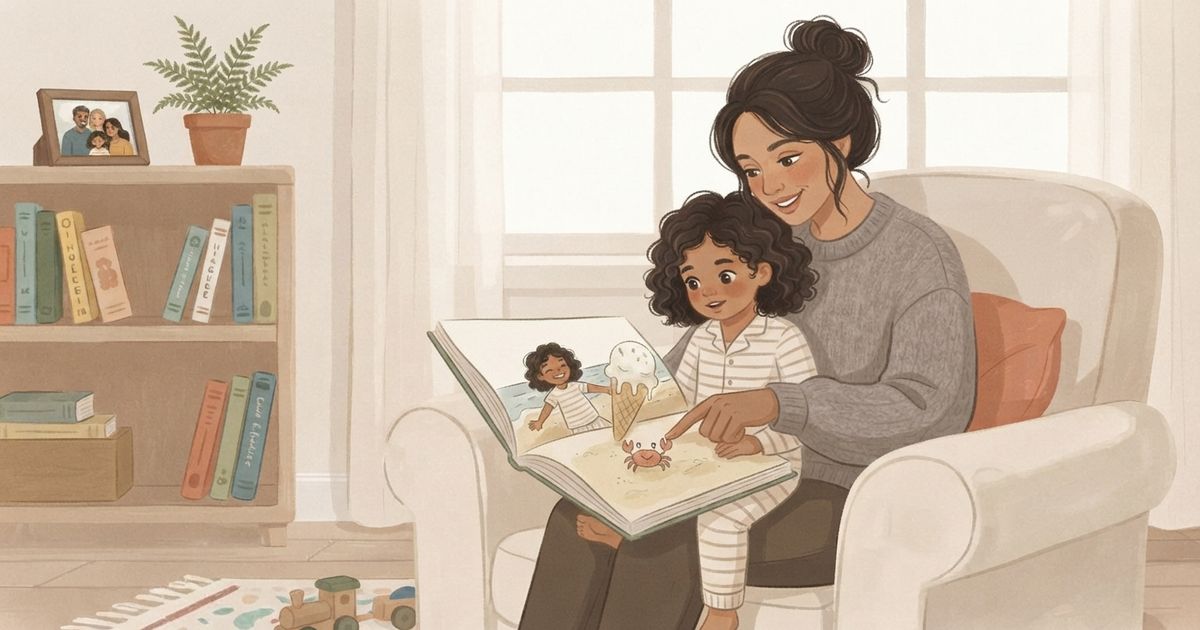
A story gives a memory a shape: a beginning, a middle, and an end that a child can hold onto and revisit. When a family moment is told as a story, and even better, captured in a book with the child in it, it becomes easy to return to again and again. Each reading is a new chance for elaborative conversation: "Do you remember that day? What else happened?" That repetition is exactly what turns a passing moment into a lasting family memory.
Frequently Asked Questions
How do you create lasting memories with your child? Talk about shared experiences afterward with open-ended questions, include feelings, and revisit the stories often. Everyday rituals and retelling matter more than expensive events.
At what age do children start remembering things long term? Most adults remember very little from before age 3 or 4. But how parents talk with young children about past events helps shape their memory skills and the stories they carry forward.
Why are family stories important for kids? Research by Marshall Duke and Robyn Fivush found that children and teens who know more family stories tend to have higher self-esteem and a stronger sense of belonging. Sharing the stories is what matters most.
Sources
- Reese, E., & Newcombe, R. (2007). Training mothers in elaborative reminiscing enhances children's autobiographical memory and narrative. Child Development, 78(4). Link.
- Duke, M. P., Lazarus, A., & Fivush, R. (2008). Knowledge of family history as a clinically useful index of psychological well-being and prognosis: A brief report. Psychotherapy: Theory, Research, Practice, Training, 45(2). Link.
- Fivush, R. (2016). The "Do You Know?" 20 questions about family stories. Psychology Today (blog).
Topics in this article
- family memories
- lasting memories with kids
- elaborative reminiscing
- family storytelling
- Robyn Fivush
- Marshall Duke
- Do You Know scale
- family rituals
- personalized book creation
- children's books
- positive parenting
QT
Quilloo Team
Bringing together child development research and thoughtful storytelling for parents.
Weekly parenting insights you'll actually use.
No spam. Just thoughtful ideas, expert tips, and stories that make a difference.