
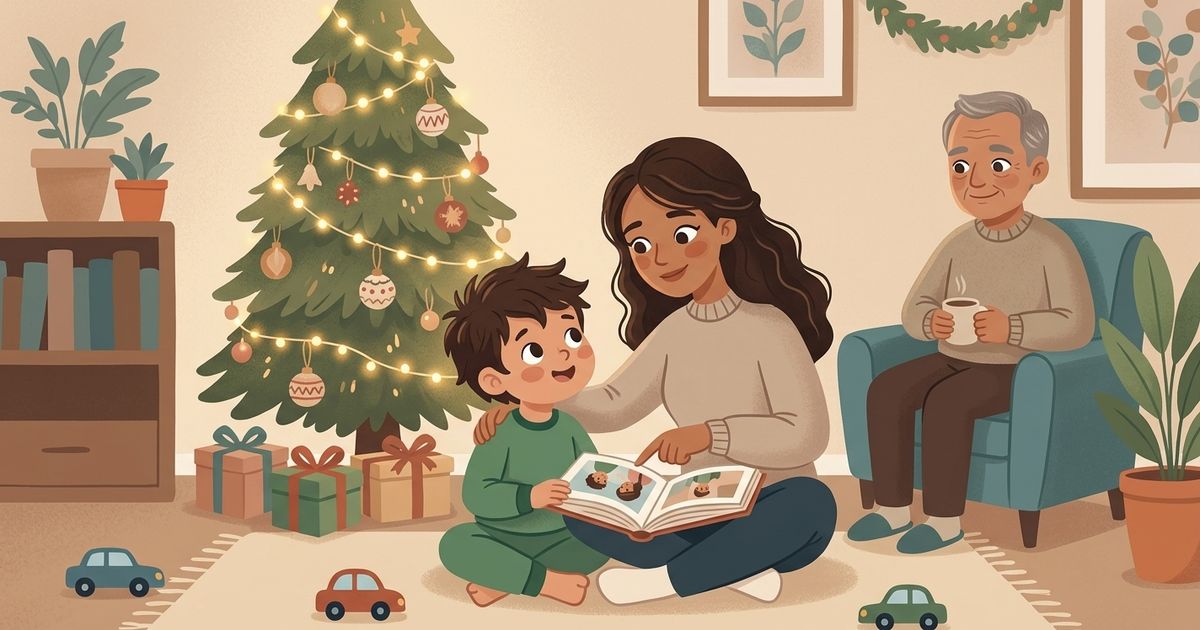
Ask any adult about their favorite childhood Christmas gift, and watch what happens. They rarely describe the toy itself. They describe the person: the grandfather who built it, the mom who stayed up wrapping, the first time they were trusted with something real.
Meaningful Christmas gifts for kids are gifts that carry a relationship inside them: something made for them, about them, or shared with them, ideally with a way to return to it later. Memory research explains why. Young children forget most specific events from their early years, but the stories, rituals and keepsakes a family returns to again and again are what help a feeling of love and belonging stay.
Why kids forget most early Christmases
Psychologists call it childhood amnesia: the way most of us remember very little from before age 3 or 4. In a study published in the journal Memory in 2014, Emory University psychologists Patricia Bauer and Marina Larkina recorded mothers talking with their 3-year-olds about recent events, then checked what the children still remembered at ages 5 to 9. Children aged 5 to 7 still recalled more than 60 percent of those events. By 8 and 9, they recalled fewer than 40 percent. The forgetting seems to speed up around age 7.
Here's the hopeful part. Children whose mothers kept the conversation going, with prompts like "Tell me more" and "What happened next?", tended to remember more details later. That was an association, not proof, but it echoes decades of work by Emory psychologist Robyn Fivush on what she calls reminiscing: families talking together about shared past events. Her research suggests these conversations help children build their memories and their sense of who they are within the family.
So the most meaningful gifts often aren't about the morning itself. They're about what you can come back to, together, for years.
Gifts that carry a relationship
In a 2017 paper in the Journal of Consumer Research, Cindy Chan and Cassie Mogilner found across four studies that experience gifts strengthened relationships more than material gifts, because they stirred stronger emotions. But one finding stands out for parents: material gifts that were emotionally evocative, like a personalized framed photo, strengthened relationships too. These studies were with adults, but the idea translates well. A gift that makes someone feel seen does more than a gift that is simply nice.
Ideas that work for young children:
- A book of their year. A simple photo book of the last twelve months, with short captions you write together. It becomes a reminiscing tool every time you open it.
- A letter from you. Write a short letter each Christmas about who your child is right now. Seal it, or read it together. Over the years it becomes a priceless stack.
- A story starring them. A homemade or personalized book where your child is the hero, built from their real life, their pet, their friends, their big moments.
- A yearly ornament with a story. Each year, choose one ornament that marks something from that year: a first bike, a new sibling, a move. Hanging them becomes a memory ritual.
- Something handed down. A grandparent's childhood book, a recipe card, a small toolbox, with the story of where it came from.
- A recording. A grandparent reading a favorite story aloud, saved to play again at bedtime.
Why young kids still want the toy, and that's okay
It's worth being honest: many young children would rather have the shiny truck. A 2020 study in the International Journal of Research in Marketing, led by Lan Nguyen Chaplin, found that children ages 3 to 12 got more happiness from material goods than from experiences. Older teens showed the adult pattern, preferring experiences. The researchers linked the shift to memory and understanding of other people's minds, both still developing in young children.
That doesn't mean meaningful gifts are wasted on little kids. It means they work best alongside a toy, not instead of it, and they work best when you revisit them. As Chaplin advised, photos and videos give children something to return to, so an experience can keep giving long after it's over.
How a story helps
A story about your child's own life does what reminiscing research describes: it turns scattered moments into a memory they can hold. When you read "the day you met your baby brother" or "the winter we built the biggest snowman," your child hears their experiences organized with a beginning, middle and end, and with feelings named. Returning to that story again and again gives them the words, and the warm feeling, to keep it. Many children ask for these stories long after they've outgrown their toys.
If you want one gift that does all of this at once, a personalized book about your child's year is hard to beat: their name, their people and their big moments, told as a story you can read together every December.
FAQ
What is a meaningful gift for a child? A meaningful gift connects a child to a person or a memory: a letter, a photo book of their year, a story about them, a handmade item, or time with someone they love.
Will my toddler remember Christmas? Probably not the specific day, because most people remember very little before age 3 or 4. But the feeling of warm routines, and the stories and photos you revisit later, help shape their memories and sense of family.
What are sentimental gifts for kids? Popular ideas include a yearly letter from a parent, a memory ornament, a family heirloom with its story, a recording of a grandparent reading aloud, and a book that features the child.
At what age do kids start remembering Christmas? Many children begin to form lasting memories around ages 3 to 4, and memories become more stable and adult-like after about age 7.
Sources
- Bauer, P. J., & Larkina, M. (2014). The onset of childhood amnesia in childhood: A prospective investigation of the course and determinants of forgetting of early-life events. Memory, 22(8), 907-924. BPS Research Digest summary. Link
- Emory University (2014). Childhood amnesia kicks in around age 7. Link
- Emory Report (2001). Fivush studies how families talk about the past. Link
- Chan, C., & Mogilner, C. (2017). Experiential gifts foster stronger social relationships than material gifts. Journal of Consumer Research, 43(6), 913-931. University of Toronto summary. Link
- Chaplin, L. N., Lowrey, T. M., Ruvio, A. A., Shrum, L. J., & Vohs, K. D. (2020). Age differences in children's happiness from material goods and experiences: The role of memory and theory of mind. International Journal of Research in Marketing, 37(3), 572-586. Link
Topics in this article
- meaningful christmas gifts for kids
- sentimental gifts for kids
- keepsake gifts
- childhood amnesia
- reminiscing with children
- Robyn Fivush
- family memory traditions
- photo book of the year
QT
Quilloo Team
Bringing together child development research and thoughtful storytelling for parents.
Weekly parenting insights you'll actually use.
No spam. Just thoughtful ideas, expert tips, and stories that make a difference.