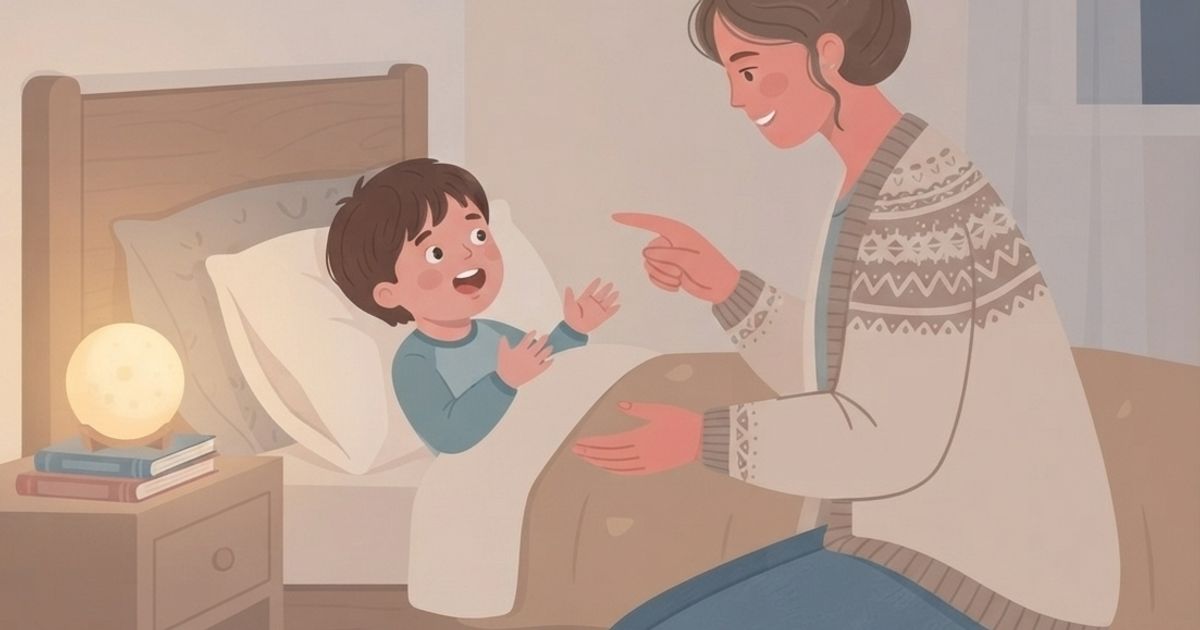
You ask the second they get in the car. "How was your day?" "Nothing." "What did you do at daycare?" "I don't remember." Then, forty minutes later, lights off, teeth brushed, you're trying to leave the room and suddenly you're getting a full, detailed replay of who sat where at lunch, a disagreement over a red crayon, and an unprompted theory about why dogs can't talk. Why kids talk nonstop at bedtime after giving you nothing all afternoon isn't a coincidence, and it isn't your child being difficult on purpose.
Why "How Was Your Day" Doesn't Work
The question feels simple, but it asks a young child to do something genuinely hard: pull a specific memory out of thin air with no help. Psychologist Robyn Fivush at Emory University, who has spent decades studying how children develop autobiographical memory, has found that young children rely heavily on cues to retrieve memories rather than open, unprompted recall (Fivush & Fromhoff, 1988, Discourse Processes). A vague, wide open question like "how was your day" gives a preschooler nothing to grab onto. "Nothing" isn't a dismissal. It's often the honest answer to a question their memory isn't yet built to answer.
What Changes the Moment the Lights Go Off
By bedtime, the day's demands have stopped. There's no one to keep up with, nothing left to figure out, and your full attention finally isn't divided. Child development specialists commonly note that this drop in pressure is exactly what makes bedtime the moment things surface. Without the noise of transitions, instructions, and other kids around, a child's mind finally has room to loop back through the day, and the parent lying next to them is the safest possible audience for whatever comes up.
Ask Better Questions, Don't Just Wait for Bedtime
You don't have to wait until lights out to hear about their day. Specific, cued questions work far better than open ones. "Who did you sit with at lunch" or "what happened during outside time" gives a child's memory something concrete to latch onto, the same kind of cue that naturally shows up once they're relaxed at bedtime.
Reading together before bed, especially a story that mirrors a child's own routine or day, can act as one of those cues. A familiar character going through drop off, lunch, or a small conflict with a friend often reminds a child of their own version of that moment, giving them an easier way in than a blank, open question ever could.
Frequently Asked Questions
Why does my child say "nothing happened" when I ask about their day? Young children have a hard time recalling memories without specific cues, so a broad question like "how was your day" often genuinely draws a blank, even when plenty happened.
Is it normal for my child to talk a lot right before bed? Yes, bedtime is a common time for children to open up since the day's pressure has eased and they finally have quiet, focused time with a parent.
How can I get my child to talk about their day earlier, not just at bedtime? Ask specific, cued questions like "what did you play at recess" instead of open ones, since specific prompts are much easier for a young child's memory to work with.
Should I let bedtime run late if my child wants to keep talking? A few extra minutes to listen is usually worth it, but you can gently wrap up with a clear signal, like "let's finish this thought and then it's sleep time," so bedtime doesn't stretch indefinitely.
Sources:
- Fivush, R., & Fromhoff, F. (1988). Style and structure in mother-child conversations about the past. Discourse Processes, 11, 337-355.
- Fivush, R., Haden, C. A., & Reese, E. (2006). Elaborating on elaborations: The role of maternal reminiscing style in cognitive and socioemotional development. Child Development, 77, 1568-1588.
Topics in this article
- bedtime talking
- child memory development
- Robyn Fivush
- autobiographical memory
- toddler communication
- school day recall
- emotional processing in children
- bedtime routines
- positive parenting
- bedtime
- personalized book creation
QT
Quilloo Team
Bringing together child development research and thoughtful storytelling for parents.
Weekly parenting insights you'll actually use.
No spam. Just thoughtful ideas, expert tips, and stories that make a difference.