
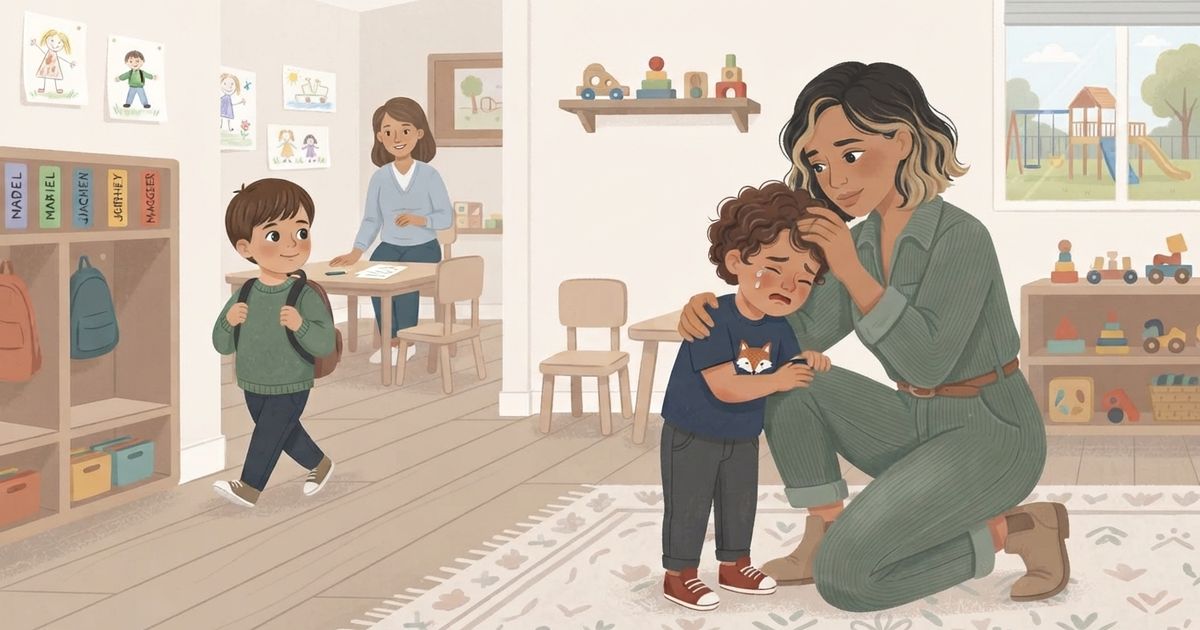
You're standing at preschool drop-off, and your four-year-old is sobbing, holding onto your leg, completely undone. Three feet away, another kid, maybe even a twin sibling, walks in without a backward glance. Same building, same teachers, same morning. Wildly different reactions. It's easy to start wondering what you're doing wrong with the one who's crying. Research on preschool-age temperament points somewhere else entirely.
It's Not About How Well You've Prepared Them
Parents often assume a harder reaction at separation means something was missed: not enough warning, not enough practice, not enough reassurance. But two four-year-olds raised in the exact same home, with the exact same routines, can respond to the same drop-off in completely different ways. That gap comes from something researchers have been studying directly in kids this age, not from a parenting gap.
The Research Behind It: Behavioral Inhibition in Preschoolers
Psychologist Jerome Kagan and colleagues introduced the concept of behavioral inhibition in 1984, describing a temperament trait where children respond to unfamiliar situations, people, or places with marked wariness, freezing, or withdrawal, rather than curiosity. Follow-up research estimated that this trait shows up in roughly 15 to 20 percent of preschool-age children specifically, not just infants.
This matters because behavioral inhibition has actually been studied and measured directly in three to five year olds, the exact age range where separation at drop-off becomes a daily event. Researchers developed a tool called the Behavioral Inhibition Questionnaire specifically for this age group, which asks parents to rate their child's reactions across several everyday situations, including one category labeled specifically as reactions to separation and preschool itself. In other words, this isn't a trait researchers are guessing might apply to four-year-olds. It's one they built a measurement specifically around preschool separation to study.
Why Twins and Siblings Can Look So Different
Behavioral inhibition doesn't automatically show up the same way in every child in a family, including twins. It has biological and genetic roots, but siblings, even twins, can carry different combinations of inherited traits and individual biology. In practice, this means one four-year-old can be wired to notice and react intensely to a new or unfamiliar transition, while a sibling, raised identically, simply isn't built to register it the same way. Neither pattern reflects better or worse parenting. They're two different temperaments responding to the same moment.
The Mistake Worth Avoiding
A common trap is assuming the calm twin is "doing fine" and the crying one is "struggling," as if one child has figured something out that the other hasn't. Behavioral inhibition isn't a problem to be solved or a skill one child is missing. It's closer to a setting a child was born with, the same way some people are naturally more sensitive to loud noises or bright light. The goal isn't to make an inhibited child act like their less-inhibited sibling. It's to support the temperament they actually have.
What Actually Helps a Behaviorally Inhibited Child
Since this reactivity is rooted in temperament rather than a lack of readiness, the most useful response isn't more warnings or pep talks before drop-off. What tends to help more is predictability: the same short goodbye phrase every time, arriving a few minutes before the room gets busy and overwhelming, and giving an inhibited child a little extra time to simply watch a new situation before jumping in. None of this needs to look like coddling. It's closer to giving a more cautious temperament the conditions it actually needs to settle.
So What Do You Actually Do in the Moment?
This is the part that matters most standing at the door: do you leave while he's still crying, or take him home? For almost every child, staying longer or taking him home doesn't make it easier, it usually makes the next drop-off harder, because it teaches him that enough crying changes the plan. The goal isn't to make the crying stop before you leave. It's a short, calm, predictable exit: one goodbye phrase, one hug, one clear "I'll see you at pickup," and then actually leaving, even while he's still upset.
It feels counterintuitive, since every instinct says to comfort him until he's calm. But a behaviorally inhibited child often needs the adult to be the steady, certain one in that moment, not the one who lingers or hesitates. Most kids settle within a few minutes of the parent actually being gone, even if they were sobbing seconds before. Checking in with the teacher afterward, rather than watching from the door or coming back in, gives him the chance to do that settling on his own terms. Taking him home, except in a genuine emergency, tends to reinforce the exact pattern you're trying to ease.
How a Story Can Help
A story featuring a character who feels big, overwhelming feelings in a new or unfamiliar place, and works through them at their own pace, gives a more cautious child language and a sense of company for something that can otherwise feel isolating. Seeing a character's nervous system settle step by step, rather than instantly, also models something true: adjusting to a new situation is a process, not a switch that flips on command.
Frequently Asked Questions
Why does my child cry at drop-off when their twin doesn't? Research on preschool temperament shows that behavioral inhibition, a tendency to react to unfamiliar situations with wariness, doesn't automatically appear the same way in siblings, including twins, raised in the same home. This difference is rooted in individual temperament, not in how each child was prepared.
Is this a real, studied trait at age four, or just a phase? Behavioral inhibition has been specifically studied and measured in children ages three to five, including reactions to separation and preschool. It's considered a fairly stable temperament trait, not a random phase.
How common is it for a preschooler to react this strongly to separation? Research estimates that behavioral inhibition appears in roughly 15 to 20 percent of preschool-age children, making it a well-documented, far from rare pattern.
Does a behaviorally inhibited child grow out of this? The trait tends to be fairly stable over time, though children typically develop skills that help them manage new situations more comfortably as they get older. The underlying sensitivity itself often remains part of who they are.
What can I do at drop-off to help my more sensitive twin? Predictable routines tend to help more than extra reassurance in the moment. The same goodbye phrase every time, arriving a little early, and allowing extra time to observe the new environment before joining in all tend to ease the transition.
Sources
Kagan, J., Reznick, J. S., Snidman, N., Gersten, M., & Garcia-Coll, C. (1984). Behavioral inhibition to the unfamiliar, introducing the temperament trait.
Kagan, J., et al. (1989). Prevalence estimates of behavioral inhibition in preschool-age children (approximately 15 to 20 percent).
Behavioral Inhibition Questionnaire (BIQ), a parent-report measure developed for children ages 3 to 5, includes a specific subscale assessing reactions to separation and preschool situations.
Topics in this article
- separation anxiety
- behavioral inhibition
- preschool temperament
- twins parenting
- sibling differences
- Jerome Kagan
- daycare drop off
- four year old behavior
- personalized book creation
- children's books
- positive parenting
QT
Quilloo Team
Bringing together child development research and thoughtful storytelling for parents.
Weekly parenting insights you'll actually use.
No spam. Just thoughtful ideas, expert tips, and stories that make a difference.