
The weekend rolls around and there's a pull to fill it, a class, a playdate, an activity that looks good on paper. An empty, unplanned afternoon can feel like a missed opportunity, or worse, like you're not doing enough. Research on how kids actually develop suggests the opposite might be true.
What a classic study found about free play and creativity
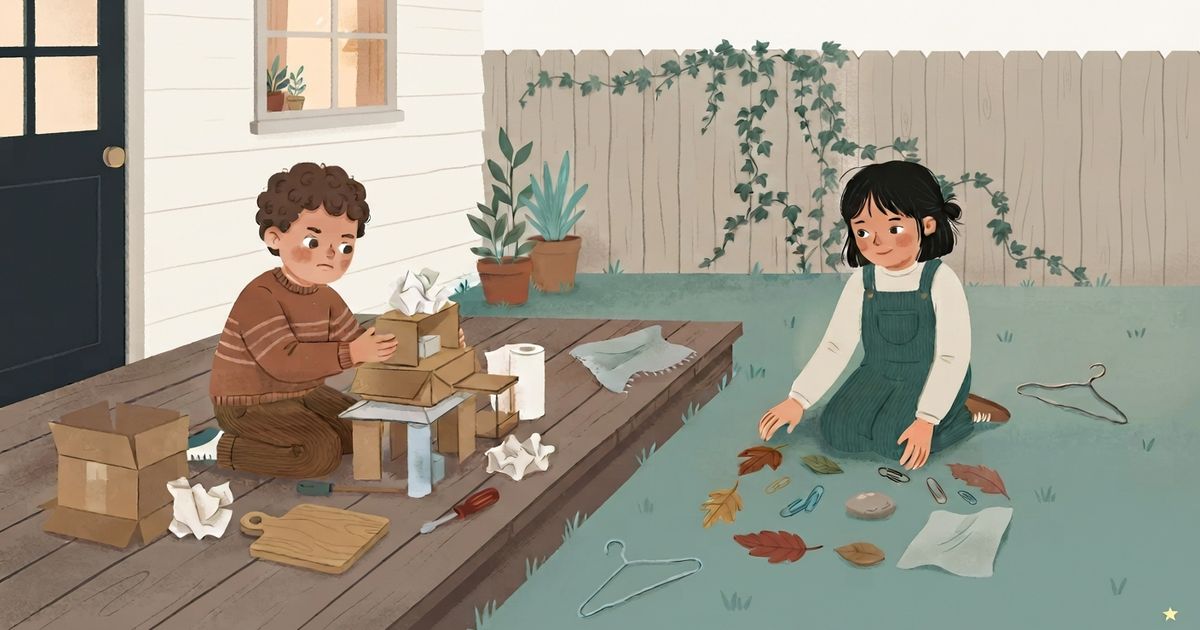
A study published in 1973 in the journal Developmental Psychology divided 90 preschoolers into three groups. One group was simply told to play freely for ten minutes with everyday objects, paper towels, a screwdriver, a wood board, paper clips. A second group watched an adult demonstrate normal uses for the same objects. A third group never saw the objects at all and just drew freely. Afterward, every child was asked to come up with new ideas for how one of the objects could be used. The kids who'd been allowed to simply play with the objects generated, on average, three times as many creative, nonstandard uses compared to either of the other two groups.
Why this isn't just about one clever study
Psychologist Peter Gray of Boston College, who has spent decades studying the effects of unstructured play, has documented a troubling pattern alongside its decline: as American children's free play time dropped by roughly a quarter between 1981 and 1997, rates of childhood anxiety and depression rose sharply over the following decades. Gray's research doesn't claim structured activities are bad, sports, music, lessons all have real value, but he argues that unstructured, child-directed time serves a different, irreplaceable function: it's where kids practice negotiating rules, managing frustration, and generating their own ideas, without an adult steering the outcome.
The part that feels counterintuitive: boredom is doing work
An empty afternoon almost always starts with a complaint. "I'm bored. There's nothing to do." That discomfort is usually treated as a problem to solve immediately. Researchers in this space describe it differently: boredom as the actual mechanism, the uncomfortable gap a child has to sit in before their own imagination steps in to fill it. A kid who's rescued from that gap every time, with a suggestion, an activity, a screen, doesn't get the chance to build the muscle of generating their own next move.
What this looks like in practice
An unplanned afternoon doesn't need a plan hiding inside it. Resist the urge to suggest an activity the moment "I'm bored" shows up, and give it a few minutes before stepping in at all. What follows is often clumsy at first, a kid wandering the yard, rearranging their room, narrating an invented game to nobody, before it turns into something genuinely self-directed. That clumsy middle part is not wasted time. According to this research, it's close to the entire point.
A quick, honest note: structured activities aren't harmful, and plenty of valuable development happens in classes, sports, and organized play too. This isn't an argument against structure, it's a case for making sure genuinely unplanned time still has a place in the week.
Frequently Asked Questions
How much unstructured time do kids actually need? There's no single agreed-upon number, but researchers in this field generally recommend building in regular, protected stretches of unscheduled time rather than filling every hour with planned activities.
Should I intervene when my child says they're bored? Most experts recommend waiting before jumping in, since the discomfort of boredom is often what prompts a child to generate their own idea for what to do next.
Does unstructured play only benefit young children? No, the benefits described in this research, creativity, social negotiation, self-direction, apply across childhood and into adolescence, not just the preschool years.
Is watching TV or using a device during free time the same as unstructured play? Generally not considered equivalent, since most researchers define unstructured play as self-directed and imaginative, distinct from passive screen consumption.
Sources:
Topics in this article
- unstructured play
- free play research
- Peter Gray research
- boredom and creativity
- child development
- weekend routines
- childhood independence
- positive parenting
- personalized book creation
QT
Quilloo Team
Bringing together child development research and thoughtful storytelling for parents.
Weekly parenting insights you'll actually use.
No spam. Just thoughtful ideas, expert tips, and stories that make a difference.