
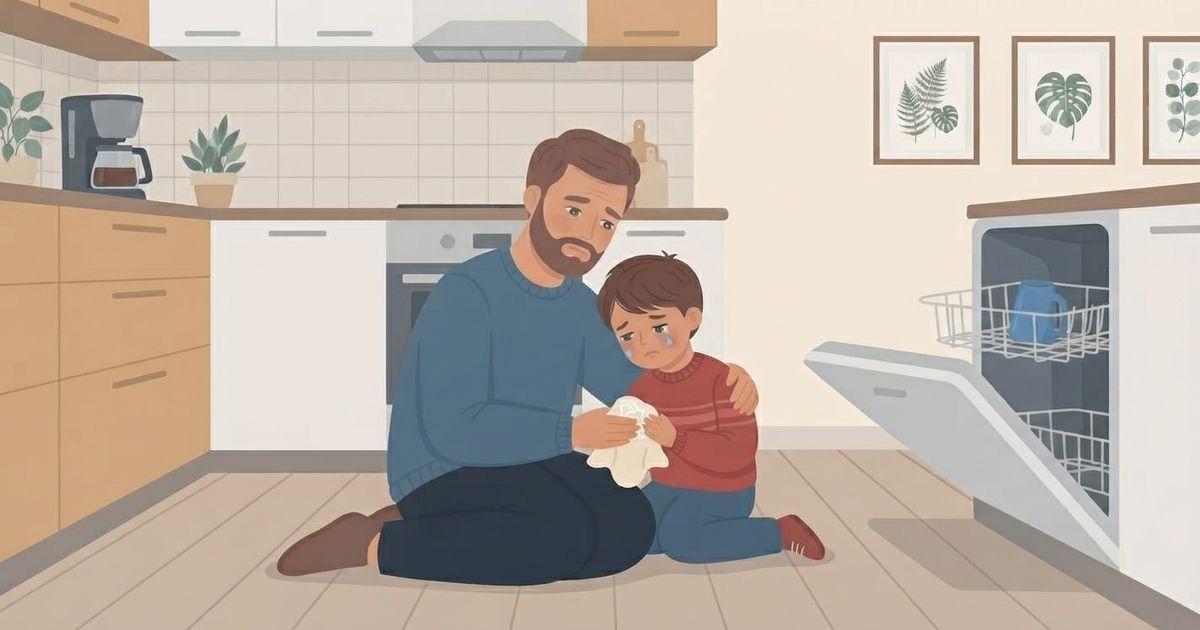
The blue cup is in the dishwasher, and your three-year-old wanted the blue cup. You explain, you offer the green one, you offer the red one, and then the sobbing begins. It is the kind of crying that seems out of all proportion to a cup. Gordon Neufeld has a name for it, and a surprisingly hopeful way of seeing it: tears of futility.
The idea, in one sentence
When something cannot be changed, crying is nature's way of helping a child let go and adapt, and a parent who stays close during those tears helps the process finish.
What tears of futility are
Developmental psychologist Gordon Neufeld describes frustration as the emotion that rises when something is not working, when a child bumps against a limit. Frustration is useful. It fuels effort and problem-solving. But when the thing truly cannot be changed (the cup is gone, the game is over, the sibling got the turn first), frustration has nowhere productive to go.
This is where futility comes in. Futility is the sad recognition that "this is not going to change." Tears of futility are the tears that carry it. The Neufeld Institute's Attachment Matters resources describe the experience of futility as the key to the doorway of adaptation, one of the critical processes of maturation. In plain language, the tears are what turn mad energy into soft sadness, and the sadness is what allows a child to accept the situation and move on.
How to tell them apart from tears of upset
Not all crying is the same. The Attachment Matters material distinguishes tears of futility from tears of upset. Tears of futility bring a sense of softness and surrender on the other side. Tears of upset are often a doubling down, a way of pushing against the reality that is trying to sink in.
A child's body language offers clues. When tears of futility come, the child often softens, leans toward the parent, and the crying tends to wind down on its own, followed by a sense of relief. In the Neufeld Institute's published story of a young girl whose game with older siblings did not go well, the storm of tears lasted several minutes before she brightened, hugged her mother, and asked whether lunch was ready.
Why it matters
Neufeld's framework holds that the capacity to experience futility is part of healthy development. According to the Attachment Matters resources, one of the fruits of adaptation is being able to avoid erupting into aggression when things do not go your way. In this view, a child who can cry about what cannot be changed has an alternative to a meltdown, an outburst, or digging in harder.
Where this natural process gets blocked, the energy can find other outlets. Neufeld's teaching links unspent frustration with aggression and with persistent resistance, which is a subject for another day.
Where the idea comes from
Neufeld is a Vancouver-based clinical psychologist with more than forty years of experience, whose developmental model is rooted in his work with children and families. The idea of futility and adaptation is a core piece of his thinking and is taught through the Neufeld Institute, including a free video on his frustration "traffic circle" model.
An honest note: this is a developmental and clinical framework from Neufeld's teaching, rather than the result of a controlled study. It is most useful as a lens on everyday upsets. It does not replace professional support if a child's distress seems unusually intense or persistent.
Staying with the tears
The most helpful thing a parent can do, according to this framework, is often the simplest: be present.
Skip the fixing and the cheering up. Offering a replacement cup or saying "Stop crying, it's okay" can interrupt the process. When a limit is truly fixed, there is nothing to repair. Compassion works better than solutions.
Name the wish, gently. "You really wanted the blue cup. It's so hard that it's not here." Putting the want into words helps a child feel understood in the very place the sadness lives.
Offer closeness and wait. An open lap, a hand on the back, a calm presence. The crying tends to finish by itself. When the child softens, a hug and a return to the day are often all that is needed.
Hold the line kindly. If the answer is no, it stays no. The tears can only do their work when the limit is real. Warmth and a steady boundary go together here.
These steps fit moments where nothing can be changed. They do not apply when safety is involved or when something can be solved together.
Frequently Asked Questions
What are tears of futility?
In Gordon Neufeld's framework, they are the tears that come when a child realizes something cannot be changed. They carry the frustration out and help the child accept the situation and adapt.
How are tears of futility different from a tantrum?
According to the Neufeld Institute's resources, tears of futility bring softness and relief afterward, while tears of upset tend to be a resistance to accepting the reality. Children may move between the two.
Should I stop my child from crying?
In this framework, crying over things that cannot be changed is a healthy process, and the parent's role is to stay close and offer comfort, not to hurry the tears away.
What should I say to a child who is crying over something that cannot change?
Something simple and warm, like "You really wanted that. It's so hard." Naming the wish shows understanding without reopening the decision.
When should I be concerned about my child's crying?
If a child's distress is intense, very frequent, or does not seem to settle, consider talking with your pediatrician or a child mental health professional.
Topics in this article
- tears of futility
- Gordon Neufeld
- toddler crying
- frustration in kids
- emotional adaptation
- big feelings
- Neufeld Institute
- attachment-based parenting
- resilience in children
- parenting ages 0-8
- positive parenting
QT
Quilloo Team
Bringing together child development research and thoughtful storytelling for parents.
Weekly parenting insights you'll actually use.
No spam. Just thoughtful ideas, expert tips, and stories that make a difference.