
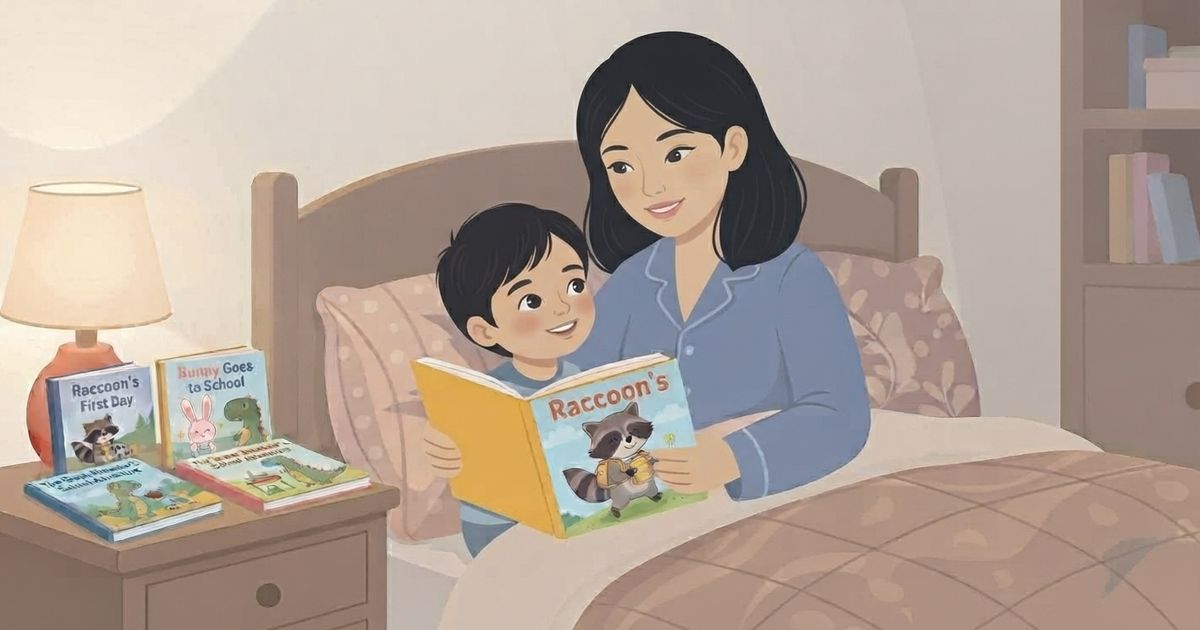
Your son is nervous about his first day of preschool, so you head to the library and come home with three lovely picture books about starting school. A raccoon, a bunny and a very brave dinosaur all have wonderful first days. Your son enjoys them. And the next morning, he still clings to your leg at the classroom door.
The books weren't the problem. They just had a different job. A picture book tells a story about a character. A social story describes your child's own upcoming situation, accurately, from your child's point of view, so they know exactly what to expect. Both are valuable, and knowing the difference helps you choose the right one at the right moment.
The core difference: purpose
A picture book exists to entertain, spark imagination, build language and, often, explore feelings through a character. It can be fantastical, funny or poetic. It does not need to match your child's real life.
A social story, as defined by Carol Gray, who developed the approach in 1991, has one job: to share accurate, meaningful information about a specific situation, in a way that feels safe and respectful to the child. It is not trying to be clever or beautiful. It is trying to be clear.
That one difference shapes everything else:
- Who it's about. A picture book follows a character. A social story is about your child, often written with "I" or your child's name.
- Accuracy. A picture book can stretch the truth for the sake of the story. A social story must be literally accurate. If the teacher's name is Ms. Rivera and snack is after circle time, that's what the story says.
- Tone. A picture book can have drama and conflict. A social story stays calm and describes more than it directs.
- Lifespan. A picture book can be loved for years. A social story is usually written for one upcoming situation, then retired or updated.
Why "realistic" matters so much for young children
Research on how young children learn from books helps explain why the raccoon didn't solve the drop-off problem. In a 2018 review, psychologists Gabrielle Strouse, Angela Nyhout and Patricia Ganea looked at which book features help young children take what they learn from a page and use it in real life. They called this transfer.
Two findings stand out. First, pictures that look more like the real thing, such as photographs, help young children connect the book to the world. Second, fantastical settings, like talking animals, can make it harder for young children to apply the lesson, because they may treat the story as make-believe that doesn't apply to them.
This doesn't mean fantasy books are bad. They are wonderful for imagination, language and emotional exploration. It means that when your goal is to prepare a child for a specific real event, realism helps.
A caveat: most of this research looked at learning facts, words and problem solutions, not emotional preparation. So it supports the logic of realistic social stories rather than testing social stories directly.
When to reach for each one
Reach for a picture book when you want to open a conversation about feelings in general ("Llama felt nervous too. Have you ever felt like that?"), normalize an experience many kids share, or simply enjoy reading together. Picture books are also gentle for very sensitive children, because the feelings belong to someone else and feel less threatening.
Reach for a social story when a specific event is coming up and your child needs to know what will happen: the dentist on Thursday, the new babysitter on Saturday, the move next month. Or when the same situation keeps going badly and you suspect your child is missing a piece of information.
Use both for big transitions. A picture book about a new baby can help your child explore feelings about becoming a big sibling. A social story can show exactly who will pick them up from preschool on the day the baby is born.
Try this tonight: turn a picture book into a bridge
Take a picture book your child already loves that touches on the upcoming situation. After reading, ask one bridging question: "Bunny went to school and met her teacher. Who do you think you'll meet at your school?" Then add two or three true sentences of your own about your child's real day. You've just connected the character's world to your child's world, which is exactly the step young children find hardest on their own.
FAQ
Is a social story just a simple picture book? No. A social story describes one real situation your child will face, accurately and from their point of view. A picture book tells a story about a character and doesn't need to match your child's life.
Can a social story have illustrations? Yes. Photos and simple drawings help a lot. For young children, realistic pictures make it easier to connect the story to real life.
Are fantasy books bad for teaching young kids? Not at all. They're great for imagination and language. For preparing a child for a specific real event, realistic stories tend to work better.
Sources
Topics in this article
- social story vs picture book
- social stories
- picture books
- realistic books for kids
- preparing kids for new situations
- first day of preschool
- reading with toddlers
- Carol Gray
- Patricia Ganea
- personalized book creation
- children's books
- positive parenting
QT
Quilloo Team
Bringing together child development research and thoughtful storytelling for parents.
Weekly parenting insights you'll actually use.
No spam. Just thoughtful ideas, expert tips, and stories that make a difference.