
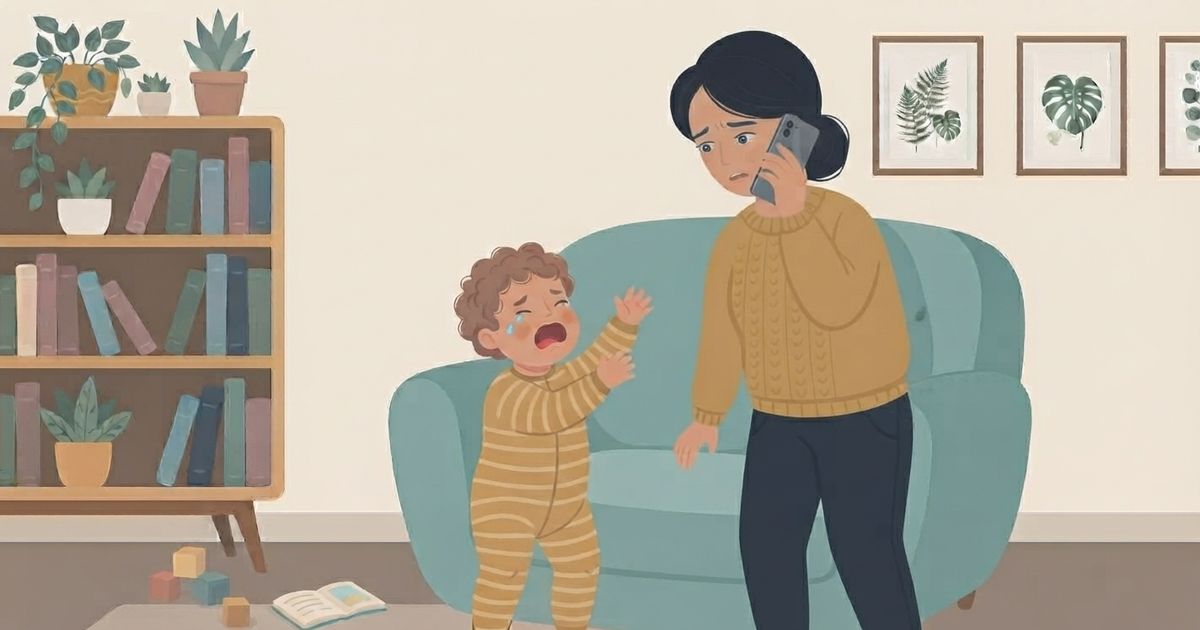
A parent walks out of the room to answer the phone, and a perfectly happy toddler suddenly wails. A first-grader gets a stern look after a spilled glass of juice and spends the next hour clingy and teary. Different ages, same ingredient. According to Gordon Neufeld, both children are responding to the same thing: a sense of separation from the person they depend on most.
The idea, in one sentence
For a child, any loss of closeness with a parent, from a physical gap to a cool tone of voice, can set off an inner alarm, and much of what looks like "difficult" behavior can be traced back to that alarm.
What Neufeld says about separation
Developmental psychologist Gordon Neufeld builds his model on the attachment instinct, the child's drive to seek and keep closeness. If closeness is the goal, then separation is the thing that threatens it. The Neufeld Institute's course on this subject, Intensive II: The Separation Complex, presents facing separation as the epicenter of troubling behavior of all kinds, and it maps out what the Institute calls the anatomy of alarm: the perceptions, feelings, impulses, emotions, physiology, and chemistry that switch on when closeness feels at risk.
An important detail is that separation is not only about distance. Neufeld describes it in a wider sense. A child can feel separated when a parent is in the same room but distracted, annoyed, or withholding warmth. Because children read connection through eyes, voice, and tone, the signals of closeness and the signals of distance can be quite subtle.
What alarm can look like
Alarm is an old, protective system. When it switches on in a young child, it can show up as clinging, following, tears, restlessness, or a sudden need for reassurance. Some children go the other way and become still or distant. The Institute's course outline connects alarm to a range of anxiety-based struggles, which is why Neufeld treats the underlying separation as the thing to address, and not only the surface behavior.
The practical upshot is a shift in the question parents ask. Instead of "Why is she behaving like this?", the question becomes "Where might she be feeling distance from me right now?"
Where the idea comes from
Neufeld is a Vancouver-based clinical psychologist with more than forty years of experience, whose attachment model was inspired by early attachment theorists such as John Bowlby. Bowlby's own work (Attachment and Loss, 1969 onward) described how young children respond with distress to separation from caregivers, and that strand runs straight through Neufeld's teaching.
An honest note: Neufeld's "separation complex" is a clinical and teaching framework, not a collection of controlled experiments. Bowlby's observations about separation distress are well established, while Neufeld's wider claims, such as separation being the root of many kinds of troubling behavior, are best treated as a perspective that many parents and professionals find clarifying, rather than a proven rule for every child.
Why it matters in the first eight years
Young children depend on adults for nearly everything, which means closeness is a matter of security. Day-to-day life is also full of small separations: the morning drop-off, a parent in another room, a moment of correction, a busy evening. None of these are failures. They are simply part of family life. Neufeld's point is that children feel them more than adults realize, and that a parent who understands the alarm underneath can respond with connection and not with more distance.
Three ways to soften the feeling of distance
Look for the connection need first. When behavior suddenly gets bigger, whether it is whining, clinging, or a meltdown, try an early check: has there been a gap, a rushed morning, or a sharp moment? A warm word or a few minutes together often changes the whole picture.
Repair quickly after friction. After a tense moment, reach out soon. A hug, a smile, or "I was frustrated, and I'm still on your side" tells a child that closeness has returned. The sooner the repair, the less time the alarm has to run.
Keep warmth in the room, even when saying no. A limit can be firm and still carry a warm voice and soft eyes. "No cookies now, and I love you" keeps the connection intact while the boundary stays in place.
Frequently Asked Questions
What is separation anxiety in children, according to Gordon Neufeld?
Neufeld sees it as part of a broader pattern: when a child's closeness with a parent feels threatened, an alarm system switches on. The Neufeld Institute teaches this under the heading of the separation complex.
Can emotional separation happen when a parent is in the same room?
In Neufeld's framework, yes. A child can feel distance when a parent is distracted, upset, or withholding warmth, because children read closeness through eyes, voice, and tone.
Why does my child cling after I correct her?
In this lens, the correction may have felt like a loss of closeness. Clinging can be a reach to restore it, and a warm reconnection often settles things.
Is separation always harmful?
No. Everyday separations such as school or errands are a normal part of family life. The focus is on helping children feel connected through them.
Who was John Bowlby?
John Bowlby was a British psychiatrist and the founder of attachment theory, who documented how young children respond to separation from caregivers. His work shaped Neufeld's approach.
Sources
- Neufeld Institute. Neufeld Intensive II: The Separation Complex . Link.
- Neufeld Institute. Gordon Neufeld biography and overview of his work. Link.
- Neufeld, G. & Maté, G. (2004). Hold On to Your Kids: Why Parents Need to Matter More Than Peers. Knopf Canada. Publisher page.
- Bowlby, J. (1969). Attachment and Loss, Vol. 1: Attachment.
Topics in this article
- separation anxiety
- separation and alarm
- Gordon Neufeld
- attachment-based parenting
- clingy child
- child anxiety
- emotional connection
- Neufeld Institute
- parent-child bond
- parenting ages 0-8
- positive parenting
QT
Quilloo Team
Bringing together child development research and thoughtful storytelling for parents.
Weekly parenting insights you'll actually use.
No spam. Just thoughtful ideas, expert tips, and stories that make a difference.