
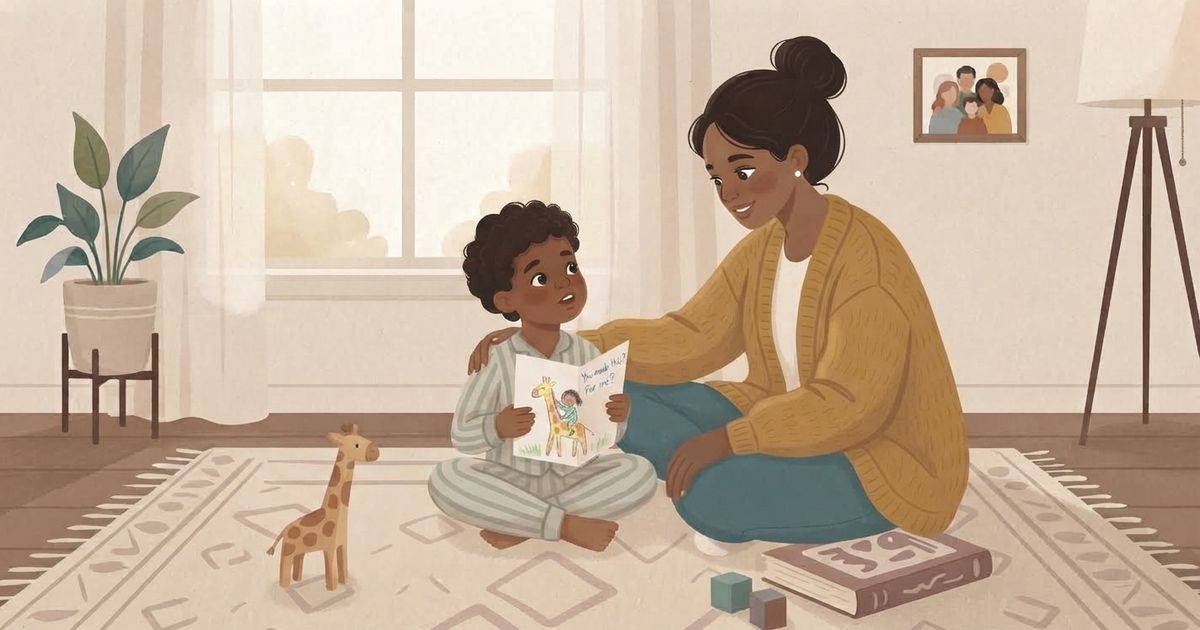
Your son is holding the birthday card you made him, the one with the lopsided drawing of him riding a giraffe. He's quiet for a second. Then he looks up: "You made this? For me?" He carries it around for three days, including to the bathtub. That moment, when a child realizes a parent created something just for them, is one of the small, unforgettable wins of parenting.
Even babies can read effort
You might think kids only care about the thing itself. But children seem wired to notice the effort behind it, and far earlier than most parents would guess.
In a 2017 study published in Science, Shari Liu, Elizabeth Spelke, and colleagues at Harvard and MIT showed 10-month-old babies simple animations of a character reaching two different goals. To reach one goal, the character had to work harder: climbing a steeper ramp, jumping a wider gap, or scaling a higher wall. Afterward, the babies expected the character to prefer the goal it had worked harder for, and looked longer, a sign of surprise, when it chose the easier one.
In other words, before they can even talk, babies seem to understand a basic rule of human behavior: people put effort into what they value. Years later, when a child sees that their parent spent time making something just for them, they're drawing the same conclusion, with a lot more feelings attached. You worked for this. So I must matter to you.
When the "made for me" moment clicks
The realization unfolds gradually, and it looks different at different ages.
Toddlers (1 to 3) mostly respond to the familiar: their name, their photo, their favorite animal. They may not grasp that you made it, but they know it's theirs, and that matters to them.
Preschoolers (3 to 5) start asking "Who made this?" Around this age, most children begin to understand that other people have their own thoughts and intentions. That's when "Mom made this for me" starts to carry real emotional weight.
Early elementary kids (5 to 8) can appreciate the thought behind the details. "You remembered I like the purple dinosaur!" Here, the specificity is the love letter. They notice that you noticed.
In a small study of toddlers reading personalized books with their parents, researcher Natalia Kucirkova and colleagues found that children smiled and laughed more with the personalized book than with comparable ones. The parents' smiles, it turned out, mostly came in response to their child's delight. The "made for me" moment is a gift that tends to flow both ways.
It's the noticing, not the hours
Good news for busy parents: the power of a handmade gesture doesn't come from how long it took or how artistic it is. The giraffe can be very lopsided. What children respond to is being seen specifically. A few ways to make that visible:
Tell them you made it. Kids don't always know. "I made this just for you, because I was thinking about how brave you were at the dentist" connects the object to the love behind it.
Put their real life in it. Their name, their pet, their best friend, the silly thing they said last week. Details prove attention.
Let them see a bit of the process. "I was working on your surprise after you went to sleep." A peek behind the curtain makes the effort real.
Add your handwriting. A short note on a lunchbox napkin or inside a book cover is tiny effort with an outsized effect. Kids often keep these for years.
Make it together sometimes. Creating something side by side gives kids the "made for me" feeling and the "made with me" feeling at once.
One gentle caution: avoid turning it into a transaction ("I worked so hard on this, so you'd better love it"). The gesture lands best when it's given freely, with no strings.
How a story helps
A story made for one specific child is one of the clearest ways to show them they were thought about. When they recognize their own name, their home, and their favorite things on the page, the message isn't only "here's a book." It's "someone who loves me paid close attention to who I am." Reading that story together turns the gift into a shared moment, and each rereading brings the feeling back.
Frequently Asked Questions
Why do kids love homemade gifts? Homemade gifts show attention and effort, and even infants seem to understand that people put effort into what they value. Personal details make a child feel specifically seen and loved.
At what age do children understand that someone made something for them? Toddlers recognize personal details like their name or photo. Around ages 3 to 5, as they begin to understand other people's thoughts and intentions, the "you made this for me" realization gains real emotional meaning.
What are easy ways to show my child I love them? Notice and mention specific things about them, leave a short handwritten note, spend a few minutes of undistracted one-on-one time, and occasionally create something small just for them.
Sources
- Liu, S., Ullman, T. D., Tenenbaum, J. B., & Spelke, E. S. (2017). Ten-month-old infants infer the value of goals from the costs of actions. Science, 358(6366). Link.
- Kucirkova, N., Messer, D., & Whitelock, D. (2013). Parents reading with their toddlers: The role of personalization in book engagement. Journal of Early Childhood Literacy, 13(4). Link.
Topics in this article
- made for me
- homemade gifts for kids
- showing love to children
- parent-child bond
- handmade gifts
- feeling seen
- Elizabeth Spelke
- infant cognition
- personalized gifts
- personalized book creation
- children's books
- positive parenting
QT
Quilloo Team
Bringing together child development research and thoughtful storytelling for parents.
Weekly parenting insights you'll actually use.
No spam. Just thoughtful ideas, expert tips, and stories that make a difference.