
Your daughter starts daycare on Monday. You've told her about the toys and the friendly teachers, and she still melts down every time the word "daycare" comes up. Something is worrying her. You just don't know what yet.
Here's how to write a social story for your child, in short: first find out how your child sees the situation. Then write a short, calm story from your child's point of view that answers where, when, who, what and why, using accurate words and at most one sentence that gently suggests what your child can try. Read it together before the big day, and again whenever they ask.
Step 1: Start with your child's view, not your goal
Carol Gray, who developed Social Stories in 1991, describes a social story as both a process and a product. The most important part comes first: understanding what the situation looks like from your child's side.
Ask open questions. "What do you think happens at daycare?" "What's the part you don't like?" Ask your child to draw it. Gray's own phrase for this attitude is that curiosity is confusion with a good attitude. Stay curious instead of correcting.
Often the real worry is a surprise. The child who dreads daycare may not be scared of the place at all. She may simply not know when you will come back. That one missing piece of information becomes the topic of the story. And sometimes this step shows that a story isn't what's needed at all. The latest version of Gray's criteria encourages parents to stay open to other solutions, like a small change in the morning routine.
Step 2: Choose one topic and a clear title
One story, one topic. Give it a simple title that names the topic: "When Mommy Picks Me Up From Daycare."
Step 3: Build it in three parts
Gray's guidelines give every story an introduction that names the topic, a body that adds detail, and a conclusion that sums it up. Inside, the story answers the questions your child needs answered:
- Where it happens
- When it happens, tied to something your child already knows ("after nap time")
- Who will be there
- What will happen, in order
- Why things happen the way they do
Step 4: Use a calm, accurate voice
Write in first or third person, never "you." Gray's guidelines rule out "you" sentences because they tend to carry the adult's assumptions and can sound like orders. "I go to daycare in the morning" instead of "You need to go to daycare."
Be literally accurate. Young children take words at face value. If pickup is usually after snack but not always, write "usually." If you write "Mommy always comes at 3:00" and traffic makes you late, the story loses its power.
Describe more than you direct. Most sentences should simply describe what happens. Gray's current criteria, Social Stories 10.4 (2023), call for descriptive sentences to appear at least four times as often as coaching sentences, with no more than one sentence that coaches the child. A coaching sentence gently suggests what the child might try, often starting with "I will try." The title counts as a descriptive sentence.
Here is what that looks like:
When Mommy Picks Me Up From Daycare In the morning, Mommy drives me to daycare. My teacher Ms. Ana says hello at the door. Mommy gives me a hug and goes to work. At daycare, I play, eat snack, and take a nap. Some kids feel sad when their mommy leaves. That is okay. After nap time, Mommy comes back to pick me up. She always comes back. When I miss Mommy, I will try to hold my blue blanket. Then I know it is almost time for her to come.
Step 5: Make it fit your child
Gray's guidelines ask authors to tailor each story to the child's abilities, attention span and interests. For a two-year-old, that may mean six sentences and a photo on every page. For a five-year-old who loves dinosaurs, it might mean a paleontologist who learns about the daycare. Real photos of the real place and people make the story easier to connect to real life.
Step 6: Introduce it on a calm day
Read the story for the first time when your child is relaxed, not in the middle of a meltdown. Then check understanding with a simple question: "What happens after nap time?" A 2010 review by Anastasia Kokina and Lee Kern found that studies which checked children's understanding tended to report better results, though a larger 2011 review didn't find a clear difference. Either way, a story can only help if your child understands it. The same 2010 review found that stories with pictures, and stories read shortly before the situation, tended to do better. So once your child knows the story, try reading it again on the morning of the big day.
If nothing changes after about two weeks, don't rewrite everything at once. Early social story researchers Brenda Swaggart and colleagues suggested changing one thing at a time, like the wording or the time of day you read it, so you can see what actually helps your child.
Try this tonight: write a story about something your child already does well
Gray's guidelines include a lovely rule that many people miss: at least half of the stories you write for a child should describe what they already do well. So before you write the "hard" story, write a celebration story. Six true sentences about a moment this week when your child was kind, brave or patient: where it happened, who was there, what they did and how others felt. Read it at bedtime. It teaches your child that stories in your home are a warm thing, not a correction.
FAQ
Can I use "you" in a social story? Carol Gray's guidelines say no. Use "I" or your child's name instead, so the story describes rather than commands.
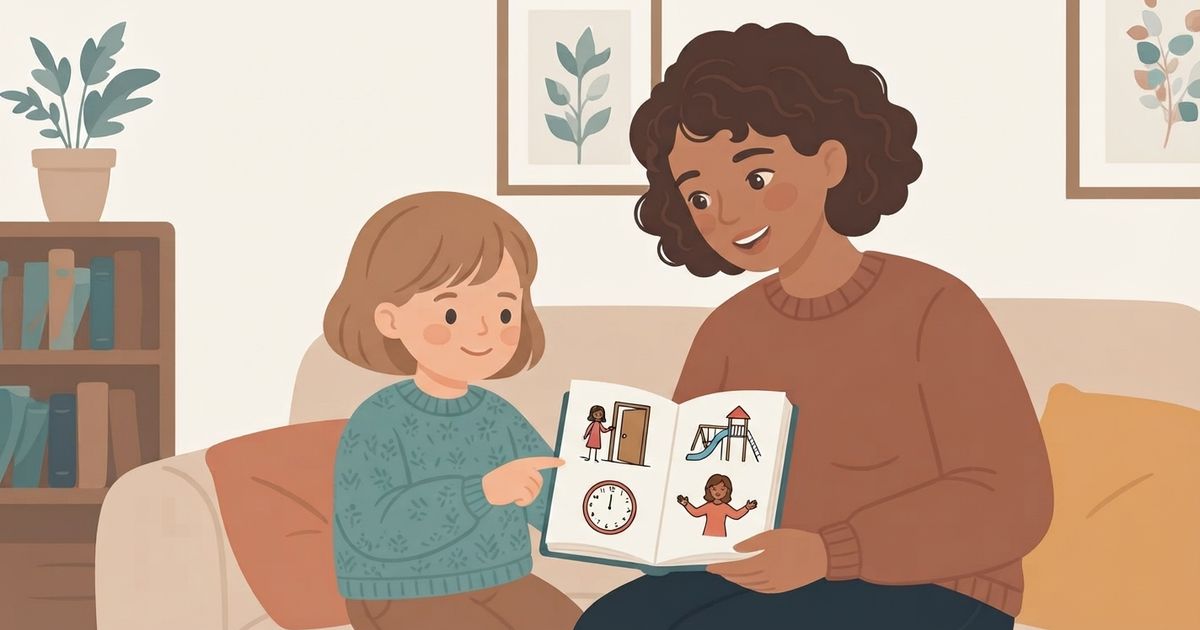
Do I need drawings or photos? They help a lot, especially before age five. Simple drawings, stick figures or phone photos of the real place all work.
What if my child doesn't want to hear the story? Don't push. Leave it out and try again on a calmer day. Some children prefer to look at it alone first.
How long should a social story be? As short as your child needs. For toddlers, five to eight sentences is plenty.
Sources
- Gray, C., Faherty, C., Timmins, S., & Lanou, A. (2023). Social Stories 10.4 Criteria. Carol Gray Social Stories.
- Gray, C. What Is a Social Story? Featuring Carol Gray. Undivided. Link
- Carol Gray Social Stories. Social Story Sampler. Link
- Kokina, A., & Kern, L. (2010). Social Story interventions for students with autism spectrum disorders: A meta-analysis. Journal of Autism and Developmental Disorders, 40, 812-826. Link
- Reynhout, G., & Carter, M. (2011). Evaluation of the efficacy of Social Stories using three single subject metrics. Research in Autism Spectrum Disorders, 5(2), 885-900. Link
- Swaggart, B. L., Gagnon, E., Bock, S. J., Earles, T. L., Quinn, C., Myles, B. S., & Simpson, R. L. (1995). Using social stories to teach social and behavioral skills to children with autism. Focus on Autistic Behavior, 10(1), 1-16.
Topics in this article
- how to write a social story
- social stories
- social story examples
- Carol Gray
- first day of daycare
- preparing kids for change
- toddler anxiety
- transitions
- stories for kids
- personalized book creation
- children's books
- positive parenting
QT
Quilloo Team
Bringing together child development research and thoughtful storytelling for parents.
Weekly parenting insights you'll actually use.
No spam. Just thoughtful ideas, expert tips, and stories that make a difference.