
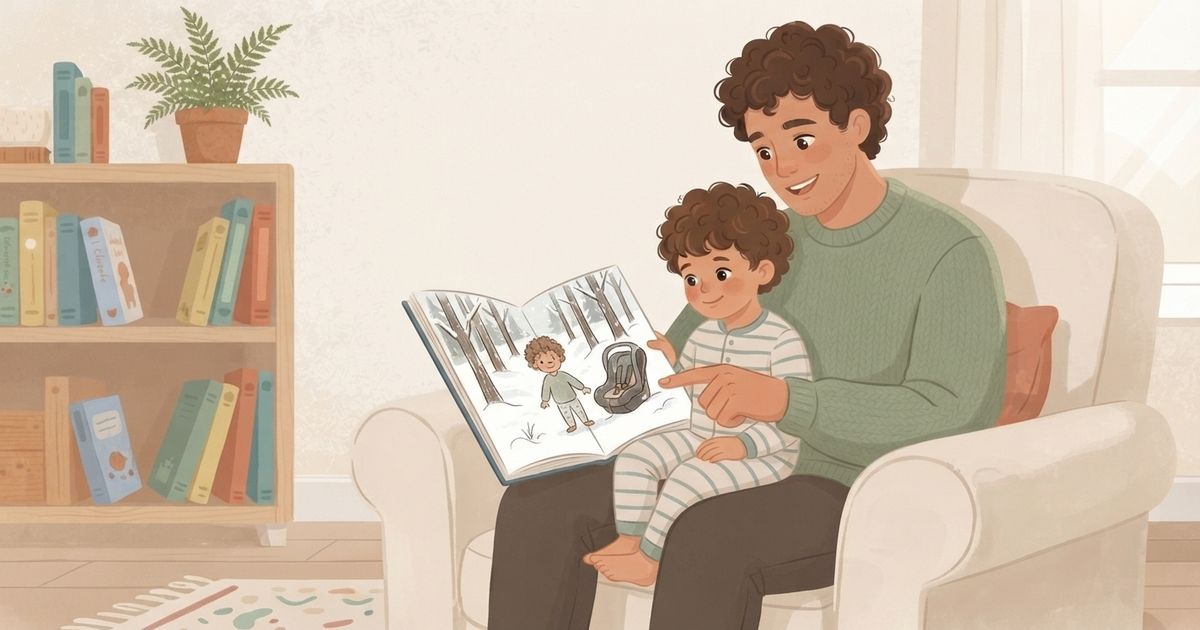
Your four-year-old is sitting on the kitchen floor, telling the dog, very seriously, "When I was born, it was snowing and Daddy forgot the car seat." He's heard that story maybe a hundred times. He tells it like it's the most important historical event of the century. To him, it is.
Feeling important isn't the same as being praised
When parents want to make a child feel important, the instinct is often praise: "You're so smart! You're amazing!" Praise has its place, but it's generic. Any kid could hear it. What children seem to crave is something more specific: proof that someone has been paying attention to them. Their snowy birthday. Their weird fear of the vacuum. The way they insist on wearing the green socks.
That's why stories about a child land so deeply. A story says: you have a history, it matters, and someone was there to notice it.
Psychologists have a name for part of what's happening. The self-reference effect describes our tendency to remember information better when it's connected to ourselves. It was long assumed to show up later in development, but a 2013 study by Sheila Cunningham and colleagues, published in the British Journal of Developmental Psychology, found it in children as young as 4 to 6. Kids sorted pictures of toys into "mine" and "yours" piles, then got a surprise memory test. They remembered the toys that were "theirs" significantly better. Even in early childhood, the brain treats "me" as a VIP category.
What happens when the story is about them
Natalia Kucirkova, a researcher who has studied personalized books for years, looked at this directly. In a 2014 study in the Journal of Pragmatics, she and her colleagues read 35 preschoolers (about 3 years old on average) a book that had a personalized section and a non-personalized section. They video-recorded what the kids said.
During the personalized part, children spoke up more, and for longer. Much of it was self-referential: "That's me!" "That's my house!" Spontaneous talk like this matters, because it shows a child is actively engaged rather than just sitting through the story. And it gives the adult an opening to ask more: "Do you remember that day?"
In a small earlier study of seven families with toddlers aged 1 to nearly 3, Kucirkova's team found that personalized books drew more smiles and laughs from children than comparable non-personalized books. Interestingly, the parents' smiles mostly came in response to their child's. Joy, it turns out, is contagious in both directions.
Simple ways to tell your child the story of them
You don't need special materials to start. You need details.
Tell their origin stories. The day they were born, their first word, the time they tried to feed the goldfish a cracker. Kids love hearing about themselves as babies, partly because it's evidence they've always been loved.
Use the specifics only you know. "You're brave" is nice. "You were scared of the big slide, and you went down anyway, with your eyes closed, yelling 'BANANA'" is unforgettable.
Let them add to it. Ask, "What do you think happened next?" Children who help shape their own stories feel like co-authors of their lives, not just the audience.
Balance "important" with "part of something." A story about your child can include siblings, grandparents, friends, and the neighbor's cat. Feeling important isn't about being the center of the universe. It's about knowing you have a real place in it.
Make it a repeatable ritual. "Tell me the snow story" might be requested for years. That's the point.
For toddlers, even a simple sentence with their name and something they did today is enough. Preschoolers and early grade-schoolers can handle longer stories, including ones where they face a problem and figure it out.
How a story helps
A story about a child works like a mirror held up by someone who loves them. It reflects their real experiences back with warmth, and it tells them their life is worth narrating. When children hear themselves in a story, they tend to engage more, talk more, and remember more, which makes it a natural bridge for conversations about feelings, milestones, or challenges. Over time, those stories become part of how a child understands who they are.
Frequently Asked Questions
How do I make my child feel special without spoiling them? Focus on specific attention rather than things or constant praise. Telling stories about their real experiences, noticing effort, and spending one-on-one time build a sense of worth without creating entitlement.
At what age do kids start to enjoy stories about themselves? Even toddlers respond to hearing their name and familiar details in a story. Research has found children aged 4 to 6 already remember "self-related" information better than information about others.
Is it good to tell my child stories about when they were a baby? Yes. Kids usually love it, and these stories help them build a sense of identity and belonging. Choose warm, funny moments, and let them ask questions or retell the story themselves.
Sources
- Cunningham, S. J., Vergunst, F., Macrae, C. N., & Turk, D. J. (2013). Exploring early self-referential memory effects through ownership. British Journal of Developmental Psychology, 31(3). Link.
- Kucirkova, N., Messer, D., & Sheehy, K. (2014). The effects of personalization on young children's spontaneous speech during shared book reading. Journal of Pragmatics, 71. Link.
- Kucirkova, N., Messer, D., & Whitelock, D. (2013). Parents reading with their toddlers: The role of personalization in book engagement. Journal of Early Childhood Literacy, 13(4). Link.
Topics in this article
- make your child feel important
- making kids feel special
- self-reference effect
- stories about your child
- personalized stories
- self-esteem in kids
- Natalia Kucirkova
- parent-child connection
- personalized book creation
- children's books
- positive parenting
QT
Quilloo Team
Bringing together child development research and thoughtful storytelling for parents.
Weekly parenting insights you'll actually use.
No spam. Just thoughtful ideas, expert tips, and stories that make a difference.