
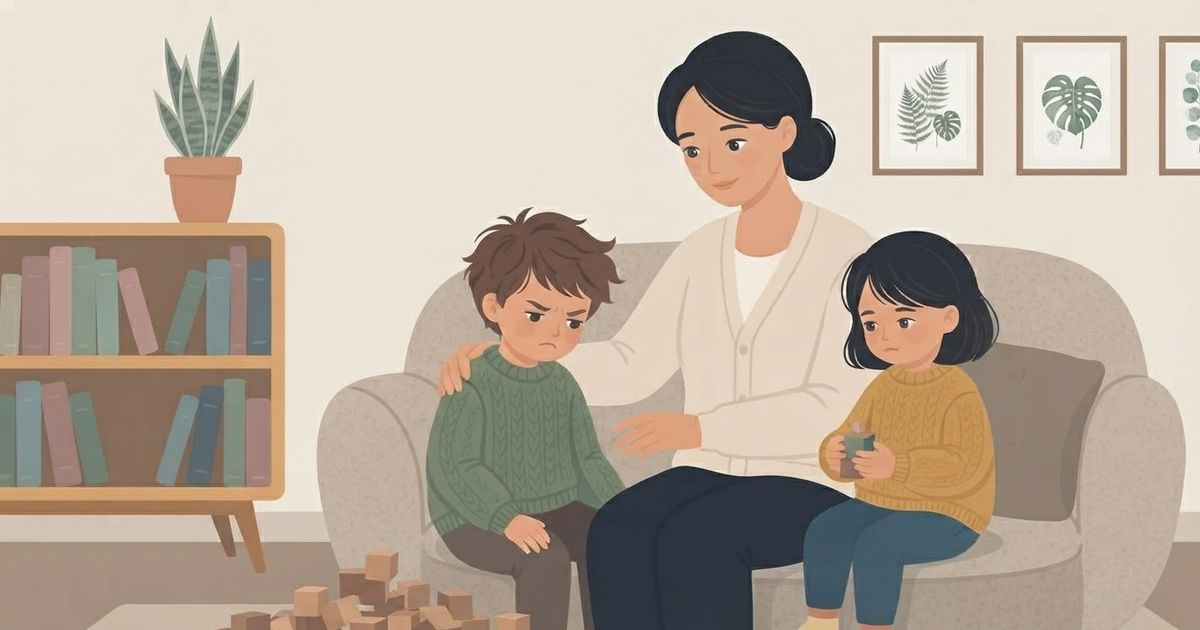
Your four-year-old's block tower topples, and in a flash a block is flying across the room. Or a sibling takes the toy, and a shove follows before anyone can blink. Moments like these can leave parents wondering where the aggression came from. Gordon Neufeld offers a clear answer, and it begins with a different emotion entirely: frustration.
The idea, in one sentence
According to Neufeld, aggression is rooted in frustration, the feeling that something is not working, and seeing it this way helps parents respond to what is underneath the outburst instead of only to the outburst itself.
What the frustration model says
Developmental psychologist Gordon Neufeld describes frustration as a primal emotion that rises whenever a child runs into something that is not working: a wish blocked, a limit hit, a task too hard. His "traffic circle" model of frustration, available as a free video from the Neufeld Institute, explains why frustration is a key to problem-solving, adaptation, and resilience, but also why it can easily turn into aggression or despair when it is blocked.
The Attachment Matters resources, which draw on Neufeld's work, put it simply: a child in an outburst of aggression can be seen as being moved by frustration. The attacking energy is the frustration finding an exit. It might be directed at another person, at the child's own self, or even at an object.
Why this changes how it looks
Seeing aggression as a form of frustration shifts the picture. A hitting child is no longer simply "being bad". The child is a person with a surge of feeling that has nowhere good to go. That does not make the behavior acceptable, and the limit on hurting stays firm. It does change what a parent looks for next: what was in the way, and what the child needs to move through it.
The Neufeld Institute makes a related point in its description of aggression: aggression problems are deeply rooted in instinct and emotion, and so they tend to resist conventional discipline practices. Where frustration is the engine, a consequence alone may not reach the engine.
Where the idea comes from
Neufeld, a Vancouver-based clinical psychologist with over forty years of experience, is recognized in Canada for his work on aggression and violence among children and youth. His theories of aggression, counterwill, bullying, and anxiety have received national and international attention, according to his professional biography. The frustration model grew out of that long clinical focus.
An honest note: Neufeld's frustration and aggression model is a clinical and teaching framework. Researchers in psychology have long studied links between frustration and aggression more broadly, but the specific model, with its traffic circle and its emphasis on adaptation, is best taken as a perspective for parents rather than a universal explanation for every outburst. If aggression is frequent or severe, a child psychologist can offer individualized support.
What this means for the early years
Young children meet frustration constantly. Their wishes are strong and their tools are small: language still arriving, muscles still learning, patience still forming. Block towers fall. Shoes will not go on. A turn comes too late. So moments of frustration are built into childhood, and the question is what happens to the feeling next.
In Neufeld's picture, the healthy path leads from frustration to adaptation, often through tears (which is the subject of a separate post on tears of futility). The aggression path appears when that route is blocked. Parents cannot remove every frustration, but they can influence both the load a child carries and the route the feeling takes.
Three ways to respond with this lens
Stop the hurt calmly, then look for the block. Safety comes first: a steady hand, a short, clear "I won't let you hit." Then, once the moment has settled, ask quietly in your own mind what was in the way. A hungry, tired, rushed, or overwhelmed child has a lot less room for frustration.
Lower the pile where you can. Frustrations stack. If a child has had a morning of hurry, a skipped snack, and a difficult task, a small trigger lands on top of a big load. Small adjustments, such as a snack earlier, a gentler transition, or help with the hard part, can reduce the odds of an eruption.
Reconnect before you talk it over. When the storm has passed, offer closeness first, with a hug, a calm voice, and a sense that the relationship is intact. The conversation about what happened is easier when the child feels safe and connected.
These steps do not replace limits or guidance. They help the guidance land.
Frequently Asked Questions
Why does my child hit when frustrated?
In Gordon Neufeld's model, aggression grows out of frustration. When a child hits a block, a limit, or something that is not working, the frustration can burst out as attacking energy, especially when it has no other outlet.
What is the traffic circle model of frustration?
It is Neufeld's way of showing how frustration can lead to problem-solving and adaptation, or, when blocked, to aggression or despair. The Neufeld Institute offers a free video explaining it.
Does seeing aggression as frustration mean no consequences?
No. Limits on hurting stay in place. The lens helps parents understand what is underneath the behavior so that their response can reach the cause as well as the symptom.
Is aggression in young children normal?
Many young children have moments of aggression as their emotions outpace their self-control. If it is frequent, intense, or worrying, it is a good idea to talk with a pediatrician or child psychologist.
What is the difference between frustration and anger?
In Neufeld's framework, frustration is the underlying emotion of something not working, and aggression is one way it can be expressed. Tears and acceptance are another.
Sources
- Neufeld Institute. Free resources, including Neufeld's Traffic Circle Model of Frustration. Link.
- Attachment Matters. "S2 Ep 5: Eruption and Adaptation". Link.
- Attachment Matters. "Grant me the serenity..." (resources and reflections on futility, based on Neufeld's work). Link.
- Neufeld Institute. "School Separation Challenges". Link.
- Neufeld Institute. Gordon Neufeld biography and overview of his work. Link.
Topics in this article
- frustration and aggression
- Gordon Neufeld
- traffic circle of frustration
- toddler hitting
- aggressive behavior in kids
- big emotions
- Neufeld Institute
- attachment-based parenting
- emotional development
- parenting ages 0-8
- positive parenting
QT
Quilloo Team
Bringing together child development research and thoughtful storytelling for parents.
Weekly parenting insights you'll actually use.
No spam. Just thoughtful ideas, expert tips, and stories that make a difference.