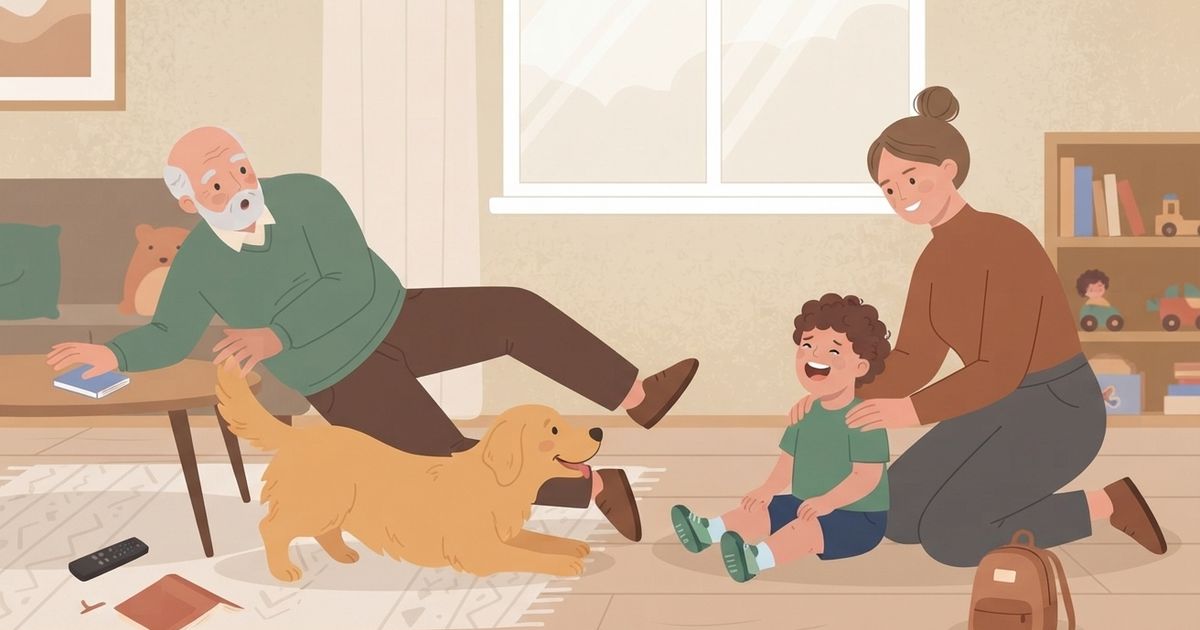
Grandpa trips over the dog and catches himself on the counter, and your kid bursts out laughing, loud, delighted, completely unbothered by the fact that an adult just nearly went down hard. It's mortifying in the moment, and it's easy to worry it means something troubling about empathy. According to research on humor development, it almost always means the opposite of what it looks like.
The theory behind almost every laugh at a fall
Psychologists studying humor point to something called incongruity theory: we laugh when reality suddenly departs from what we expected, a mismatch between what should happen and what actually did. A person walking confidently one moment and sprawled on the ground the next is about as clean an example of incongruity as everyday life offers. A more specific, widely cited framework built on this idea is benign violation theory, developed by researchers Peter McGraw and Caleb Warren, which holds that something strikes us as funny specifically when it violates our expectations in a way that also feels safe. Remove the safety, and the same event stops being funny and starts being alarming instead.
Why kids specifically laugh at this before almost anything else
Research tracking humor development across early childhood has found that this kind of physical, incongruity-based humor, a tower of blocks toppling, someone making an exaggerated stumble, shows up between roughly 12 and 36 months of age, well before children are capable of understanding verbal jokes or wordplay. In other words, laughing at a fall isn't a learned habit picked up from watching slapstick videos. It's one of the very first forms of humor a developing brain is capable of processing at all, arriving long before language-based humor is even possible.
The judgment call happening faster than you can see
Here's the part that explains why this isn't a sign of missing empathy. According to research summarized by a clinical psychologist writing for The Conversation, we don't actually laugh at someone else's suffering. We laugh once we've unconsciously registered that the person is surprised, not truly in danger, and that the situation is safe. That judgment happens fast, often before a child could put it into words, but it's a real evaluation, not an absence of one. A child laughing at Grandpa's near-fall has effectively decided, in a fraction of a second, that Grandpa is fine.
What's happening in the brain during this split-second read
Part of the mechanism involves mirror neurons, brain cells that fire both when we perform an action ourselves and when we watch someone else perform it. When your kid watches someone flail while trying to catch their balance, some of their own neurons fire as though they were the one flailing, which is part of why a fall registers as viscerally interesting and attention-grabbing in the first place, before the "is this actually okay" evaluation even finishes running.
Why laughter sometimes shows up even when it's not quite appropriate
This same system explains a related, more confusing scenario: a kid who laughs even when someone is genuinely hurt, not just startled. Younger children are still developing the ability to accurately read whether a situation is truly safe or truly distressing, and that judgment call, which adults make almost instantly and mostly unconsciously, is still a skill in progress for a preschooler. A laugh in a moment that turns out to actually be serious usually reflects a miscalibrated read of the situation, not a lack of caring once the child understands what really happened.
What this looks like at home tonight
There's no need to scold a laugh at a genuinely harmless stumble, since it's a normal, well-documented developmental response, not a character flaw. For the more confusing moments, when the laugh turns out to be a misread of a situation that wasn't actually funny, a calm, simple correction afterward helps build the skill faster than shame does: "That actually hurt him, let's check if he's okay," said matter-of-factly, gives your child new information to fold into the next split-second judgment call, without making them feel bad for the one they just got wrong.
A quick, honest note: a child who consistently seems to enjoy others' pain even after understanding someone was genuinely hurt, repeatedly and without the normal shift toward concern, is a different pattern worth mentioning to a pediatrician. For the overwhelming majority of kids, though, laughing at a fall is a normal, temporary, developmentally expected response.
Frequently Asked Questions
Does laughing at someone falling mean my child lacks empathy? No, research indicates this laughter reflects a fast judgment that the situation is safe, not an absence of empathy, and it's one of the earliest forms of humor children develop.
At what age does this kind of laughter typically start? Physical, incongruity-based humor, like laughing at a fall or a toppling block tower, typically emerges between 12 and 36 months, well before verbal humor is possible.
What should I do if my child laughs when someone is actually hurt? A calm, factual correction, noting that the person was genuinely hurt and checking on them together, helps refine the skill without shaming a normal developmental miscalibration.
Does this kind of laughter fade as kids get older? Yes, as children get better at reading others' mental states and distinguishing real distress from harmless surprise, their humor typically becomes more accurately calibrated to the situation.
Sources:
- McGraw, A. P., & Warren, C. Benign violation theory of humor, University of Colorado Boulder.
- Why do we laugh when someone falls down? Here's what science says, clinical psychologist writing for The Conversation. Link
- Ask the Brains: Why Do We Laugh When Someone Falls?, Scientific American, on incongruity and mirror neurons. Link
- Research on early humor development in children ages 12 to 36 months, tracking mother-child interactions. Link
Topics in this article
- child humor development
- incongruity theory
- benign violation theory
- laughing at falls
- child empathy
- mirror neurons
- developmental psychology
- toddler behavior
- personalized book creation
- children's books
- positive parenting
QT
Quilloo Team
Bringing together child development research and thoughtful storytelling for parents.
Weekly parenting insights you'll actually use.
No spam. Just thoughtful ideas, expert tips, and stories that make a difference.