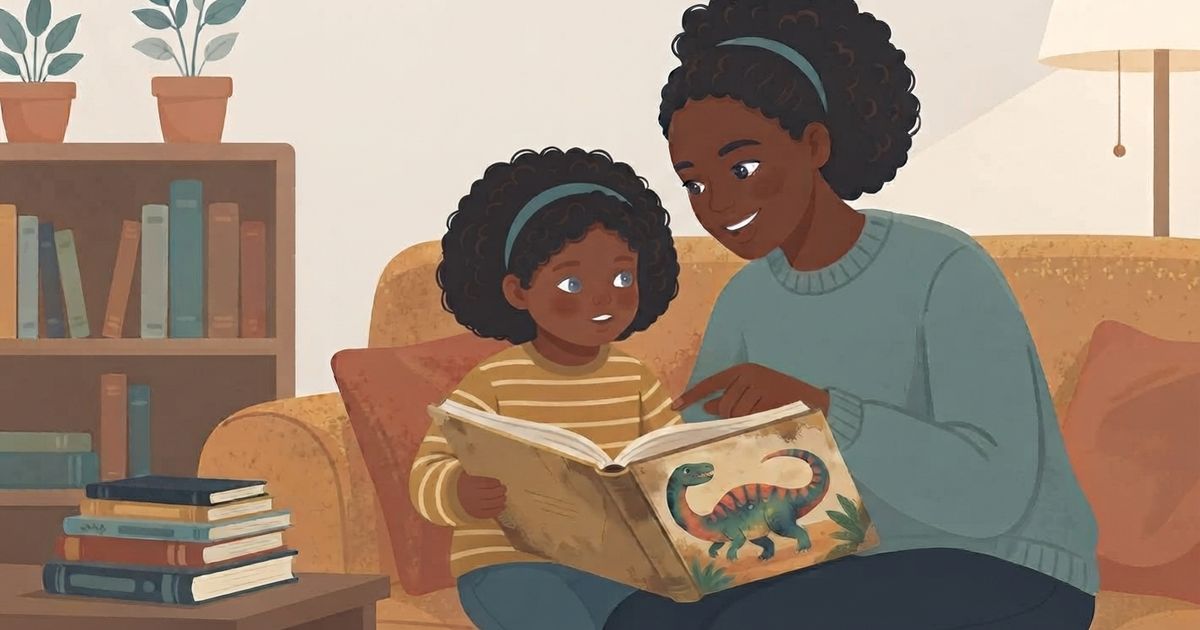
You're on reading number 47 of the same dinosaur book. You could recite it in your sleep, and some nights you practically do. You try to sneak in a new one, and your child slams it shut: "No. This one. Again." Before you hide the dinosaur book behind the washing machine, here's the good news. That request for the same story over and over is one of the smartest things your kid does all day.
The "again" that's secretly a learning strategy
Researchers at the University of Sussex tested exactly this. In a 2011 study published in Frontiers in Psychology, Jessica Horst and her team created special storybooks containing made-up words for unfamiliar objects, like a "sprock," and read them to 3-year-olds three times over one week. Some children heard the same stories repeated. Others heard different stories. The clever part: every child heard each new word the same number of times.
Right after the readings, both groups did about equally well. A week later, the difference showed up. The children who had heard the same stories again and again were the ones who still remembered the new words. The ones who got variety had mostly lost them.
Horst's explanation is called contextual repetition. The first time through a story, a child's brain is busy with everything: who's who, what happens, what's on each page. By the fifth time, the plot is familiar, so there's attention left over for the finer details, like new words and how sentences work. Horst summarized it simply: children don't necessarily need a huge quantity of books, but they do benefit from repeated exposure to the ones they have.
It's also about feeling in charge
Learning isn't the only thing going on. Young children live in a world where almost nothing is up to them. Bedtime, vegetables, car seats, leaving the park: all decided by someone else. A familiar story is one place where they know exactly what happens, and it happens every single time.
That predictability is soothing, especially after a big day or during a change like a new baby, a move, or starting preschool. Knowing that the bear finds his hat on page 12 is a small, reliable win. Many parents notice that the "same book phase" gets more intense when life gets bumpy. That's rarely a coincidence.
There's also pride. When a toddler shouts the last word of every line before you do, they're showing off mastery. For a small person, being the expert on something is a big deal.
How to survive (and use) the repeat phase
Say yes, most of the time. The repetition is doing real work. Rereading isn't a sign your child is stuck.
Let them fill in the blanks. Pause before a familiar word and let them finish the line. It turns listening into active participation.
Change how you read, not what you read. Try a squeaky voice for one character, whisper the scary part, or "accidentally" get a word wrong. Most kids will correct you with enormous joy.
Add one new book gently. Pair the favorite with a new one: "First our dinosaur book, then let's peek at this one." No pressure. A new book introduced next to a beloved one gets a better reception.
Notice the pattern. If your child suddenly asks for a book about a hospital visit or a new sibling, over and over, they may be working through something. That's a great opening for a gentle conversation.
The phase usually eases on its own as kids get older and hungrier for new plots. Somewhere around ages 6 to 8, many children shift to series, which is really just repetition in disguise: same characters, new adventure.
How a story helps
A story a child loves becomes a kind of safe room they can enter any time. Each rereading strengthens vocabulary and comprehension, but it also builds security: the same characters, the same ending, the same parent's voice. Stories that reflect the child's own world, their name, their home, the people they love, tend to become the most requested of all, because the familiarity is doubled. That's exactly the kind of book worth reading for the 48th time.
Frequently Asked Questions
Is it normal that my child wants the same book every night? Yes, completely normal and actually beneficial. Research shows young children learn more new words from hearing the same stories repeatedly than from hearing different ones. It also gives them comfort and a sense of control.
How long does the same book phase last? It varies, but it's most intense in toddlers and preschoolers. Many kids gradually seek more variety as they approach school age, though favorite books often stay in rotation for years.
Should I refuse to read the same book again? Usually there's no need. If you're desperate for variety, keep the favorite and add a new book alongside it, rather than replacing it. Changing voices or letting your child "read" parts to you keeps it fresh for you too.
Sources
- Horst, J. S., Parsons, K. L., & Bryan, N. M. (2011). Get the story straight: Contextual repetition promotes word learning from storybooks. Frontiers in Psychology, 2. Link
- Horst, J. S. (2013). Context and repetition in word learning. Frontiers in Psychology, 4. Link
- University of Sussex news release (2011). "Again, again!" Why repetition in reading helps children learn more. Link
Topics in this article
- same book over and over
- repeated reading
- why kids want the same story
- contextual repetition
- Jessica Horst
- word learning
- toddler reading
- preschool language development
- personalized book creation
- children's books
- positive parenting
QT
Quilloo Team
Bringing together child development research and thoughtful storytelling for parents.
Weekly parenting insights you'll actually use.
No spam. Just thoughtful ideas, expert tips, and stories that make a difference.