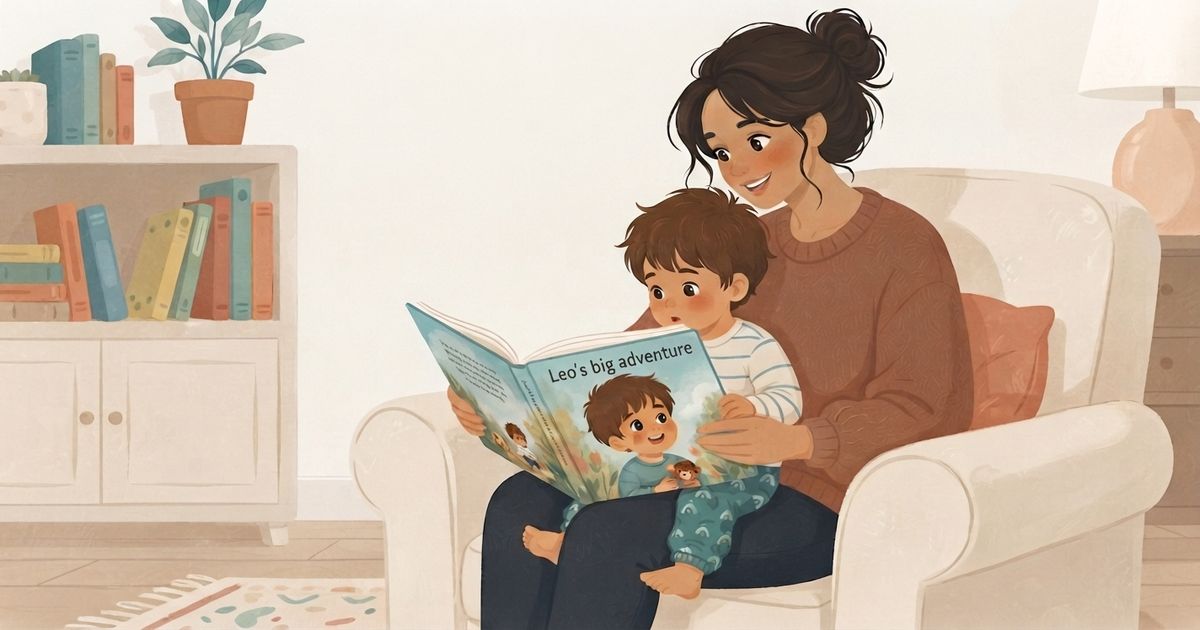
Teaching a specific lesson, sharing, courage, honesty, whatever it is, often comes down to a choice between two options. A story where a child is the hero themselves, or a story about a different character going through something similar. It feels like it should matter which one gets picked, and according to the research, it genuinely does, just not in quite as simple a way as "personalized always wins."
The foundational finding behind personalization
Cognitive psychologists Rogers, Kuiper, and Kirker demonstrated back in 1977 what's now called the self-reference effect: information processed in relation to oneself gets remembered more accurately than information processed about someone else. This has been replicated many times since, across both adults and children, and it's the actual mechanism underneath the popular claim that personalized books "work better."
Where the evidence is genuinely strong: attention and vocabulary
A study by Turk and colleagues in 2015, working with children ages 7 to 9, found that self-referencing specifically enhanced vocabulary learning, both for real words and made-up nonsense words. This is solid, direct evidence that framing new information in relation to a child themselves helps that specific kind of learning stick. A more recent fMRI study scanning children's brains while they listened to personalized versus generic narratives found that personalized content activated both language-processing regions and reward and self-reference brain regions more strongly, and did so more consistently across different children, despite each child's personalized content being completely different from the next child's.
Where the evidence is more nuanced than the marketing suggests
Here's the honest complication. A study specifically testing self-reference in 3-year-olds' memory for new words found a real advantage for self-referenced items immediately after learning them, but that advantage largely disappeared by the next day, when self-referenced and other-referenced words were both remembered about equally well. In other words, self-reference seems to boost initial attention and encoding strongly, the kind of thing that matters most in the moment a lesson is being introduced, but the long-term memory advantage isn't as clearly established as some personalized book marketing implies. A separate academic review of personalized digital books also noted directly that the relationship between self-referencing and deeper learning outcomes, comprehension and lesson application specifically, hasn't been as thoroughly studied as the vocabulary and engagement pieces have.
The study that gets closest to the real question at hand
A 2020 study by Kruse, Faller, and Read, published in Early Childhood Education Journal, examined specifically whether reading personalized storybooks to children could increase prosocial behavior, essentially the "does this actually teach a lesson" question, not just vocabulary or engagement. This is the most directly relevant piece of research to the choice between a personalized and a similar-but-different-character book, since it targets behavior change and lesson uptake rather than simple memory or attention.
Why "similar to them" still carries real weight, even without their name on it
None of this means a book about a different character teaching the same lesson is a weak option. Separate, well-established research on modeling, the same body of work behind why kids build confidence from watching someone succeed at something hard, has consistently found that the more similar an observed character is to the observer, the stronger the effect. A character who shares your child's exact situation, even without sharing their name and face, is still activating a real, evidence-backed mechanism, just a slightly less concentrated version of it than full personalization provides.
Why depth of personalization seems to matter more than personalization itself
One detail worth taking seriously: research distinguishes between shallow personalization, just inserting a child's name into an otherwise generic story, and deeper personalization, name, appearance, and specific personal details woven throughout. The self-reference effect appears to depend on how deeply the content actually connects to the child's real sense of self, not simply whether their name shows up on the page. A name swapped into a template doesn't automatically deliver the same effect as a story genuinely built around a child's actual face, situation, and specific details.
What this means for choosing between the two options
If the goal is maximum attention, emotional engagement, and vocabulary encoding right when a lesson is introduced, deep personalization has the strongest direct evidence behind it. If a fully personalized version isn't available or practical for a specific lesson, a story about a clearly similar character, facing the same specific situation your child is in, still carries real, well-documented benefit through the modeling mechanism, just without personalization's added boost to attention and initial encoding.
A quick, honest note: this is still a developing area of research, particularly for questions about long-term lesson retention rather than short-term engagement. Both options described here are genuinely evidence-supported; this isn't a case of one being backed by science and the other not.
Frequently Asked Questions
Does just putting my child's name in a generic story deliver the same benefit as full personalization? Research suggests depth of personalization matters, and name-only insertion into an otherwise generic story may not activate the same self-reference advantage as deeper personalization involving appearance and specific details.
Is the self-reference effect permanent, or does it fade? Some research on young children found the memory advantage from self-reference was strong immediately but faded by the next day, suggesting the effect may be more about initial attention than permanent retention.
Can a non-personalized story still teach my child something effectively? Yes, research on modeling and observational learning shows that characters similar to a child, even without sharing their name or face, still produce real learning and behavioral effects.
Which option is better for a one-time important lesson versus a book they'll read repeatedly? Personalization's biggest documented advantage is in initial attention and encoding, which may matter most for a lesson being introduced for the first time, though this specific comparison hasn't been directly studied.
Topics in this article
- personalized children's books
- self-reference effect
- Rogers Kuiper Kirker research
- children's book research
- storytelling and learning
- prosocial behavior stories
- book personalization
- personalized book creation
- children's books
- positive parenting
QT
Quilloo Team
Bringing together child development research and thoughtful storytelling for parents.
Weekly parenting insights you'll actually use.
No spam. Just thoughtful ideas, expert tips, and stories that make a difference.