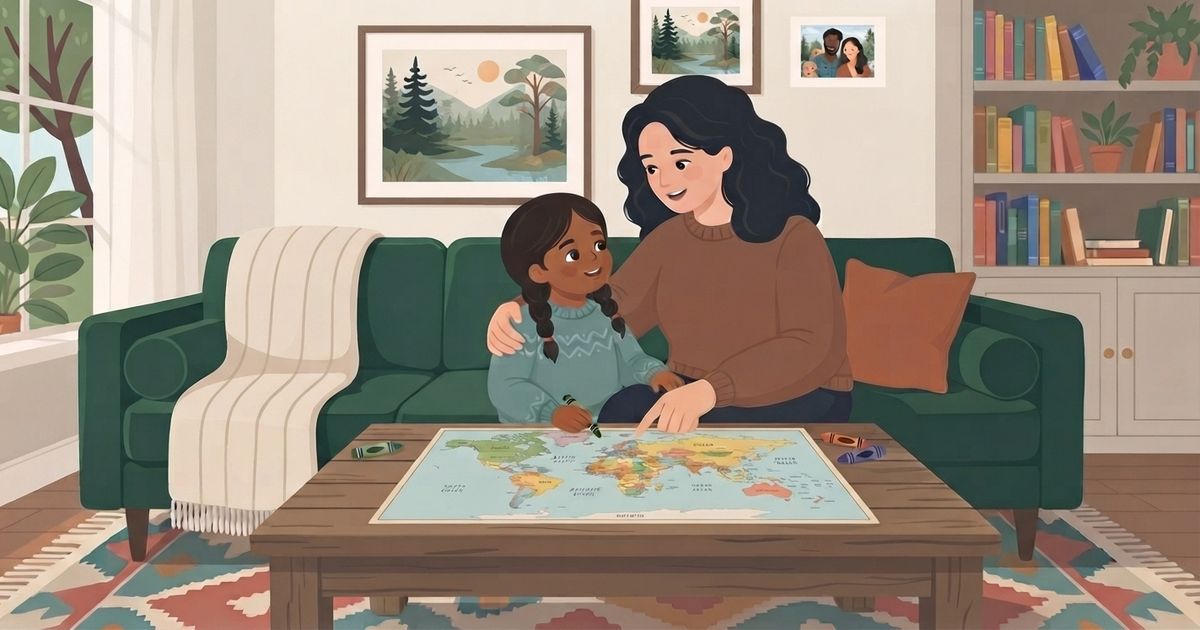
Today is the International Day of Peace, and somewhere between the news coverage of world events and a preschooler who just declared war over a shared crayon, there's a real question worth asking. What does peace actually mean to a young child, and is there anything concrete a parent can do with a day like this beyond a nice conversation that mostly goes over their head?
Why "peace" as a concept is the wrong starting point
Peace is an abstraction, and abstractions are exactly the kind of thing young children struggle to translate into action. This lines up with a pattern seen across children's media research more broadly: kids tend to interpret big, general lessons far too literally or too narrowly to apply them beyond the exact example they were given. A conversation about "world peace" is unlikely to change how a four-year-old handles the next crayon dispute, not because the concept isn't important, but because it's pitched at a level of abstraction a young child's brain isn't yet built to translate into daily behavior.
What actually builds it instead
UNICEF's own guidance for the day is notably specific rather than abstract: parents and caregivers can teach kids about peace by modeling empathy, respectful communication, inclusion, and constructive conflict resolution, the exact same small, concrete skills that show up in an ordinary preschool disagreement over a toy. Peace, at this age, isn't a topic. It's a set of specific, practiced behaviors: sharing, taking turns, listening, and finding a way through a disagreement without escalating it.
The research behind why this actually works
A quasi-experimental study using a pretest-posttest control group design examined the effects of a structured peace education program on sixth graders' empathy levels, comparing an experimental group that received the program against a control group that received none. The design itself reflects something important about how this field studies peace-building: not by measuring abstract attitudes toward the concept of peace, but by measuring concrete empathy skills, the same building blocks UNICEF points to for much younger kids too, just assessed with older students.
What predicts empathy in the real world
A large multi-country study examining empathy in sixth graders across 16 Latin American and Caribbean countries found some genuinely useful patterns. Empathy levels were higher among students who had attended preschool in a meaningful share of the countries studied, and notably lower among students who experienced high victimization at school or high classroom disruption. This points to something practical: consistent, safe, socially engaged early environments appear to matter more for building empathy than any single lesson or conversation about kindness in the abstract.
Why conflict resolution is the actual skill worth practicing
Peace education guidance across early years settings consistently centers on the same small set of concrete skills: sharing, taking turns, expressing feelings in words, and working through small disagreements respectfully. These aren't separate from the "peace" a day like this is meant to honor. They're its most basic, practicable unit, the actual raw material peace at any larger scale is eventually built from.
What this looks like at home today
Skip the big conversation about world peace if your child is young enough that it won't land. Instead, use today as a reason to name and practice one concrete skill directly: when the next small conflict happens, whether it's a sibling squabble or a disagreement with a friend, narrate the peaceful resolution out loud as it happens. "You both wanted the same toy, and you found a way to take turns instead of fighting over it. That's exactly what peace looks like." The abstraction becomes concrete the moment it's attached to something your child actually just did.
A note on older kids and current events
For children old enough to be aware of conflict in the news, UNICEF's broader framing is worth keeping in mind: peace is described as more than the absence of war. It means safety, dignity, and the chance to thrive. Older kids can handle age-appropriate conversations about this larger meaning, but the same underlying principle holds even then: pairing any conversation about big-picture peace with something concrete they can actually practice tends to make it land more than the conversation alone.
A quick, honest note: a single day of conversation or activity won't build empathy or conflict resolution skills on its own. The research points to consistent, everyday practice as the real driver, this day is simply a good, low-pressure occasion to start or reinforce that practice.
Frequently Asked Questions
Is my child too young to understand the International Day of Peace? Very young children don't need to understand the global concept to benefit from the day. Practicing concrete skills like sharing and conflict resolution captures the same underlying value.
What's the most effective single thing I can do today? Narrating a real, small moment of peaceful conflict resolution as it happens, out loud, tends to be more effective than an abstract conversation about peace as a concept.
Does attending preschool actually affect a child's empathy levels? A large multi-country study found preschool attendance was associated with higher empathy in a meaningful share of the countries studied, alongside other factors like classroom safety.
How do I talk to an older child about conflict in the news without overwhelming them? Age-appropriate framing that connects the bigger picture to concrete values, like safety, fairness, and respect, tends to work better than abstract political discussion for most kids.
Sources:
- UNICEF USA. International Day of Peace: What Peace Means for Children Today. Link
- Quasi-experimental study on the effects of a Peace Education Program on sixth-grade students' empathy levels, pretest-posttest control group design. Link
- Multi-country study on empathy levels among sixth graders across 16 Latin American and Caribbean countries, Inter-American Development Bank. Link
Topics in this article
- International Day of Peace
- teaching empathy
- conflict resolution skills
- peace education research
- kindness in children
- social emotional learning
- UNICEF guidance
- early childhood empathy
- personalized book creation
- children's books
- positive parenting
QT
Quilloo Team
Bringing together child development research and thoughtful storytelling for parents.
Weekly parenting insights you'll actually use.
No spam. Just thoughtful ideas, expert tips, and stories that make a difference.