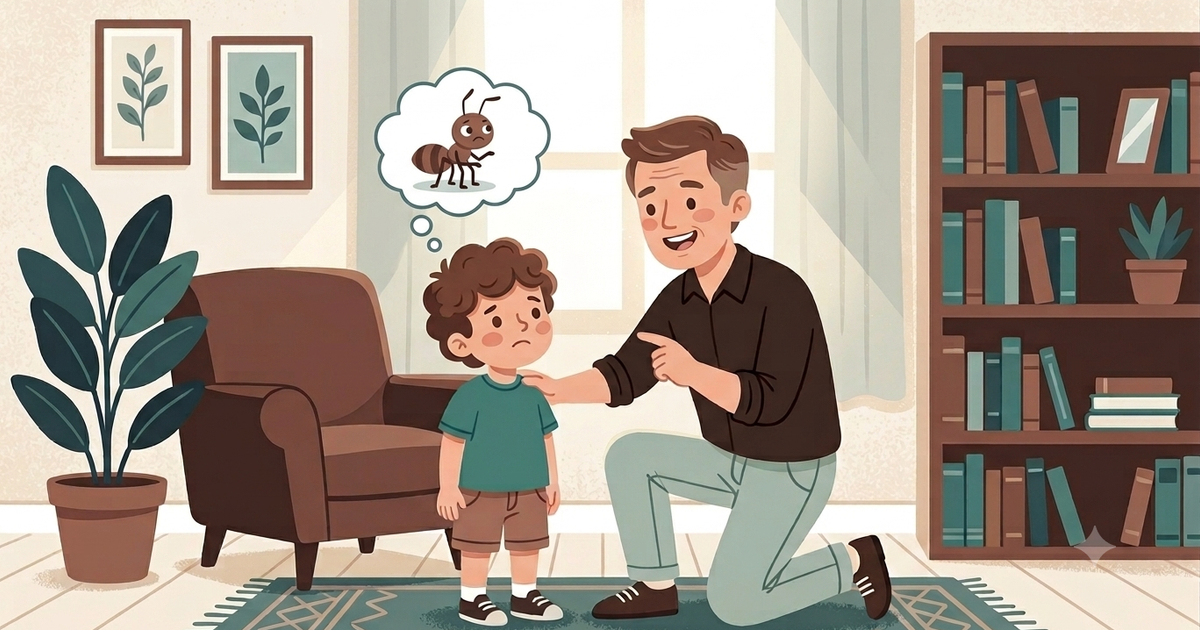
Your kid misses one shot at basketball and immediately announces they're "the worst at everything" and want to quit forever. That leap, from one missed shot to a permanent verdict on their whole worth, has a name simple enough to explain using actual insects.
The concept, explained simply
Psychiatrist Daniel Amen coined the term ANTs, short for automatic negative thoughts, after coming home to find his kitchen literally infested with ants and noticing how the image matched what these small, automatic thoughts do in the mind. Left unchecked, they crawl in constantly and build up into something that genuinely affects mood and behavior. The idea builds on the work of psychiatrist Aaron Beck, a founder of cognitive behavioral therapy. Amen's version is a kid-friendly package simple enough to teach a young child to use.
The question that does the actual work
Amen built a children's book around this exact idea, teaching kids a specific question to ask a negative thought instead of just believing it: is this actually true. Not "stop thinking that." A specific, answerable question a kid can actually run through in the moment.
The exact phrase to use
Next time your kid spirals from one bad moment into "I'm terrible at everything," try this exact phrase: "is that actually true, or is that an ANT talking?" Say it lightly, almost playfully, since the whole point is giving them a tool, not a lecture. Over time, kids start catching their own ANTs without needing the prompt at all.
Frequently Asked Questions
At what age can kids learn to identify their own negative thoughts? Amen's children's book targets ages roughly four to eight, suggesting even young kids can grasp a simplified version of this idea.
Is this the same as telling a kid to just think positive? No, it's about questioning whether a thought is accurate, not forcing positivity or suppressing the thought.
How do I introduce this concept without it feeling like a lecture? Framing it playfully, calling out an "ANT" almost like a game, tends to land better than a serious conversation about thought patterns.
Does this replace professional help for anxiety in kids? No, this is a coping tool. Persistent or significant symptoms should be evaluated by a mental health professional.
Sources:
- Amen, D. G. Concept of ANTs (automatic negative thoughts), Amen Clinics.
- Amen, D. G. (2018). Captain Snout and the Super Power Questions: How to Calm Anxiety and Conquer Automatic Negative Thoughts.
Topics in this article
QT
Quilloo Team
Bringing together child development research and thoughtful storytelling for parents.
Weekly parenting insights you'll actually use.
No spam. Just thoughtful ideas, expert tips, and stories that make a difference.