
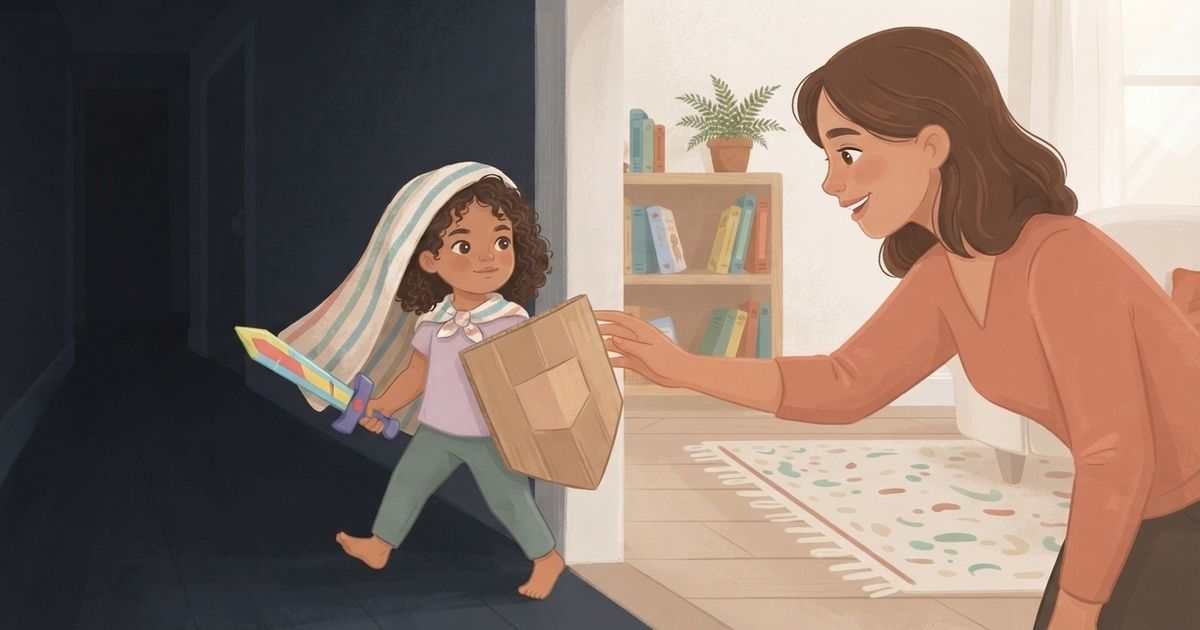
Your daughter refuses to go into the dark hallway to get her shoes. Then you say, "What would Captain Maya do?" and she marches in, cape (bath towel) flying, and comes back with the shoes and a report on the hallway's "all clear" status. Same kid. Same hallway. Different story in her head.
Why stepping into a hero's shoes changes behavior
Seeing a child as the hero of the story isn't just cute. It seems to change what kids are willing to try. In a 2017 study published in Child Development, researchers Rachel White, Stephanie Carlson, and colleagues asked 180 children aged 4 and 6 to do a deliberately boring computer task for ten minutes. The catch: a very tempting video game was right there, and they could take breaks to play it whenever they wanted.
Some children did the task as themselves. Some were asked to think about themselves in the third person, using their own name ("Is Maya working hard?"). And some pretended to be a hardworking character like Batman or Dora the Explorer, complete with costume props.
The kids who became a hero character stuck with the task the longest. The kids who thought about themselves by name came next, and the kids who stayed in the plain "I" perspective persisted least. The researchers linked this to self-distancing: stepping slightly outside your own point of view makes it easier to push through frustration and resist temptation. The media nicknamed it "the Batman Effect."
The interesting middle result is the one worth noticing. Simply seeing yourself from the outside, as a character with a name, already helped. That's exactly the position a child is in when they hear a story where they're the hero.
Heroes are made of struggle, not perfection
Here's where many hero stories go wrong: the hero is perfect. They're never scared, never mess up, never cry. A child who struggles with all three can't really see themselves in that.
The best hero stories for young kids feature a hero who:
- Feels scared and does it anyway. Courage only exists when fear shows up.
- Tries, fails, and tries again. A second attempt is more inspiring than instant success.
- Asks for help. Real heroes have friends, parents, and a trusty sidekick. Needing help isn't weakness.
- Solves problems at kid scale. Defeating a dragon is fun. Staying overnight at Grandma's for the first time is the kind of bravery your child actually needs.
When your child is the hero and the story mirrors a real challenge, like the first day of kindergarten, a doctor's visit, or sharing a room with a new sibling, the story becomes a rehearsal. They get to practice being brave in their imagination before doing it in real life.
Bringing the hero into everyday life
Name the hero in them. "Remember when Hero Leo climbed the whole rock wall?" Recalling real moments of courage builds a track record kids can lean on.
Use the third person for tough moments. When your child is stuck, try, "What would Brave Sofia do right now?" It's the same self-distancing the researchers used, in bedtime-friendly form.
Let them write the next chapter. Ask your child how the hero should handle the next problem. Kids often come up with solutions they're more willing to follow because they invented them.
Keep it age-appropriate. Toddlers love simple heroic acts: finding the lost teddy, helping the puppy home. Preschoolers can handle a small problem and a satisfying fix. Kids 5 to 8 enjoy bigger adventures with real stakes and a twist.
Don't overdo the pressure. The goal isn't "you must always be brave." It's "you've been brave before, and you can try again." A hero on a rest day is still a hero.
How a story helps
A story where the child is the hero gives them a safe distance from their own fears while keeping the lesson personal. They can watch "themselves" face something hard and succeed, which makes the real-life version feel more possible. Research on personalized books also suggests that young children pay closer attention, and even learn new words better, in the parts of a story built around them. When the adventure mirrors a challenge they're actually facing, the book becomes a small practice run for courage.
Frequently Asked Questions
How do I help my child be braver? Acknowledge the fear first, then offer a small, achievable step. Remind them of past brave moments and use stories or role play where they practice being brave, so the real situation feels more familiar.
Is it good for kids to pretend to be superheroes? Yes, in most cases. One study found that children who pretended to be a hardworking character like Batman persisted longer on a boring task. Pretend play also builds imagination and emotional regulation.
What is the Batman Effect in kids? It's the finding that children stick with difficult tasks longer when they pretend to be a capable character, or even when they think about themselves by name. Taking an outside perspective seems to make frustration easier to manage.
Sources
- White, R. E., Prager, E. O., Schaefer, C., Kross, E., Duckworth, A. L., & Carlson, S. M. (2017). The "Batman Effect": Improving perseverance in young children. Child Development, 88(5). Link.
- Kucirkova, N., Messer, D., & Sheehy, K. (2014). Reading personalized books with preschool children enhances their word acquisition. First Language, 34(3). Link.
Topics in this article
- child as hero
- hero stories for kids
- Batman Effect
- self-distancing
- building courage in children
- perseverance
- Stephanie Carlson
- pretend play
- personalized book creation
- children's books
- positive parenting
QT
Quilloo Team
Bringing together child development research and thoughtful storytelling for parents.
Weekly parenting insights you'll actually use.
No spam. Just thoughtful ideas, expert tips, and stories that make a difference.