You're finally on the phone with the pediatrician's office, and your five-year-old is tugging your sleeve. "Mom. Mom. Mommy. MOM." You hold up one finger, the universal sign for "one minute," and he keeps going, because to him one minute might as well be a week. Nobody offered him a cookie, yet this is the same skill psychologists have been studying for over fifty years with the famous marshmallow test: the ability to hold back right now for something better later, in this case a parent who can actually listen. Here is what the test shows, and what it doesn't.
The experiment, in one minute
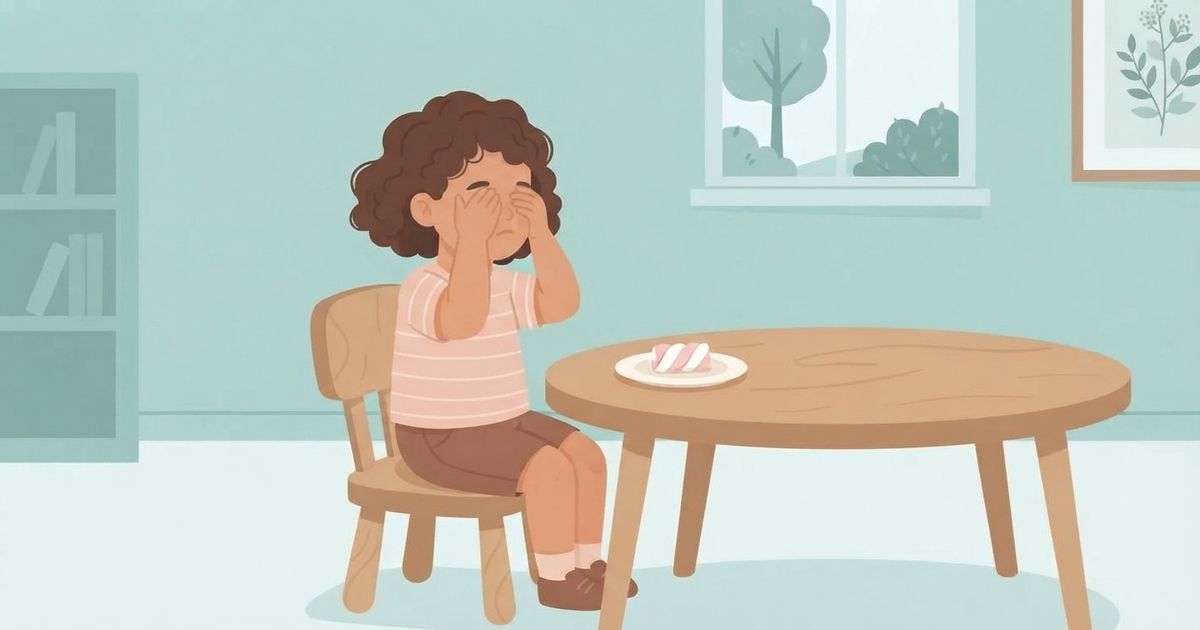
In the late 1960s and early 1970s, psychologist Walter Mischel and his colleagues at Stanford sat preschoolers in a bare room with a treat, often a marshmallow, in front of them. The deal: eat it now, or wait about 15 minutes alone and get two. Some kids gobbled it up right away. Others sang, covered their eyes, turned their chairs around, or whispered "no" to themselves, over and over.
Why Dr. Amen cares about it
In their 2024 book Raising Mentally Strong Kids, Dr. Daniel Amen (a neuropsychiatrist) and Dr. Charles Fay (a child psychologist) describe about a third of the children as finding creative ways to distract themselves from the treat. They use the experiment to anchor one of their "bricks" of mental strength: teach kids to say no to themselves. To be clear, this is a parenting book, not a peer-reviewed study, so we'll lean on the original research for the science.
What it shows about your child
Amen and Fay's point is that giving up a small pleasure now for a bigger one later is one of the hardest things in life, whether you're 5, 15, or 25. They treat it as a core piece of mental fortitude.
The follow-up research gives that some backing. In a 1990 study of children from Stanford's preschool, Yuichi Shoda, Mischel, and Philip Peake found that preschool waiting time predicted some adolescent outcomes, including how well teens coped with frustration and, in the subset of 94 kids whose parents reported SAT scores, those scores too. In 2011, a team led by B. J. Casey scanned nearly 60 of the original participants, now in their mid-forties. People who had struggled to wait as kids had a harder time holding back from happy faces they were told to ignore. Their reward-related brain region (the ventral striatum) was more active, while the prefrontal cortex, the brain's planning and braking system, differed in the high delayers.
So what does one marshmallow moment show? A snapshot of how well a child, at roughly age four, can hold back an impulse while the temptation sits right in front of them. A snapshot of a skill under construction, not a verdict. Child development experts note that the prefrontal cortex keeps maturing well into the twenties, so nobody is "finished" at four.
What waiting depends on (it's not just willpower)
Later research shows that a child's wait time depends on much more than grit.
Trust. In 2013, Celeste Kidd and colleagues tested 28 children, average age about four and a half. Before the marshmallow task, half the kids met an adult who kept her promises, and half met one who didn't. Children in the reliable group waited about four times longer. Waiting is only a smart move if the second marshmallow actually shows up, and kids seem to figure that out.
Background. In 2018, Tyler Watts, Greg Duncan, and Haonan Quan repeated the idea with a larger, more diverse sample. The link between waiting and later achievement was about half the size of the original, and it shrank further once they accounted for family background, early thinking skills, and the home environment. Most of the difference came from whether a child could wait at least 20 seconds at all.
Attention. In Mischel's 1972 experiments with Ebbe Ebbesen and Antonette Zeiss, children who focused on the reward waited less. Children who were distracted from it waited longer. That finding is the hopeful part: where your child puts their attention is something you can teach.
So a child who grabs the marshmallow isn't necessarily "weak." They may have learned that promises around here are shaky, they may be four, or they may simply never have been shown what to do with their eyes and brain while they wait.
How to teach a child to say no to themselves
Amen and Fay suggest teaching kids some distraction moves, the same kinds the patient preschoolers invented on their own:
- Sing a song
- Look the other way
- Talk to yourself about why waiting is better
- Take a walk
- Think about pleasant memories
- Play a game
They also describe follow-up work in which adults modeled distraction strategies for preschoolers, and some kids who had failed to wait before were then able to hold out for the bigger reward. Treat that as the authors' account, but it fits with Mischel's attention findings.
Their second idea is quieter and probably more powerful. Every time you tell your child no to something that isn't good for them, like swimming without a life jacket, skateboarding without a helmet, or eating the entire tub of ice cream, you are handing them practice at hearing "no" and surviving it. The skill of saying no to themselves is built partly from your calm, loving no's.
Try this tonight: a tiny waiting game
Pick a small, real wait and make it a game, not a test.
- Name the feeling. "Waiting is hard. I'd want it right now too."
- Offer a menu. "Some kids sing while they wait. Some turn around so they can't see the cookie. Which one do you want to try?"
- Start tiny. Think seconds, then a minute, then a few minutes. Use a sand timer so the clock is the boss, not you.
- Go first. Say out loud, "I really want a cookie, so I'm going to hum this song until dinner is ready."
- Always deliver. If you promised two, they get two, on time. This is the trust part, and it's the part parents forget.
- Praise the strategy. "You turned your chair around. That was a smart move," beats "You're so good at waiting."
If your child melts down halfway through, skip the lecture. A short dose of empathy ("That was a tough one") and a fresh try tomorrow does more than a debate over a cookie.
Frequently Asked Questions
At what age can kids wait for a bigger reward? The classic studies tested preschoolers, mostly around age four. Toddlers under three can't be expected to manage this yet, so adults need to keep temptations out of reach and offer lots of simple distractions.
If my child ate the marshmallow, will they struggle later in life? No. Larger, more recent research found the link between early waiting and later outcomes was much weaker than first reported, especially once family circumstances were considered. Strategies like distraction can also be learned.
How long should I ask my child to wait? Start with a wait they can win, often under a minute for a young preschooler, and stretch it slowly. Success builds the skill, and failure mostly builds frustration.
Should I run the marshmallow test at home? You can as a fun game, but it's not a diagnostic tool. The result depends on trust, mood, hunger, and how the adult behaves, so treat it as practice, not a score.
Sources
- Amen, D. G., & Fay, C. (2024). Raising Mentally Strong Kids, Tyndale Refresh. Parenting book (not peer-reviewed research), Chapter 8, "Brick #5." Publisher page.
- Mischel, W., Ebbesen, E. B., & Zeiss, A. R. (1972). Cognitive and attentional mechanisms in delay of gratification. Journal of Personality and Social Psychology. Link
- Shoda, Y., Mischel, W., & Peake, P. (1990). Predicting adolescent cognitive and self-regulatory competencies from preschool delay of gratification. Developmental Psychology. Link
- Casey, B. J., et al. (2011). Behavioral and neural correlates of delay of gratification 40 years later. PNAS. Link
- Kidd, C., Palmeri, H., & Aslin, R. N. (2013). Rational snacking: young children's decision-making on the marshmallow task is moderated by beliefs about environmental reliability. Cognition. Link
- Watts, T. W., Duncan, G. J., & Quan, H. (2018). Revisiting the marshmallow test: a conceptual replication investigating links between early delay of gratification and later outcomes. Psychological Science. Link
Topics in this article
- marshmallow test
- delayed gratification
- self-control for kids
- Dr. Daniel Amen
- Charles Fay
- Love and Logic
- Walter Mischel
- teaching kids to wait
- impulse control preschoolers
- mentally strong kids
- personalized book creation
- children's books
- positive parenting
QT
Quilloo Team
Bringing together child development research and thoughtful storytelling for parents.
Weekly parenting insights you'll actually use.
No spam. Just thoughtful ideas, expert tips, and stories that make a difference.