
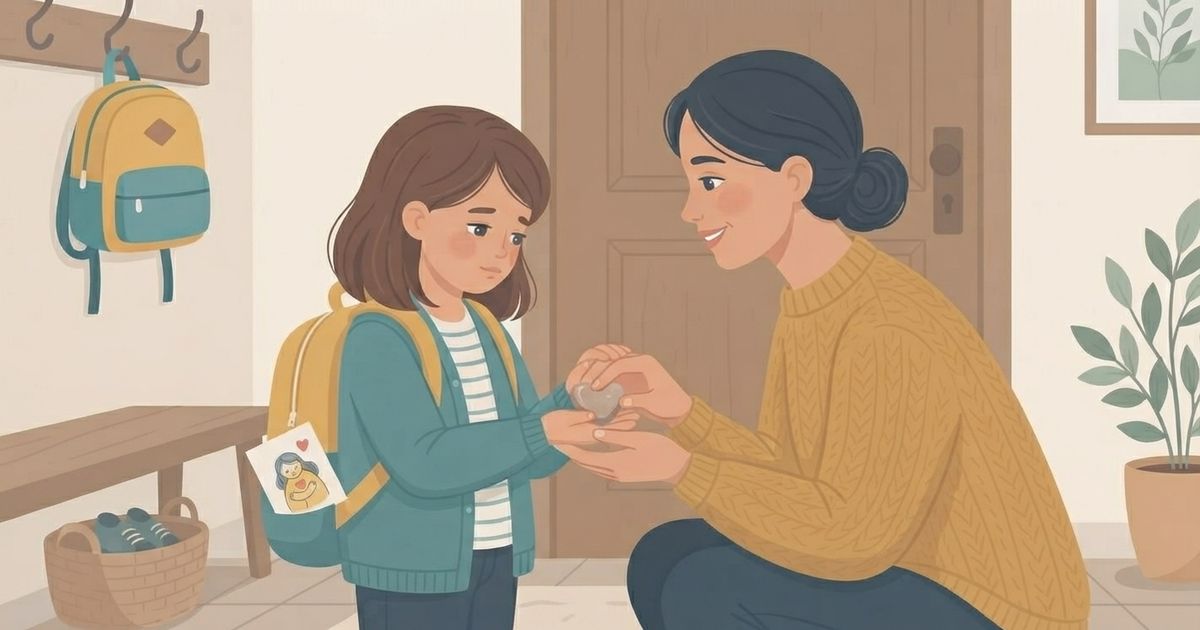
The backpack is on, the shoes are tied, and your five-year-old's hand tightens around yours at the classroom door. Goodbyes at school, preschool, a grandparent's house, or bedtime can be tough, and the usual advice is to leave quickly and keep it light. Gordon Neufeld suggests looking at the whole stretch of time around the goodbye, and building a bridge across it.
The idea, in one sentence
Children handle time apart far better when parents connect warmly before the separation and give them something to hold on to while they are apart, a practice Neufeld calls bridging the divide.
What "bridging" means
In his parenting video series The Vital Connection, Gordon Neufeld uses the phrase "bridging the divide" for the ways a parent can keep a child connected across a separation. The Neufeld Institute's guidance on school separations summarizes the approach in three parts: connect with your child in the morning, focus on uniting again when you are back together, and give your child something to hold on to during the day.
The logic follows from how Neufeld understands attachment, as the drive to keep closeness. A separation challenges that drive. A child who leaves with the sense of connection already topped up, and with a tangible reminder of it, has more to lean on. A child who is hurried out the door has a gap that the day must fill.
Why the goodbye is only part of the story
Many parents focus all the effort on the moment of parting. Neufeld's picture is wider. The morning itself is the first plank of the bridge: unrushed contact, eye contact, a snuggle, a smile. The middle of the bridge is whatever the child carries along. The last plank is the reunion, when the parent makes a point of being glad to see the child.
This also explains why mornings that feel chaotic often lead to harder goodbyes. When the connection has not been fed, the child arrives at the door still hungry for it, and the instinct to hold on grows louder.
Where the idea comes from
Neufeld is a Vancouver-based clinical psychologist with more than forty years of experience with children, youth, and the adults who care for them. His model of attachment draws on early attachment researchers such as John Bowlby, who documented how young children respond to separation from caregivers. Bridging is a practical idea that grew from Neufeld's clinical teaching, and it appears across the Neufeld Institute's parenting resources.
An honest note: bridging is a practical framework from Neufeld's teaching, not something that has been tested in trials of its own. It fits well with what is generally known about warm routines helping young children manage transitions, and many families find it simple to try.
Why this matters for ages 0 to 8
Transitions fill the early years: starting preschool, starting school, sleepovers, babysitters, new classes. Each one involves leaving a trusted adult for a while. A reliable way of bridging gives children a pattern they can count on, and patterns are comforting. Over time, children often come to carry the bridge themselves, and goodbyes become shorter and easier.
Three planks for your bridge
Fill the cup in the morning. Even five unhurried minutes help. Get down to eye level, smile, share a hug, say a few warm words. The goal is for your child to leave feeling that closeness is stocked up.
Send something to hold on to. A small keepsake in a pocket, a note in the lunchbox, a special handshake, or a phrase that belongs to the two of you. Choose something your child can touch or recall in the middle of the day: "When you feel your heart-stone, I'm thinking of you."
Make reunions a celebration. When you meet again, greet your child first and ask questions later. A big smile, open arms, and "There you are!" restore the connection fully. The warmer the reunion, the easier the next goodbye tends to be.
Bedtime can follow the same pattern, since sleep is also a separation. A warm goodnight ritual, a small comfort object, and a promise about the morning ("I will see you at breakfast") can all serve as planks.
Frequently Asked Questions
What does "bridging the divide" mean in Neufeld's approach?
It means helping children feel connected across a separation by connecting warmly beforehand, giving them something to hold on to during the time apart, and reuniting with warmth afterward.
How can I make school drop-off easier for my child?
Neufeld's approach suggests unhurried connection in the morning, a small keepsake or ritual to carry, and a warm reunion at pickup. These steps help a child feel that closeness continues during the day.
Is it better to leave quickly or to stay a bit?
This depends on the child, but the bridging idea is that the whole arc matters, not just the exit. Connection before the goodbye usually makes the goodbye itself smoother.
Does this work for bedtime and sleepovers?
Yes. Any separation can use the same three steps: connection first, something to hold on to, and a warm reunion.
What kind of keepsake works best?
Something small and personal that your child can hold or remember: a note, a stone, a bracelet, a shared phrase. The meaning matters more than the object.
Sources
Topics in this article
- bridging the divide
- Gordon Neufeld
- school drop-off
- separation anxiety
- goodbye rituals
- The Vital Connection
- attachment-based parenting
- back to school
- bedtime routine
- parenting ages 0-8
- positive parenting
QT
Quilloo Team
Bringing together child development research and thoughtful storytelling for parents.
Weekly parenting insights you'll actually use.
No spam. Just thoughtful ideas, expert tips, and stories that make a difference.