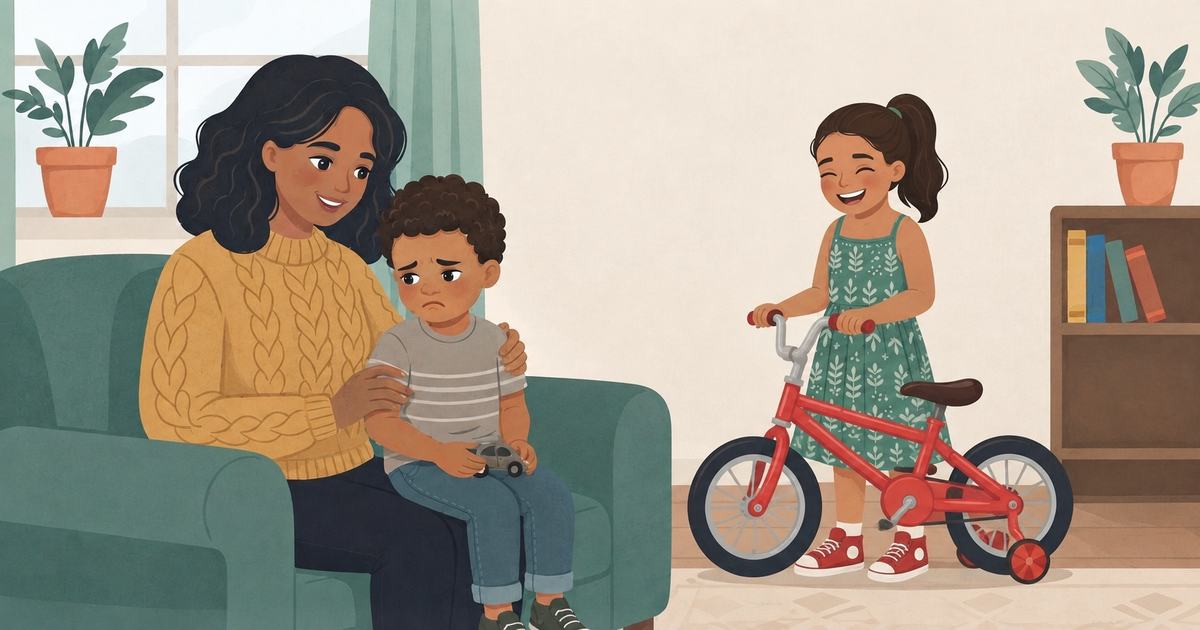
Your kid catches sight of a sibling's new shoes, or hears a friend describe a bigger birthday party than theirs, and the reaction is instant and disproportionate. It's not really about the shoes. According to research on how children process these moments, the who matters just as much as the what.
The study that looked at this directly
Researchers presented children ages 6 to 11 with story scenarios involving upward social comparison, situations where another child has more or better than they do, and tracked their emotional and behavioral responses. The study distinguished between malicious envy, wanting to take away what the other person has, benign envy, wanting to achieve something similar for yourself, and no envy at all. One of the clearest findings: kids showed significantly more envy, especially the malicious kind, when the person they were comparing themselves to belonged to an "out-group," someone outside their close circle, than when it was someone from their own group, like a close friend or sibling treated as an insider.
Why the relationship changes everything
This helps explain something that can feel confusing in the moment. The same gap in possessions, a sibling with a new toy versus a random classmate with one, can trigger completely different reactions. When the comparison feels like it's coming from inside the child's own "team," the sting tends to be smaller and less likely to turn into resentment. When it feels like an outsider has something better, the reaction skews more toward wanting to take it away rather than wanting to achieve something similar.
What this means for how you respond
A flat "it's not fair to compare" often misses what's actually happening internally. It can help more to name the specific feeling directly, "it's hard to see your brother get something new when you didn't," and separately reinforce the relationship itself, that a sibling or close friend having something isn't a loss for the child, before jumping to logic about fairness or turns.
A story can offer a version of the same comparison, safely
Reading a story where a character deals with a similar comparison, wanting what someone else has, and works through the feeling without it damaging the relationship, gives a child a version of the exact emotional experience to reference later, in a lower-stakes setting than the actual moment of comparison.
Frequently Asked Questions
At what age do kids start comparing themselves to others this way? This kind of social comparison and envy has been documented in children as young as 6, though awareness of fairness and comparison can appear even earlier in simpler forms.
Is it worse when the comparison is with a sibling or with a friend? According to this research, comparisons with someone perceived as an "insider," which can include a close sibling relationship, tend to produce less malicious envy than comparisons with an outsider.
Should I stop my kids from comparing what they have to what others have? It's difficult to prevent entirely, since comparison is a natural part of how kids process fairness, but naming the underlying feeling tends to help more than suppressing the comparison itself.
Is "benign envy" actually a good thing? It can be. Benign envy, wanting to achieve something similar rather than wanting to take it away, is associated with motivation rather than resentment.
Sources:
- Study on the influence of group identification on malicious and benign envy in children ages 6 to 11, developmental psychology research. Link
Topics in this article
- sibling comparisons
- envy in children
- social comparison research
- jealousy
- fairness
- emotional development
- family dynamics
- personalized book creation
- children's books
- positive parenting
QT
Quilloo Team
Bringing together child development research and thoughtful storytelling for parents.
Weekly parenting insights you'll actually use.
No spam. Just thoughtful ideas, expert tips, and stories that make a difference.