
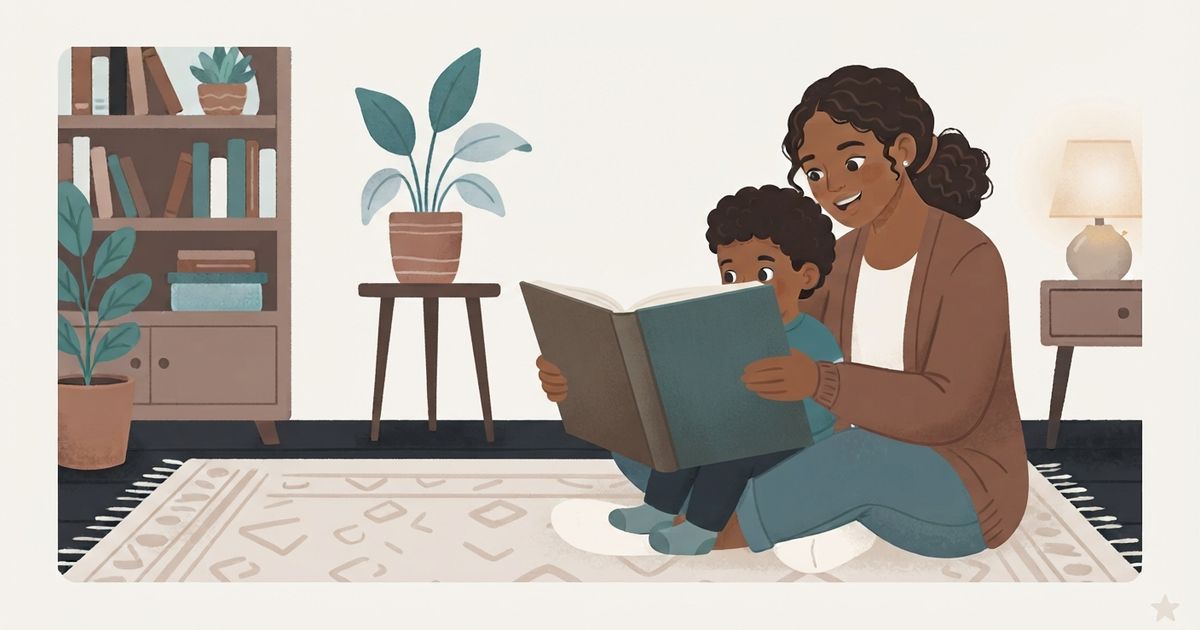
Your kid has never actually experienced most of what happens in the average children's book, a friend moving away, a grandparent dying, jealousy over a new sibling. And yet somehow, after enough bedtime stories, they seem to understand these situations before they've lived a single one. That's not a coincidence.
The study that connected books to understanding other minds
Psychologist Raymond Mar at York University ran a study testing 55 children and their parents, looking at the relationship between exposure to children's literature and something researchers call theory of mind, the ability to understand that other people have their own beliefs, feelings, and desires that might be completely different from your own. Mar found that parents who were better able to recognize children's book titles and authors, a proxy for how much their family actually engaged with books, had kids who performed significantly better on theory of mind tests. He also cited earlier research finding that more than 75 percent of books read aloud to preschoolers reference mental states and complex emotional situations, far more than shows up in typical daily conversation.
Why fiction can teach what real life hasn't happened yet
Mar's explanation gets at something worth sitting with: even though a story is invented, it can still communicate real truths about how people think, feel, and relate to each other. A child doesn't need to have lived through a friend moving away to start building an understanding of what that might feel like, if a story has already walked them through a character's version of it. Experiences shape a child's understanding of the world, and researchers increasingly find that imagined experiences through story do some of that same shaping.
The part that requires you, not just the book
Mar's research points to something easy to miss: the benefit wasn't simply tied to how many books were in the house, it was tied to engagement, parents who talked about and connected with these stories alongside their kids. This lines up with a broader pattern in reading research: it's the conversation happening around a story, not the story sitting quietly on a shelf, that seems to do the most work.
Worth being honest about the state of the research
Most of the strongest evidence connecting fiction reading to empathy and theory of mind comes from studies of adult readers. A 2025 review specifically noted that while there's good reason to expect similar effects in children, and some promising early studies point that way, the summative evidence for kids specifically is still catching up to what's known about adults. This doesn't undercut the case for reading, it just means the picture is still filling in.
What this looks like at home tonight
When a story's character feels something big, scared, jealous, left out, pause and name it directly: "I wonder how she's feeling right now." That small habit, treating the character's inner world as worth talking about, is closer to what Mar's research actually measured than the reading itself.
A quick, honest note: books are one part of a much bigger picture that includes real relationships, direct experience, and everyday conversation. This is about adding a genuinely useful tool, not suggesting stories alone can substitute for lived experience.
Frequently Asked Questions
Does reading fiction really build theory of mind in young kids specifically? Early research, including Mar's study, found associations in children, though researchers note the evidence base for kids specifically is still developing compared to what's known about adult readers.
Does it matter what kind of book I read, or does any story work? Books that reference characters' thoughts, feelings, and beliefs, which the majority of preschool books already do, appear especially relevant to building this kind of understanding.
Do I need to explicitly discuss characters' feelings, or does reading alone work? Talking about the story together appears to matter as much as the reading itself, based on how this research measured family engagement with books.
At what age do kids start understanding that characters have their own separate thoughts and feelings? Most children begin developing this understanding between ages 3 and 5, around the same time they start grasping theory of mind more generally.
Sources:
- Mar, R. A., et al. (2010). Predicting the theory-of-mind of children from parental recognition of children's authors and titles. Society for Personality and Social Psychology, cited via MedicalXpress.
- Systematic review and meta-analysis: How the type and context of children's storybook reading relates to select empathy skills. Journal of Research in Childhood Education, 2025.
Topics in this article
- children's books research
- theory of mind
- Raymond Mar research
- empathy development
- fiction and children
- storytelling benefits
- emotional understanding
- personalized book creation
QT
Quilloo Team
Bringing together child development research and thoughtful storytelling for parents.
Weekly parenting insights you'll actually use.
No spam. Just thoughtful ideas, expert tips, and stories that make a difference.