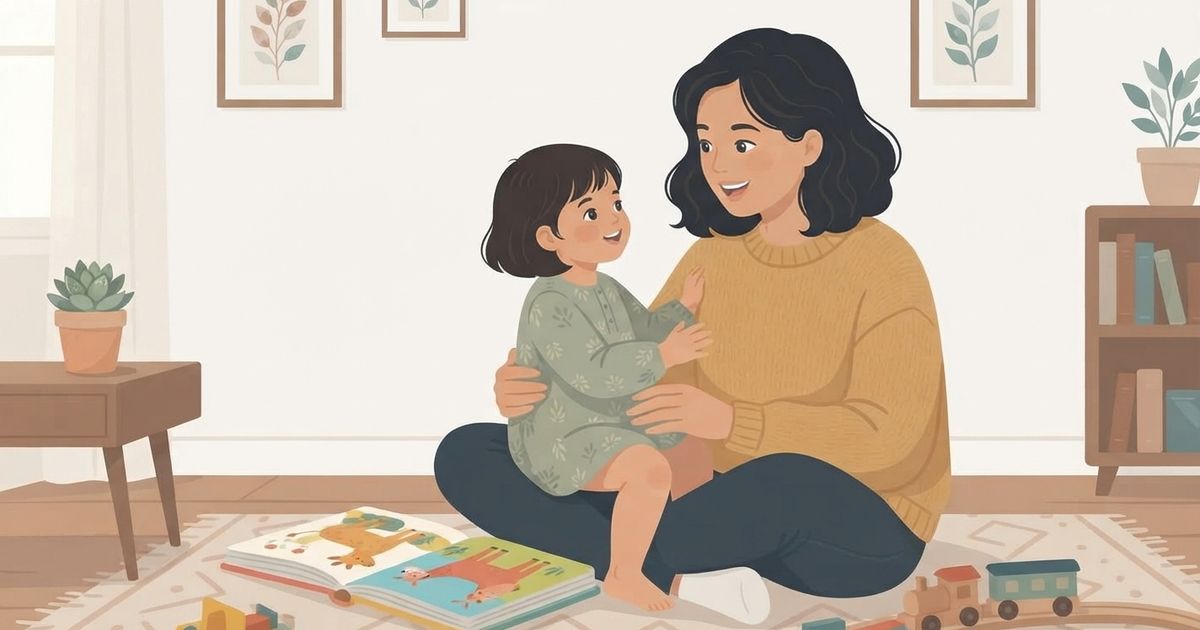
Your three-year-old follows you into the bathroom. Then into the kitchen. Then onto your lap while you are trying to answer one email. "Watch me!" arrives for the fortieth time before lunch. It can feel like too much, and it is easy to wonder whether this much closeness is normal. According to Gordon Neufeld, it is not only normal. It is the engine that development runs on.
The idea, in one sentence
Children have a built-in instinct to seek and keep closeness with the people they depend on, and meeting that need generously is what allows real independence to grow later.
What Neufeld says about attachment
Developmental psychologist Gordon Neufeld defines attachment as the pursuit and preservation of closeness. It is a drive, much like hunger, and it asks for contact: being near, being seen, being held, being enjoyed. In Hold On to Your Kids (2004), written with physician Gabor Maté, Neufeld explains that a child must be actively seeking this closeness to the adult for the adult's guidance to take hold.
He also describes how that closeness deepens over time. It begins in the physical, with arms, eyes, and proximity, and gradually matures into emotional closeness and finally into psychological intimacy, the feeling of truly being known by someone. A toddler who wants to be on your lap is starting that journey, and a ten-year-old who tells you a secret is arriving at a later stop on the same road.
Why "clingy" may be the wrong word
Behaviors that adults often label as clingy, attention-seeking, or needy can be read in this light as signs of an active attachment instinct. A child who hangs on your leg, narrates every move, or wants you within sight is doing what the instinct tells children to do. The need is not a problem to solve. It is a hunger to feed.
Neufeld's view is that dependence is the path to independence, not its enemy. A child who is generously supplied with closeness can eventually let go, because the need has been met. A child pushed toward independence early may keep reaching, because the need is still open. The authors argue that rushing autonomy tends to backfire, while secure dependence lets a child separate in a healthy way when the time is right.
Where the idea comes from
The study of attachment began with psychiatrist John Bowlby, whose work in the mid-twentieth century (Attachment and Loss, first volume published in 1969) described the bond between young children and their caregivers as a biological system that promotes survival and security. Neufeld's biography describes his own model as inspired by Bowlby and other early attachment researchers such as Konrad Lorenz and Harry Harlow, and as informed by current brain science.
Neufeld, a Vancouver-based clinical psychologist with more than forty years of practice, built on that foundation to describe how attachment unfolds through stages and what it asks of parents day to day. His Neufeld Institute now teaches the approach worldwide.
One honest note: Bowlby's attachment theory rests on a large body of research. Neufeld's developmental model, including his ideas on how closeness deepens, is a clinical framework rather than a set of controlled experiments, so it is best taken as a thoughtful lens on what children seem to need.
What this means in an ordinary day
Seen through this lens, a day with a young child contains hundreds of small bids for closeness. A child shows you a drawing, calls your name from the other room, brings a toy to your side, reaches for your hand on the sidewalk. Each one is the attachment instinct reaching toward you. Each one is also an opportunity: when the reach is met with warmth, the instinct settles, and the child often gets calmer and more independent as a result, not less.
This does not mean responding to everything perfectly or all the time. Parents are human, and ordinary ups and downs are part of any relationship. The idea is the overall climate: a child who experiences closeness as freely available tends to rest in it.
Feed the hunger before it asks
Here are three simple ways to put the idea to work, each taking a minute or less.
Say yes to "watch me." When your child calls you to see a jump, a drawing, or a handstand, look up fully for a few seconds. A warm "I see you" meets the need more completely than a distracted "nice job" from across the room.
Offer closeness before it is demanded. Reach out first with a hand on the shoulder, a squeeze, a smile across the table. Giving closeness proactively often means less pulling for it later.
Name the closeness out loud. Try, "You like being close to me. I like being close to you, too." Putting words to the need tells your child that wanting you is welcome here.
Frequently Asked Questions
What is the attachment instinct in children?
It is the built-in drive to seek and stay close to the people a child depends on. Gordon Neufeld describes it as the pursuit and preservation of closeness, and sees it as the foundation of child development.
Why does my toddler follow me everywhere?
Following a caregiver is a classic sign of an active attachment instinct. In the Neufeld framework, it is a healthy expression of a child's need for closeness, not a sign that something is wrong.
Will giving my child a lot of closeness make them too dependent?
Neufeld's view is the reverse: generously met dependence is what makes independence possible. Children whose need for closeness is satisfied tend to feel safer exploring.
What is the difference between attachment and attention-seeking?
In this lens, what looks like attention-seeking is often a child reaching for connection. Responding to the connection need directly, with warmth and presence, usually works better than ignoring the behavior.
Who was John Bowlby?
John Bowlby was a British psychiatrist and the founder of attachment theory. His research described the bond between children and caregivers as a biological system, and it influenced Gordon Neufeld's work.
Sources
- Neufeld, G. & Maté, G. (2004). Hold On to Your Kids: Why Parents Need to Matter More Than Peers. Knopf Canada. Publisher page.
- Neufeld Institute. Gordon Neufeld biography and overview of his work. Link.
- Bowlby, J. (1969). Attachment and Loss, Vol. 1: Attachment. Basic Books. No free public link found.
Topics in this article
- attachment instinct
- Gordon Neufeld
- John Bowlby
- attachment theory
- clingy toddler
- need for closeness
- secure attachment
- child development
- parent-child bond
- parenting ages 0-8
- positive parenting
QT
Quilloo Team
Bringing together child development research and thoughtful storytelling for parents.
Weekly parenting insights you'll actually use.
No spam. Just thoughtful ideas, expert tips, and stories that make a difference.