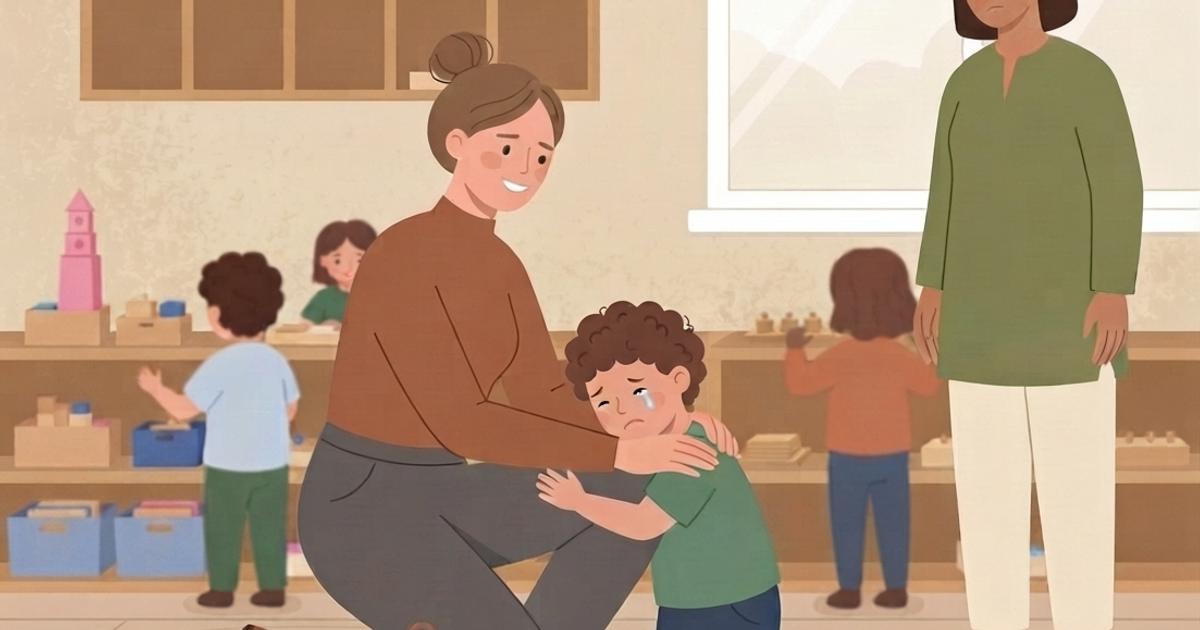
Your child is glued to your leg, negotiating like a tiny lawyer for five more minutes, and you're not even sure if you should be firm, gentle, or just quietly disappear. Separation anxiety on the first day of daycare or kindergarten hits almost every family. The Montessori approach offers a genuinely useful way to understand what's happening for your child and what you, specifically, can do about it.
What's Actually Going On Underneath the Tears
It looks like your child is upset about the wrong shoes or the wrong cup, but that's rarely the real story. Underneath it is usually a need for predictability that hasn't caught up with the new situation yet. Psychologist Angeline Lillard, in her book Montessori: The Science Behind the Genius, reviews research showing that children function better, with fewer meltdowns and better self-regulation, when their daily environment holds a stable, recognizable order. Your child isn't being dramatic. Their sense of "what happens next" has genuinely gone offline, and that's frightening at this age.
Build the Predictability at Home, Not Just at Drop Off
This is the part every parent can control directly. A consistent wake up time, the same steps in the same order each morning, and the same drop off routine every day give your child something solid to hold onto before they even walk through the door. What matters is repetition, the same few steps, done the same way, enough times that your child stops having to guess.
The Goodbye That Drags On Is the One That Hurts
Long, drawn out goodbyes feel loving in the moment, but they tend to stretch the anxiety out instead of easing it. A short, warm, predictable goodbye, the same phrase and the same gesture every time, gives your child something to hold onto. What matters is that it's brief, it's consistent, and you leave with calm confidence instead of lingering uncertainty, because children read your emotional state as information about whether the situation is actually safe.
What to Look for in the Adults Around Your Child
You can't control every teacher's training, but you can pay attention to a few things that matter. Does the adult greet your child by name and let them settle in at their own pace, rather than rushing or forcing cheerfulness? Do they treat your child's feelings as valid instead of something to be talked out of? A caregiver who can stay calm and patient while your child is upset is doing the single most useful thing for easing separation anxiety.
Reading a story together about a character going through the same kind of first day, the nerves, the goodbye, the new room, gives your child a low stakes way to rehearse the transition before it happens for real. Seeing a character feel scared and then okay hands your child language and a mental script they can borrow on the actual morning, which tends to make the real goodbye a little easier for everyone.
Frequently Asked Questions
How long does separation anxiety at daycare drop off usually last? For most children it eases within two to four weeks of starting a new routine, though it can resurface after breaks, illness, or schedule changes.
Is it normal for a 4 year old to still cry at drop off? Yes, separation anxiety is developmentally normal well into the preschool years and isn't a sign that something is wrong with your child or the school.
Should I sneak out without saying goodbye? No, a brief and honest goodbye builds more trust over time than disappearing, even though slipping away feels easier in the moment.
When should I be concerned about separation anxiety? If distress is severe, doesn't ease after the first few minutes once you're gone, or persists for months without improvement, it's worth talking to your child's teacher or a child psychologist.
Sources: Lillard, A. S. (2017). Montessori: The Science Behind the Genius (3rd ed.). Oxford University Press. Chapter 10, "Order in Environment and Mind."
Topics in this article
QT
Quilloo Team
Bringing together child development research and thoughtful storytelling for parents.
Weekly parenting insights you'll actually use.
No spam. Just thoughtful ideas, expert tips, and stories that make a difference.