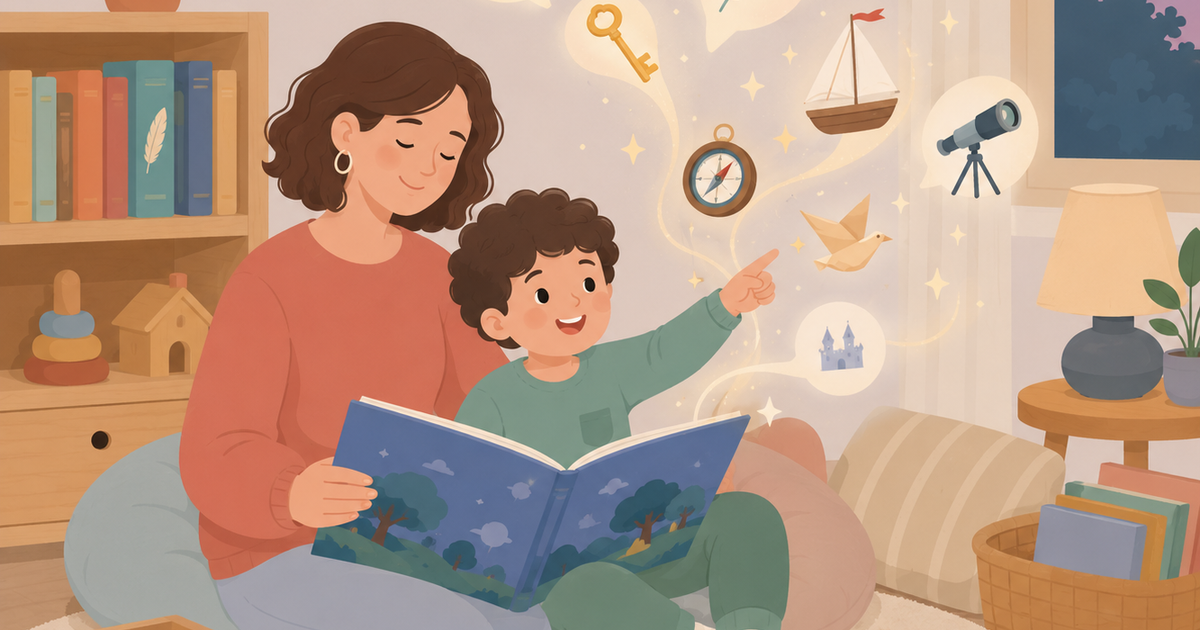
In a normal conversation with a 3 year old, you almost never use a word like "hesitant" or "astonished." But in a book, words like that show up all the time, without anyone really noticing. So where do kids actually learn all these words nobody says to them directly?
Books talk differently than people do
A 1988 study (Hayes and Ahrens) looked at how many rare words show up across different sources kids are exposed to, and found something worth pausing on. Children's books contain, on average, three times as many rare words as television shows, and even more than what adults typically say to children in everyday conversation. Parent-child conversation tends to stay within a "safe," familiar range of words, but a book doesn't work that way. It just uses whatever word fits the story, even if it's not one you'd hear around the house every day.
Ninety nine studies, one conclusion
A large meta-analysis reviewing 99 different studies (Mol and Bus, 2011, published in Psychological Bulletin) examined the link between print exposure and language and reading skills across a wide age range. For preschoolers and kindergartners, exposure to books explained about 12 percent of the variance in their language abilities, a percentage that only grows as children get older. The study also found an interesting pattern: kids who are already stronger in language tend to read more, and because they read more, their language keeps improving even further. The researchers called this a self-reinforcing cycle between reading and language.
The rare word that sticks because it's personal
Here's something the classic research didn't test directly, but makes intuitive sense: a new word lands much better when it shows up inside something the child already feels connected to. If a word like "nervous" or "hesitant" appears in a story where your own child is the character feeling exactly that, in a moment they already recognize, the odds of that word actually sticking go up considerably compared to hearing it in a story about some other kid, in a faraway place, in a situation that has nothing to do with them.
That's exactly where Quilloo comes in. When you create a story where your child is the hero, you can deliberately weave in slightly richer, more precise words right at the story's most emotionally charged moments. Your child isn't just hearing a new word. They're hearing it at the exact moment it makes the most sense, while they themselves are feeling precisely what that word describes.
Frequently Asked Questions
At what age should I expose my child to "harder" words? From a very young age. Children pick up new words through context and tone, even before they fully grasp the exact meaning, so there's no need to oversimplify the language in books.
Do digital books contribute to vocabulary as much as printed books? Research mostly focuses on content rather than format, so a good book, whether printed or digital, can help, as long as it includes rich language and real interaction around the reading.
How much reading time per day is enough to make a difference? There's no fixed number, but consistency matters more than length. A short, daily reading habit tends to contribute more than long, irregular sessions.
Do I need to explain every new word my child doesn't know? Not necessarily every time. Sometimes it's better to let your child figure out the meaning from the story's context, and only stop to explain when they genuinely seem confused.
Want your child's new words to land at exactly the moments that matter most to them?
Topics in this article
QT
Quilloo Team
Bringing together child development research and thoughtful storytelling for parents.
Weekly parenting insights you'll actually use.
No spam. Just thoughtful ideas, expert tips, and stories that make a difference.