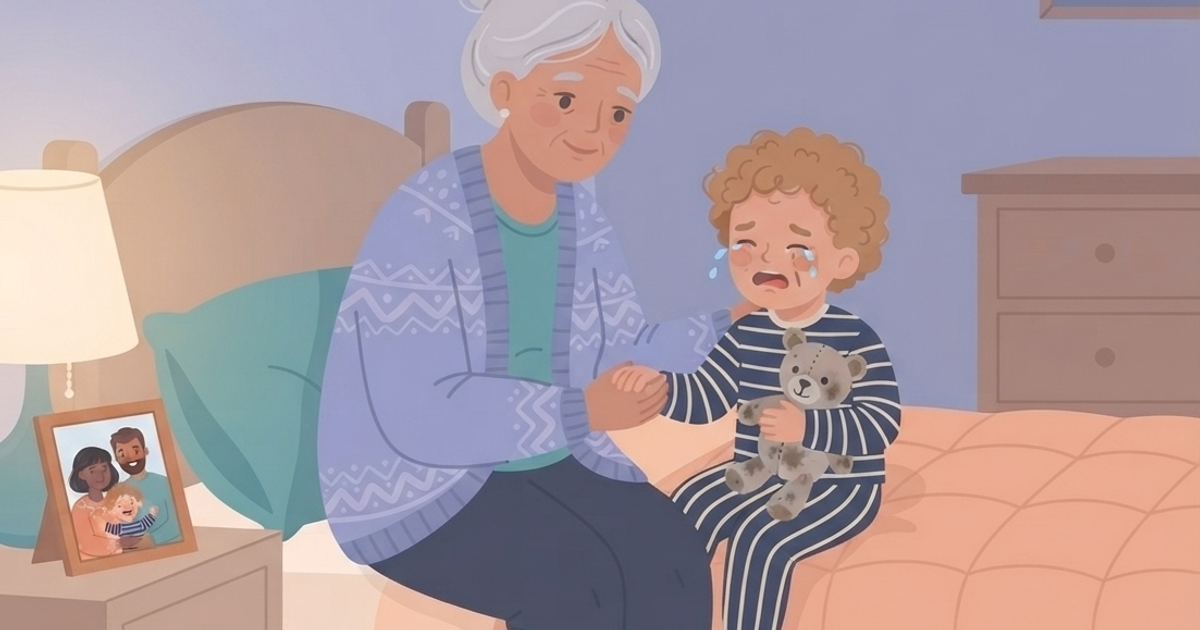
The sleepover at Grandma's was going great. Games, snacks, way too much screen time by your standards but not hers. And then it's dark, the house is quiet, and suddenly your kid is crying for you in a way that feels disproportionate to a two-night visit. Grandma texts you a slightly panicked update. Here's the reassuring part. This isn't a sign anything went wrong.
There's a seven-decade-old theory that explains exactly this
Pediatrician and psychoanalyst Donald Winnicott introduced the concept of the transitional object back in 1953, describing how young children use something soft, a blanket, a worn stuffed animal, to bridge the emotional gap when a parent isn't physically there. The object isn't a substitute for you. It's a tool a child's mind builds specifically because the bond with you is real and important enough that its absence needs managing somehow.
Nighttime is when the gap feels biggest
During the day at Grandma's, there's enough novelty and distraction to keep a child's attention pulled outward, new toys, different snacks, a whole new house to explore. At night, with the lights off and the stimulation gone, there's nothing left to compete with the awareness that the most familiar people in their world aren't in the next room. That's not regression. That's just what's left once the distractions clear out.
Missing you hard is actually a good sign, not a bad one
It's worth sitting with this for a second, because it runs against instinct. A child who gets a little tearful missing their parents overnight is showing exactly the kind of secure, meaningful attachment that child development research treats as the healthy outcome, not the concerning one. The kids who show zero reaction to being away from their primary attachment figures are the ones developmental psychologists tend to look at more closely, not the ones who cry a little and then settle.
The stuffed animal earns its keep here
This is precisely the situation Winnicott's transitional object concept was built for. Sending the actual, well-loved, slightly grubby stuffed animal or blanket, not a clean backup, gives a child something tangible to hold onto that carries real emotional weight specifically because it's familiar and theirs. It's a small, physical stand-in for you, doing quiet work in the dark.
A story can sit right alongside that stuffed animal
A story where a character spends the night away from home, feels a wave of missing their parents at bedtime, and is still completely okay by morning, gives a child language for a feeling that's otherwise hard to name at that age. Reading it before the actual sleepover means the feeling, when it does show up in the dark, isn't a total surprise. It's something they've already met once before, on a page, in the daylight.
Frequently Asked Questions
Is it normal for my child to cry for me at a grandparent's house even if they're usually confident? Yes, this is very common and doesn't indicate a step backward. Nighttime specifically tends to bring these feelings to the surface.
Should I avoid overnight visits if my child tends to get upset? Not necessarily. Gradual, supported practice with trusted caregivers tends to build comfort with separation over time, rather than avoiding it entirely.
Does bringing a stuffed animal or blanket actually help? Yes, according to Winnicott's transitional object theory, a familiar, well-loved object can meaningfully ease the emotional gap of a parent's absence.
At what age does this kind of nighttime missing typically ease up? It varies widely by child, but many kids show noticeably less distress around overnight separations as they move through the preschool and early elementary years.
Sources:
- Winnicott, D. W. (1953). Transitional objects and transitional phenomena. A study of the first not-me possession. International Journal of Psychoanalysis.
Topics in this article
QT
Quilloo Team
Bringing together child development research and thoughtful storytelling for parents.
Weekly parenting insights you'll actually use.
No spam. Just thoughtful ideas, expert tips, and stories that make a difference.