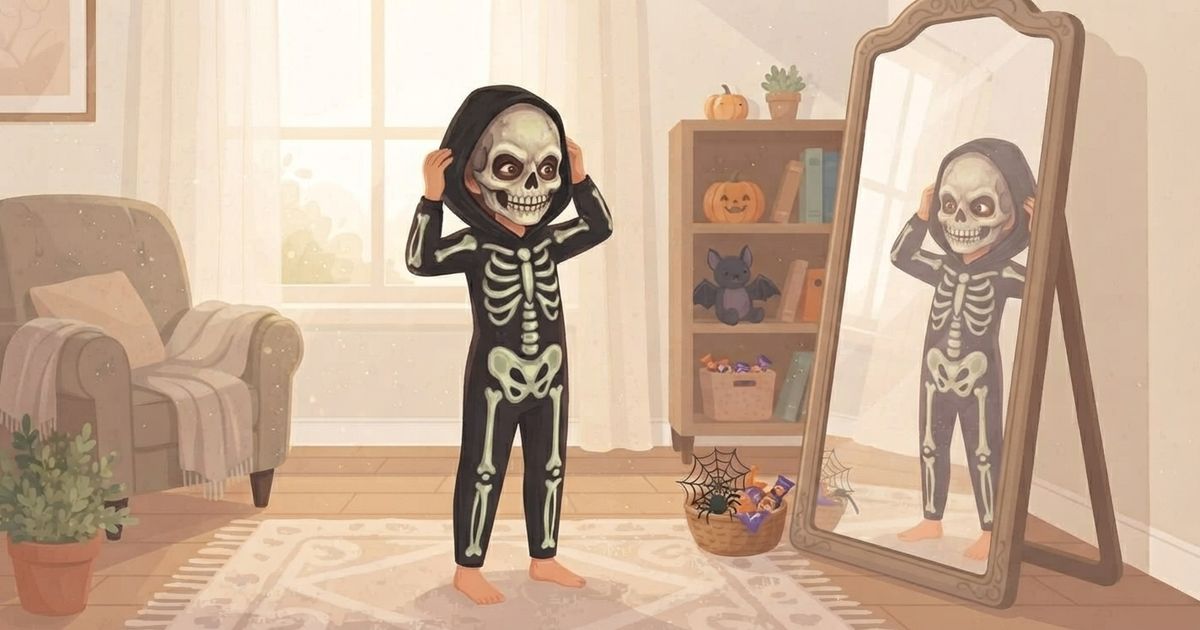
You had it all planned: the whole family as the Wizard of Oz, with your toddler as the cutest little lion on the block. Then your four-year-old announces she's going as "a spider who is also a mailman." She will not be taking questions. Before you start negotiating, it's worth knowing that letting kids choose their own Halloween costume is one of the easiest, lowest-stakes wins in the whole parenting year.
It's not really about the costume
A Halloween costume looks like a tiny decision. For a young child, it's something bigger: a rare chance to decide who they get to be, in public, with adults cheering them on.
Psychologists who study motivation have a name for what parents give kids in moments like this: autonomy support. In a 2008 review in Canadian Psychology, Mireille Joussemet, Renée Landry, and Richard Koestner summarized research built on self-determination theory, the idea that people of all ages thrive when they feel their actions come from within rather than being imposed. Across studies with children of different ages, parental autonomy support was linked to motivation in infants, better internalization of values in toddlers, better school adjustment in children, and healthier functioning in teens.
The authors make an important distinction, though. Autonomy support isn't permissiveness, and it isn't "do whatever you want." It means taking a child's perspective seriously, offering real choices, and explaining the limits that exist, while parents still provide structure. Halloween is almost a perfect training ground for that balance. The stakes are low, the choices are fun, and the limits (budget, weather, safety) are easy to explain.
Most of a young child's day is decided for them. What to eat, when to leave the park, which shoes are for rain. A costume they picked themselves is a small, visible piece of evidence that their preferences count.
Why the weird choices are often the best ones
Kids rarely choose the costume adults would choose. They pick a jellyfish, a stop sign, their own dog, or "Grandpa, but a vampire." It's tempting to steer them toward something more recognizable or more photogenic. Try to resist.
Children often choose costumes that connect to what's on their minds. The kid obsessed with garbage trucks wants to be a garbage truck. The kid nervous about a new baby sibling might want to be a big, powerful dinosaur. The one who's been scared of the dark lately might, surprisingly, want to be a ghost. Pretend play is one of the main ways young children explore identity, power, and fear, and a costume is pretend play you can wear.
That last point deserves a moment, because many parents worry when a gentle child picks something scary. In a 2011 theoretical paper in Evolutionary Psychology, Ellen Sandseter and Leif Kennair argued that children seek thrilling, slightly scary play partly because it helps them master fears on their own terms: the rush of excitement comes paired with a sense of control. Their paper focused on physical risky play like climbing, not costumes, so it's an analogy rather than direct evidence. Still, the principle fits: becoming the monster, for one night, can be a way of shrinking it.
There's also a confidence bonus. In the well-known "Batman Effect" study published in Child Development in 2017, Rachel White, Stephanie Carlson, and colleagues found that 4- and 6-year-olds who pretended to be a capable character like Batman stuck with a boring task longer than children who stayed in their own perspective. A child who spends Halloween as their chosen hero isn't just dressed up. They may be trying on a braver version of themselves.
How to say yes without losing your mind (or your budget)
Letting your child choose doesn't mean giving up all say. It means setting the frame, then stepping back inside it.
Set the limits first, clearly. "Your costume needs to be warm enough for outside, cost less than this much, and follow the school rules." Then everything inside those lines is their call.
Offer fewer options to younger kids. For toddlers, a choice between two or three costumes works better than a whole aisle. Research on choice overload by Sheena Iyengar and Mark Lepper (2000) found that too many options can actually reduce motivation and satisfaction. A giant costume catalog can overwhelm a three-year-old.
Set a "final answer" date. Preschoolers change their minds with breathtaking speed. Agree on a day after which the costume is locked in, and put it on the calendar.
Build it together. Homemade doesn't have to be elaborate. A cardboard box, some paint, and your child's creative direction ("the spider mailman needs a bag for letters") give them ownership of the result, not just the idea.
Skip the commentary on "boy" and "girl" costumes. If your son wants to be a fairy or your daughter wants to be a firefighter, a neutral "Great, let's figure out how to make it" goes a long way. Kids notice our hesitation more than we think.
Keep safety non-negotiable, and explain why. Face paint instead of a mask that blocks vision, reflective tape, a costume short enough not to trip on. These are limits kids can understand when you tell them the reason.
Let go of the family theme (or make it opt-in). Coordinated costumes are adorable, but if your child's heart is set on being a lightbulb, the lightbulb wins. Maybe the rest of the family can be moths.
One cultural note: choice isn't the only path to motivation. In a 1999 study, Iyengar and Lepper found that Anglo-American children were most motivated when they chose a task themselves, while Asian-American children were often most motivated when a trusted parent chose for them. The takeaway for every family is the same: kids thrive when they feel their preferences matter, whether that looks like choosing alone or choosing together.
How a story helps
Stories and costumes work on the same magic: both let a child step into a role and see what it feels like to be brave, powerful, or a little bit spooky. Reading a story in the weeks before Halloween where a child faces a choice, or dresses up as something unexpected, can open a conversation about what they'd like to be and why. When the hero of the story looks like your child and makes a choice that's all their own, it quietly reinforces a message worth repeating: who you want to be is worth listening to.
Frequently Asked Questions
Should I let my child pick their own Halloween costume? In most cases, yes. It gives them a low-stakes chance to practice making decisions and expressing who they are. Set clear limits first (budget, weather, safety), then let them choose within those lines.
What to do if my child wants a scary costume? It's usually normal and even healthy. Children often use scary pretend play to feel in control of their fears. Check that the costume fits their age and your family's comfort level, and talk about what they like about it.
How do I stop my child from changing their costume choice every day? Offer a small number of options and agree on a firm "final answer" date. Once the date passes, remind them kindly that the decision is made, and next year they get to choose again.
Sources
- Joussemet, M., Landry, R., & Koestner, R. (2008). A self-determination theory perspective on parenting. Canadian Psychology, 49(3). Link
- Sandseter, E. B. H., & Kennair, L. E. O. (2011). Children's risky play from an evolutionary perspective: The anti-phobic effects of thrilling experiences. Evolutionary Psychology, 9(2). Theoretical article. Link
- White, R. E., Prager, E. O., Schaefer, C., Kross, E., Duckworth, A. L., & Carlson, S. M. (2017). The "Batman Effect": Improving perseverance in young children. Child Development, 88(5). Link
- Iyengar, S. S., & Lepper, M. R. (1999). Rethinking the value of choice: A cultural perspective on intrinsic motivation. Journal of Personality and Social Psychology, 76(3). No free public link found.
- Iyengar, S. S., & Lepper, M. R. (2000). When choice is demotivating: Can one desire too much of a good thing? Journal of Personality and Social Psychology, 79(6). No free public link found.
Topics in this article
- Halloween costume
- kids Halloween costume
- letting kids choose
- autonomy support
- self-determination theory
- pretend play
- Batman Effect
- scary costumes for kids
- choice overload
- personalized book creation
- children's books
- positive parenting
QT
Quilloo Team
Bringing together child development research and thoughtful storytelling for parents.
Weekly parenting insights you'll actually use.
No spam. Just thoughtful ideas, expert tips, and stories that make a difference.