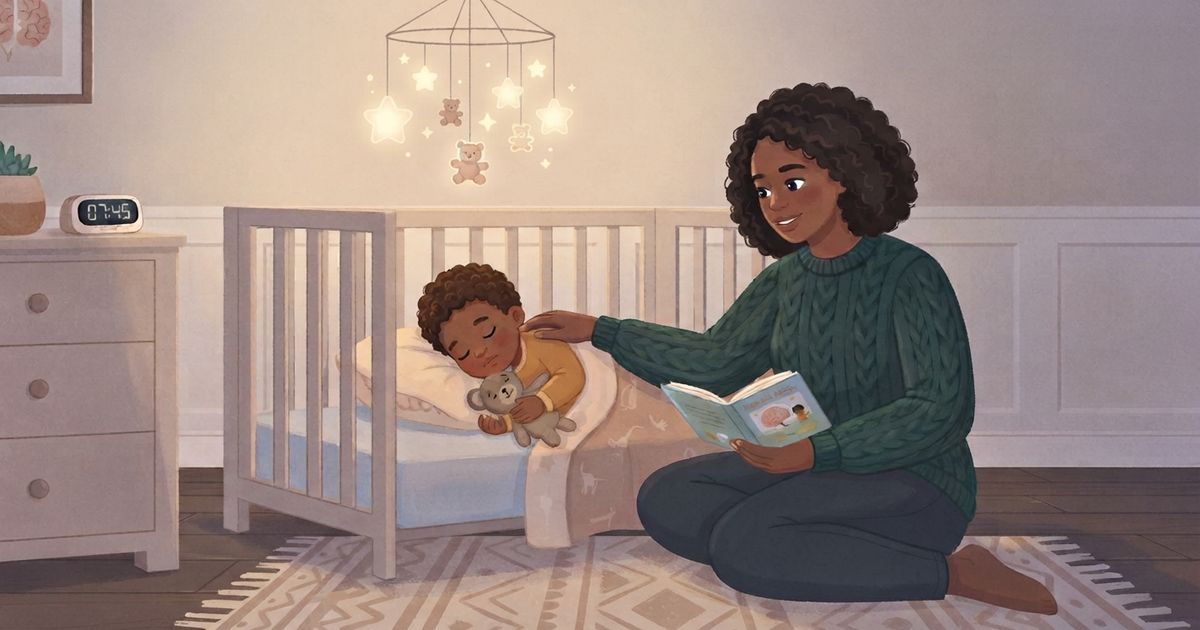
It's 7:40 p.m. Your toddler is running laps around the couch, laughing like a tiny villain, and swears they are "not even a little bit tired." Ten minutes later, the same child is sobbing on the floor because their banana broke in half.
That banana was not the problem. Sleep was. And according to psychiatrist Dr. Daniel Amen, the way most of us think about how much sleep babies and toddlers need is missing the main point. We treat sleep as rest. He treats it as brain care.
The idea, in one sentence
Sleep is not downtime for the brain. It is one of the core things the brain needs to stay healthy, in the same category as blood flow and nutrition.
Dr. Amen is a child and adult psychiatrist and the founder of Amen Clinics. Over years of clinical work, he and his team built a framework called BRIGHT MINDS, an acronym for 11 risk factors that, in his view, harm the brain. The last letter, S, stands for sleep. Amen Clinics describes sleep problems as the "last but not least" factor on that list.
It's worth being clear about what this is. BRIGHT MINDS is a clinical framework from Dr. Amen's practice, not a single research finding, and it was built mostly with adult brain health and memory in mind. His brain imaging approach is also debated among psychiatrists. But the core message, that sleep is a physical need of a physical organ, lines up well with mainstream pediatric sleep science. And it's the part that matters most for parents of little kids.
In Raising Mentally Strong Kids (2024), written with child psychologist Dr. Charles Fay, Dr. Amen carries the same starting point into parenting: if you want a mentally strong child, you start by taking care of their brain. Sleep is one of the most practical places to begin, because you already control a lot of it.
How much sleep babies and toddlers need
Here is where the official numbers come in. In 2016, the American Academy of Sleep Medicine published a consensus statement on recommended sleep for children, based on a review of 864 published studies. The totals include naps and count the full 24 hours:
- Babies 4 to 12 months: 12 to 16 hours
- Toddlers 1 to 2 years: 11 to 14 hours
- Preschoolers 3 to 5 years: 10 to 13 hours
Newborns under 4 months weren't given a number, because normal sleep at that age varies so widely from baby to baby.
The same panel found that kids who regularly get enough sleep show better attention, behavior, learning, memory, and emotional regulation. Kids who regularly get less are more likely to struggle in those exact areas.
Read that list again with Dr. Amen's lens. Attention, memory, emotional regulation. Those aren't "mood" issues. They are brain functions. A toddler who is short on sleep isn't just cranky. Their brain is running with less of what it needs to manage big feelings, which is why a broken banana can feel like the end of the world.
Why the brain needs sleep, not just the body
Amen Clinics points to several things that suffer when kids don't sleep enough. Sleep supports the release of growth hormone, and poor sleep can interfere with attention, learning, and behavior.
There's also a newer line of research about what the brain does while we sleep. A 2013 study in Science, led by Lulu Xie and Maiken Nedergaard at the University of Rochester, found that in sleeping mice, the space between brain cells expanded by about 60 percent. That let fluid flow through more freely and clear out waste products faster. It's an exciting finding, and Dr. Amen's clinics often cite this "cleanup" idea. It's also worth knowing it was a study in mice, and scientists are still debating exactly how brain clearance works during sleep in humans.
You don't need the full neuroscience to use the idea, though. The takeaway is simple: while your child sleeps, their brain is busy. Consolidating what they learned. Resetting emotional systems. Growing. Skipping sleep isn't skipping nothing. It's skipping maintenance.
Why "they seem fine" can be misleading
One of the tricky things about sleep in young kids is that tiredness rarely looks like tiredness. Adults yawn and slow down. Toddlers often do the opposite. They get wired, silly, and louder, then collapse into tears over something tiny.
This is where the brain health view is useful. Instead of asking "Does my child seem sleepy?", ask "Is my child's brain getting what it needs?" If your toddler is consistently getting 9 hours when the range is 11 to 14, that gap matters even if they're bouncing off the walls at bedtime. Especially if they're bouncing off the walls at bedtime.
The ranges are wide on purpose. Some kids truly do fine on the lower end, and some need the upper end. The best sign is how your child functions during the day: mostly steady mood, able to play and focus in age-appropriate ways, and not falling apart every late afternoon.
Treat bedtime like brain care, starting tonight
If sleep is brain care, then protecting it becomes as ordinary as brushing teeth. Here's how to put that into practice:
- Do the math once. Add up your child's total sleep over 24 hours, naps included, for three or four days. Compare it to the range for their age. This one step often explains a lot of "mystery" meltdowns.
- Move bedtime earlier by 15 minutes. If your child is under the range, small shifts work better than big ones. Give it about a week before judging.
- Keep the routine boringly predictable. Bath, pajamas, book, lights out, in the same order every night. Predictability helps a young brain wind down.
- Dim the lights and screens an hour before bed. Bright light in the evening tells the brain it's still daytime.
- Protect naps for babies and toddlers. Naps count toward the daily total. Skipping one to run errands can cost you more than the errand saves.
- Change the story you tell yourself. When your toddler melts down at 6 p.m., try thinking "their brain is low on fuel" instead of "they're being difficult." It makes it easier to respond calmly, and to fix the actual problem tomorrow.
None of this has to be perfect. Kids get sick, travel happens, and some nights are just a mess. What counts is the pattern over weeks, not one rough Tuesday.
Frequently Asked Questions
How much sleep does a 1 year old need? Children 1 to 2 years old should get 11 to 14 hours of sleep in 24 hours, including naps, according to the American Academy of Sleep Medicine. Most 1 year olds get this from a long night of sleep plus one or two naps.
How many hours should a baby sleep at 6 months? Babies 4 to 12 months old need 12 to 16 hours of total sleep per 24 hours, including naps. At 6 months, many babies still take two or three naps a day.
Is it normal for my toddler to act hyper when tired? Yes. Young children often get more energetic, silly, or irritable when overtired, instead of looking sleepy. If this happens regularly near bedtime, an earlier bedtime is often worth trying.
Do naps count toward total sleep for toddlers? Yes. The recommended sleep ranges for babies, toddlers, and preschoolers include naps. Look at total sleep across the whole 24 hours, not just nighttime.
Topics in this article
- how much sleep do babies need
- toddler sleep
- baby sleep schedule
- naps
- bedtime routine
- Dr. Daniel Amen
- BRIGHT MINDS
- brain health for kids
- personalized book creation
- children's books
- positive parenting
QT
Quilloo Team
Bringing together child development research and thoughtful storytelling for parents.
Weekly parenting insights you'll actually use.
No spam. Just thoughtful ideas, expert tips, and stories that make a difference.