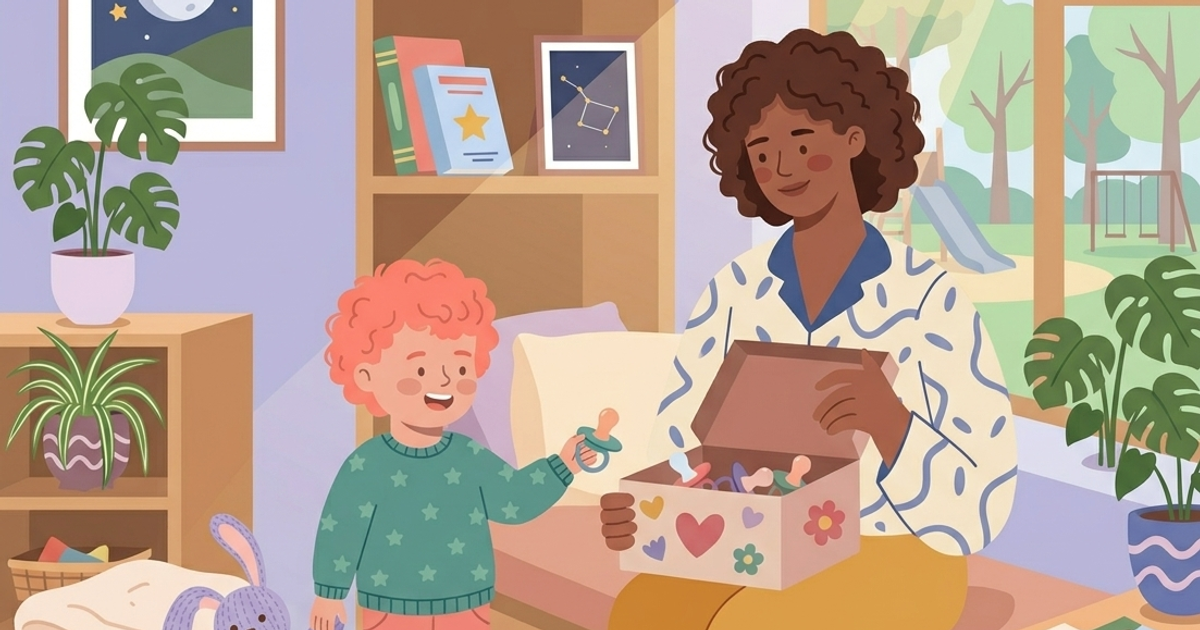
There's a moment every parent knows: the pacifier that was "supposed to be gone by now," and the idea of pulling it away by force makes your stomach turn. Because it's not just a small piece of plastic, it's the tool your child trusts to calm down, fall asleep, and get through hard moments. So how do you actually do this without starting a war?
What the medical guidelines actually say
According to the American Academy of Pediatrics (AAP) and the American Academy of Family Physicians (AAFP), weaning off the pacifier is recommended by 18 months, mainly to reduce the risk of ear infections. The dental impact becomes significant starting around 18 months, and the broad medical consensus is that by age 3, the process should be complete, beyond that point, the odds of lasting bite problems climb sharply.
A scoping review published in 2025 in the journal Children examined dozens of studies on the topic and found something worth noting: the most successful approach to weaning wasn't taking the pacifier away suddenly, it was guided, professional explanation to the child about the reasons why. That approach showed the highest success rates.
So why does this connect to stories at all?
And here's exactly the point: professional sources in the field explicitly recommend using books where a character goes through the exact same process, so the child can "watch" someone else do it successfully, before they themselves are asked to give up the pacifier. This isn't just a nice distraction, it's precisely the mechanism that makes guided, explanation-based weaning work: the child understands the process, instead of just experiencing it as a sudden loss.
Where Quilloo fits in
When you create a Quilloo story about giving up the pacifier, your child doesn't just hear about "some kid" who gives it up, they watch themselves, with their own name and their own likeness, going through the exact process: the worry about the first night without it, the hesitation, and finally, the pride of the achievement. That turns the moment from "my parents took something from me" into "I decided to grow up."
Frequently Asked Questions
At what age should we start weaning off the pacifier? Medical guidelines recommend starting to reduce daily use around age 1, and completing the process by around age 3, to minimize the risk of dental effects.
Is it better to remove the pacifier suddenly or gradually? According to the research, a guided approach that explains the process to the child (rather than removing it suddenly) shows the highest success rates.
Does the "pacifier fairy" actually work? It's a common and recommended approach, similar to the "tooth fairy" idea, that gives the child a sense of choice and a closing ritual instead of a sudden loss.
What if my child really struggles to give up the pacifier? It helps to build up other self-soothing tools in advance (hugs, a comfort toy, breathing techniques), and to give the child a sense of control over the process instead of feeling like it was forced on them.
Want to turn giving up the pacifier into an achievement your child is proud of?
Topics in this article
QT
Quilloo Team
Bringing together child development research and thoughtful storytelling for parents.
Weekly parenting insights you'll actually use.
No spam. Just thoughtful ideas, expert tips, and stories that make a difference.