Most first-day advice focuses on feelings, talking through worries, naming the nerves, rehearsing the goodbye. There's a completely different angle worth knowing about, one that skips the emotional conversation almost entirely and focuses on something much more concrete: can your kid actually do the physical stuff the day will require.
The idea behind it
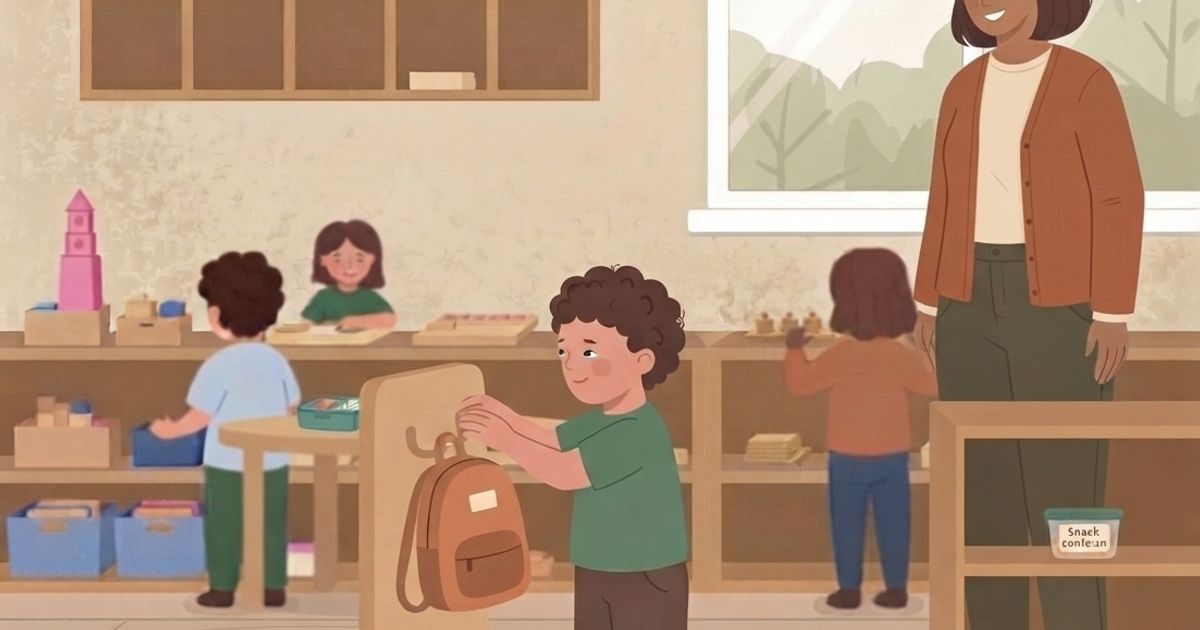
Maria Montessori built her entire educational philosophy around a phrase she attributed to children themselves: help me to do it myself. Her method centers on what's called the prepared environment, classrooms deliberately built with child-sized tools and materials so kids can pour, button, hang up their own coat, and manage their own belongings without needing an adult to step in. The underlying belief is that real competence, not reassurance, is what actually builds a child's confidence heading into something new.
What the research says about this approach
This isn't just philosophy. A 2021 study by Tiryaki and colleagues found that children in Montessori classrooms showed significant improvements in self-regulation and impulse control compared to kids in traditional classrooms. A separate longitudinal study by Lillard and colleagues in 2017 found that Montessori education was associated with stronger executive function skills, the same skills involved in focus, adapting to new situations, and managing a brand new environment like a first day at school.
Why this matters specifically for day one
A lot of first-day anxiety isn't really about the classroom itself. It's about a string of small, unfamiliar physical tasks stacked on top of an already overwhelming day: unfamiliar cubbies, an unfamiliar backpack routine, unfamiliar snack containers, unfamiliar bathroom logistics. A child who has already practiced these exact mechanics at home walks in with one less category of unknowns to manage, freeing up emotional bandwidth for the actual social and academic newness of the day.
What this looks like at home this week
Skip another conversation about feelings for a night and instead run a practical dry run. Have your child practice opening their own snack container, putting on their own backpack, hanging a jacket on a hook, using the bathroom independently, whatever your child's specific school day will actually require of them physically. It's less emotionally satisfying than a heart-to-heart, but according to this research, it's addressing the part of first-day stress that talking alone doesn't reach.
Frequently Asked Questions
Does this mean I shouldn't talk to my child about their feelings before the first day? Not at all, emotional preparation still matters. This approach adds a practical layer alongside it, not instead of it.
What specific skills are most worth practicing before day one? Self-dressing, opening lunch containers, managing a backpack, and independent bathroom use are commonly cited as the most useful, since they come up constantly during a school day.
At what age can a child start practicing these kinds of skills? Montessori environments introduce practical life skills as early as toddlerhood, adapted to the child's current physical ability.
Does a more traditional classroom setting still benefit from this approach at home? Yes, the practical skill-building applies regardless of what kind of classroom a child is heading into.
Sources:
- Tiryaki, et al. (2021). Study on self-regulation and impulse control in Montessori versus traditional classrooms.
- Lillard, A. S., et al. (2017). Longitudinal study on Montessori education and executive function development.
Topics in this article
QT
Quilloo Team
Bringing together child development research and thoughtful storytelling for parents.
Weekly parenting insights you'll actually use.
No spam. Just thoughtful ideas, expert tips, and stories that make a difference.