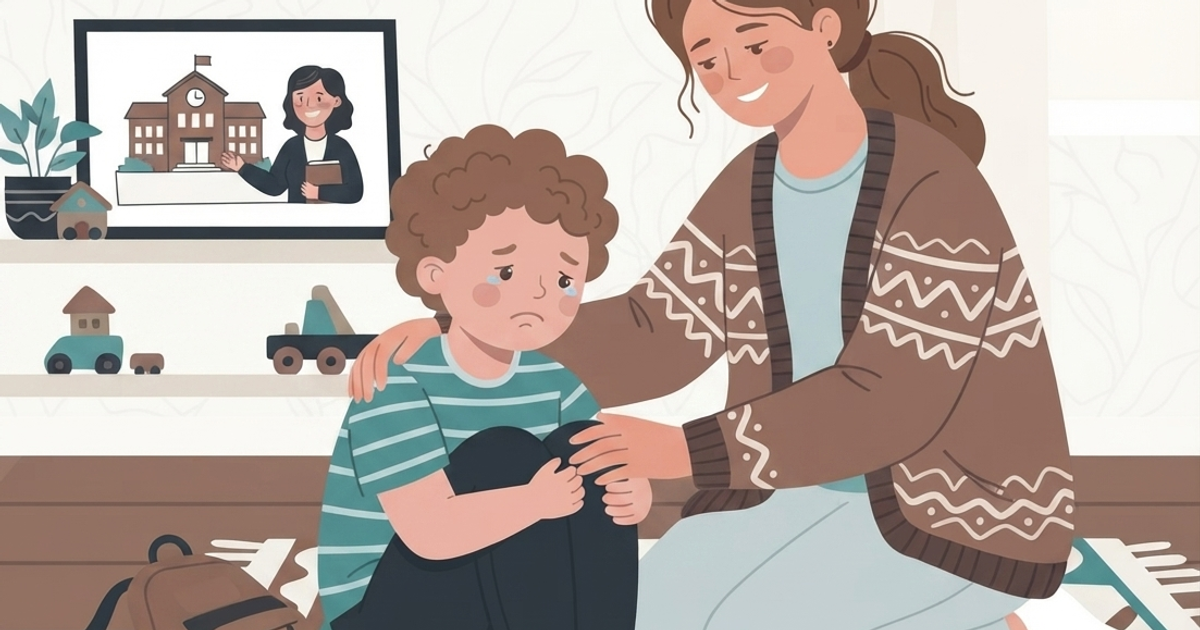
You'd think the hardest part of starting kindergarten is the social stuff. New kids, new teacher, new rules about who gets to be line leader. Turns out there's a whole biological subplot happening too, one you can't see, that's just as real as the tears at drop-off.
This isn't just in their head. It's in their spit.
A 2018 review in the journal Stress pulled together eight independent studies that all measured something specific: cortisol, the body's main stress hormone, in kids transitioning from preschool into formal schooling. The consistent finding across every single study was that cortisol levels measurably rise during this transition. Not "kids seem stressed." Actual, measurable, hormonal stress response, picked up in saliva and hair samples.
The part that should actually make you feel better
Here's the detail worth holding onto on a rough morning. The same review found that cortisol levels typically return to baseline within three to six months. That's not a guess or a vibe, it's the pattern researchers found across multiple studies tracking kids over time. So if your kid is still having a hard time in October after starting school in September, that's not a red flag. That's just biology working through its own timeline, on its own schedule, mostly unrelated to how well you packed the lunchbox.
Some kids run hotter than others, and that's not your fault
The same body of research also found that temperament plays a real role here. Kids who are naturally more fearful or inhibited tend to show a bigger stress response than kids who are more outgoing by nature. This part matters because it means a rough transition isn't a report card on your parenting. Some nervous systems just react more to novelty, and that's wiring, not a mistake anyone made.
A story can rehearse the part that actually settles the body
Since a big chunk of this stress response comes from novelty and unpredictability, anything that makes the first day feel less unknown tends to help. A story where a character walks through their own first day, meets a new teacher, feels nervous, and gets through it fine, gives a child a mental preview of the unfamiliar parts before they have to face them cold. It's not going to override biology entirely, nothing does that fast, but familiarity is one of the few levers that actually seems to move the needle here.
Frequently Asked Questions
Is it normal for my child to seem fine at drop-off but struggle later at home? Yes, delayed reactions are common. Stress responses don't always show up exactly when you'd expect them to.
How long should I expect the adjustment period to last? Research suggests it can take anywhere from a few weeks up to several months for stress hormone levels to fully settle back to baseline.
Does a rough start mean my child isn't cut out for school? No. Individual differences in temperament play a big role here, and a slower adjustment doesn't predict long-term struggles.
Is there anything that speeds up the adjustment? Predictability and familiarity tend to help the most, consistent routines, knowing what to expect, and repeated exposure to the new environment.
Sources:
- Review published in Stress: The International Journal on the Biology of Stress (2018), synthesizing 8 independent studies on cortisol response during the preschool-to-formal-schooling transition.
- Watamura, S. E., Donzella, B., Alwin, J., & Gunnar, M. R. (2003). Morning-to-afternoon increases in cortisol concentrations for infants and toddlers at child care. Child Development.
Topics in this article
QT
Quilloo Team
Bringing together child development research and thoughtful storytelling for parents.
Weekly parenting insights you'll actually use.
No spam. Just thoughtful ideas, expert tips, and stories that make a difference.