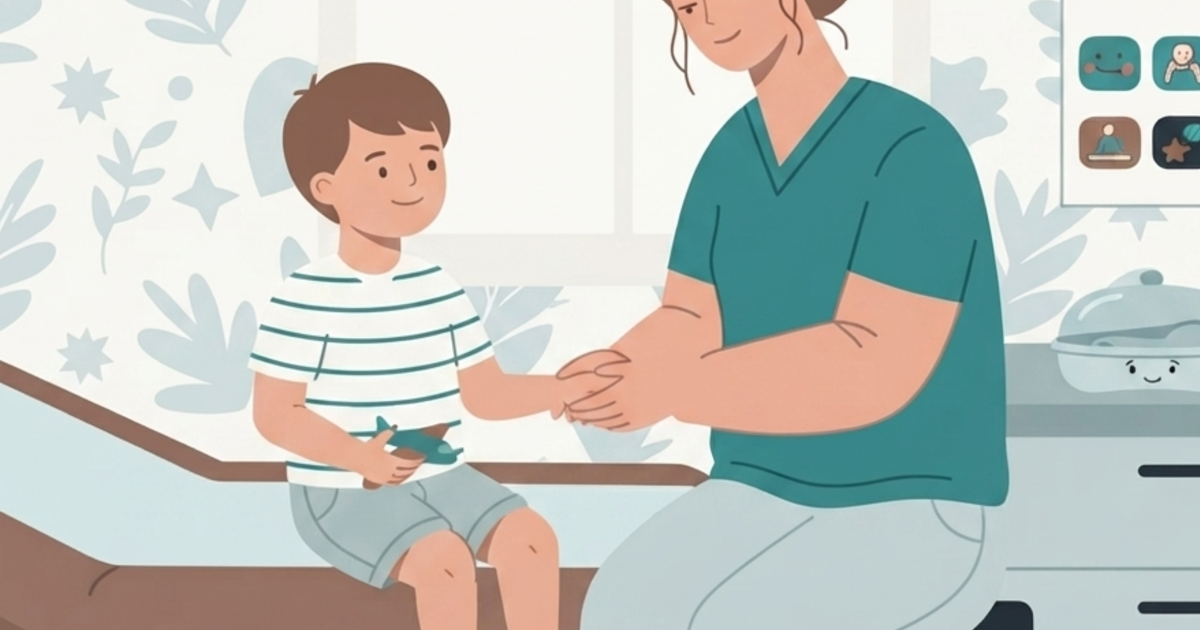
The nurse walks in with the little tray. Your kid, who was calm and chatting thirty seconds ago, suddenly transforms into a creature made entirely of elbows and knees, actively trying to become one with the exam table. You've tried "it'll be quick," "look at the poster," and increasingly desperate bribery. There's actually a real, tested system for this, and it's not any of those things.
Nearly everyone underestimates how common this is
Research from pharmacy and pain scientist Dr. Anna Taddio at the University of Toronto found that close to two-thirds of children, and about a quarter of parents, report real fear related to needles. This isn't a small quirky subset of kids. It's the overwhelming majority. And the consequences aren't trivial either. Needle fear and pain concerns contribute to somewhere between 7 and 8 percent of the population not getting vaccinated on schedule.
The four-letter system with actual trial data behind it
Taddio and her colleagues developed something called the CARD system, which stands for Comfort, Ask, Relax, Distract. It's not a vague feel-good concept. It's been tested in cluster randomized trials, including one in schools that specifically measured fear levels in grade 6 and grade 9 students getting vaccinated, and found it genuinely reduced fear compared to standard care. Each letter is a category of strategy a kid (or parent) can pick from.
Comfort means choosing a physical position that feels less vulnerable, sitting up instead of lying down, for instance. Ask means getting to ask questions beforehand so the procedure isn't a total unknown. Relax covers things like deep breathing or muscle relaxation right before the needle. Distract is exactly what it sounds like, shifting attention somewhere else entirely during the actual poke.
Why "just distract them" alone isn't the whole answer
Here's what's easy to miss if you've only ever tried the distraction part. The CARD system works because it gives kids some choice and some warning, not just a diversion tactic sprung on them last second. Taddio's research specifically points out that negative early experiences with needles can shape healthcare avoidance for years afterward, which is exactly why treating this as a real, solvable problem rather than something kids just have to white-knuckle through actually matters long term.
A story can cover the "ask" part before you're even in the waiting room
One piece of the CARD framework, giving a child a chance to know what's coming and ask questions ahead of time, works especially well through a story read well before the actual appointment. A character walking through the whole sequence, arriving, waiting, the quick pinch, and then it's over, gives your child a preview of exactly what CARD's "ask" step is trying to provide in the moment, just with more time and less pressure to process it.
Frequently Asked Questions
At what age does needle fear typically show up? It can appear quite young and, without intervention, often persists into later childhood and even adulthood for some people.
Does distraction alone work if I don't do the other CARD steps? It can help some, but the research suggests combining it with comfort positioning, advance information, and relaxation techniques works better than distraction on its own.
Is it bad to let my child see the needle beforehand? Not necessarily. The "ask" component of CARD is specifically about reducing the unknown, which for many kids lowers fear rather than increasing it.
Can needle fear actually affect whether my child gets vaccinated on time? Yes, according to Taddio's research, fear and pain concerns are linked to meaningful rates of delayed or skipped vaccinations.
Sources:
- Taddio, A., et al. CARD (Comfort Ask Relax Distract) system research, University of Toronto and The Hospital for Sick Children, including cluster randomized trials in school-based immunization settings, published in Vaccine and Human Vaccines & Immunotherapeutics.
- Taddio, A., Ilersich, A., McMurtry, C. M., Bucci, L. M., & MacDonald, N. E. (2021). Managing pain and fear: Playing your CARDs to improve the vaccination experience. Canada Communicable Disease Report.
Topics in this article
QT
Quilloo Team
Bringing together child development research and thoughtful storytelling for parents.
Weekly parenting insights you'll actually use.
No spam. Just thoughtful ideas, expert tips, and stories that make a difference.