
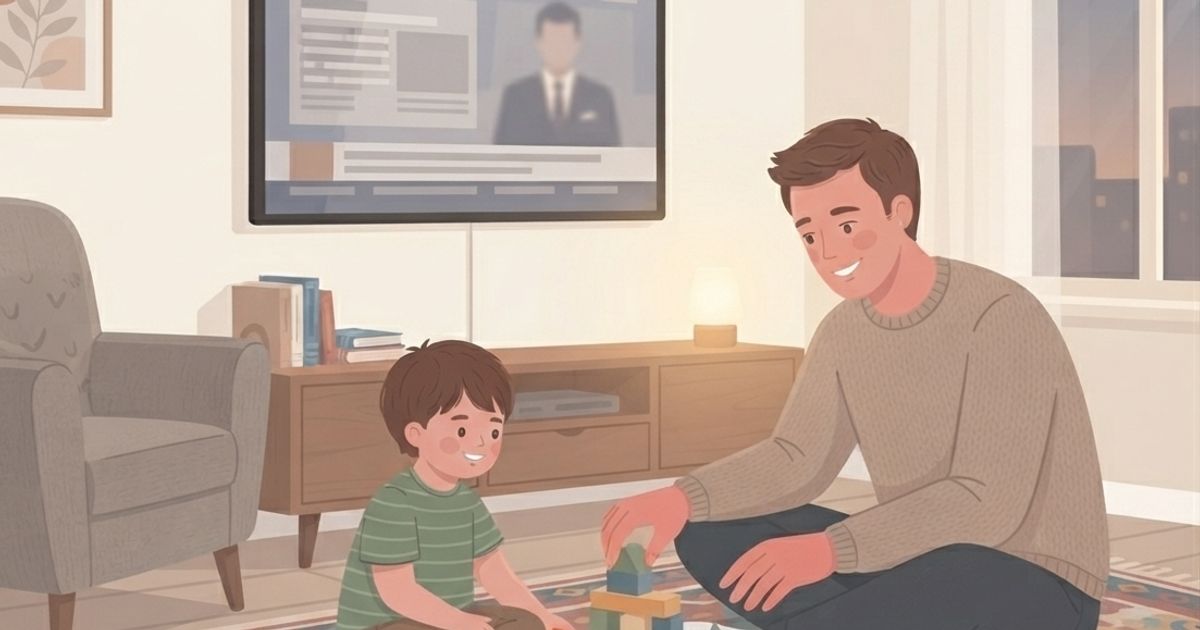
You're playing blocks with your toddler on the living room floor, and the TV is on across the room. Nobody's really watching it. It's just there, the way background noise usually is. New research suggests it might not be as background as it feels.
It's Not Even a Kids' Show, So Why Would It Matter?
That was the exact question a team of researchers set out to answer. The show playing in the background wasn't made for toddlers. Nobody in the room was paying attention to it. And yet, when it was on, something in the room changed anyway. Parents talked less.
Not less to the TV. Less to their kid.
What Researchers Actually Measured
In a study led by Tiffany Pempek along with Heather Kirkorian and Daniel Anderson, parents of toddlers aged 12, 24, and 36 months were observed playing with their children during two separate sessions. In one, a television program aimed at older kids or adults played in the background. In the other, the TV stayed off.
The difference showed up almost immediately. When the TV was on, parents said fewer words overall, used fewer new words, and spoke fewer full sentences to their toddlers, compared to sessions with no TV at all. The content itself was adult directed programming, nothing a toddler would understand or engage with directly. It didn't need to be understood to have an effect. It just needed to be on.
The Real Reason Background Noise Isn't Actually Background
Toddler vocabulary grows almost entirely from one source: the words an adult says directly to them, in real time, in response to what the child is doing or pointing at. Researchers sometimes call this responsive, child directed talk, and it's considered one of the strongest predictors of early language growth.
A television playing in the same room doesn't need a child's attention to interrupt this. It only needs a parent's attention, even briefly, even without noticing it happening. A half second glance at the screen, a beat where a parent's train of thought gets pulled elsewhere, and the back and forth conversation that would otherwise be happening quietly drops.
What This Doesn't Mean
This isn't a case for banning television entirely or feeling guilty about every hour it's been on in the house. Most families have the TV on sometimes, and that's a normal part of daily life. What the research points to is something narrower and more useful: during dedicated playtime, when the goal is actually connecting and talking with a toddler, a television running in the background, even unwatched, comes with a real and measurable cost.
Knowing that makes it easier to choose, on purpose, a screen free stretch of play here and there, not because screens are dangerous, but because that particular window is when a parent's words are doing the most work.
How a Story Can Help
Reading and telling stories together creates the exact opposite dynamic of background television. A story invites back and forth: a child points at a picture, a parent responds, a question gets asked, a page gets turned because the child wants to know what happens next. That kind of responsive exchange is precisely the ingredient researchers point to when they talk about what builds early language. A few minutes of an engaged story, with a parent's full attention and voice, does the opposite of what a background screen does.
Frequently Asked Questions
Does background TV really affect a baby's language development? Research has found that when a TV plays in the background during playtime, parents talk less to their toddler, even when the child isn't watching the screen. Since parent talk is closely tied to language growth, this reduction can matter over time.
Is it bad to have the TV on if my toddler isn't even watching it? The content doesn't need to be watched to have an effect. Studies show that just having a TV on in the room is enough to reduce how much parents talk to their child during play.
How much background TV is too much for toddlers? There's no single number that applies to every family. The research suggests the more useful approach is protecting specific stretches of screen free playtime, rather than tracking total background TV hours.
Does turning off the TV really help my toddler talk more? Studies comparing play sessions with the TV on versus off found parents used more words, more new words, and more full sentences when the television was off, which points to more opportunities for language building conversation.
What age is background TV most likely to affect? Existing research has focused mainly on toddlers between 12 and 36 months, an age range when vocabulary is growing quickly and responsive adult talk plays an especially large role.
Sources
Pempek, T. A., Kirkorian, H. L., & Anderson, D. R. (2014). The Effects of Background Television on the Quantity and Quality of Child-Directed Speech by Parents. Journal of Children and Media.
Topics in this article
- background television
- toddler language development
- screen time research
- child directed speech
- toddler vocabulary
- parent child interaction
- language development
- positive parenting
- personalized book creation
QT
Quilloo Team
Bringing together child development research and thoughtful storytelling for parents.
Weekly parenting insights you'll actually use.
No spam. Just thoughtful ideas, expert tips, and stories that make a difference.