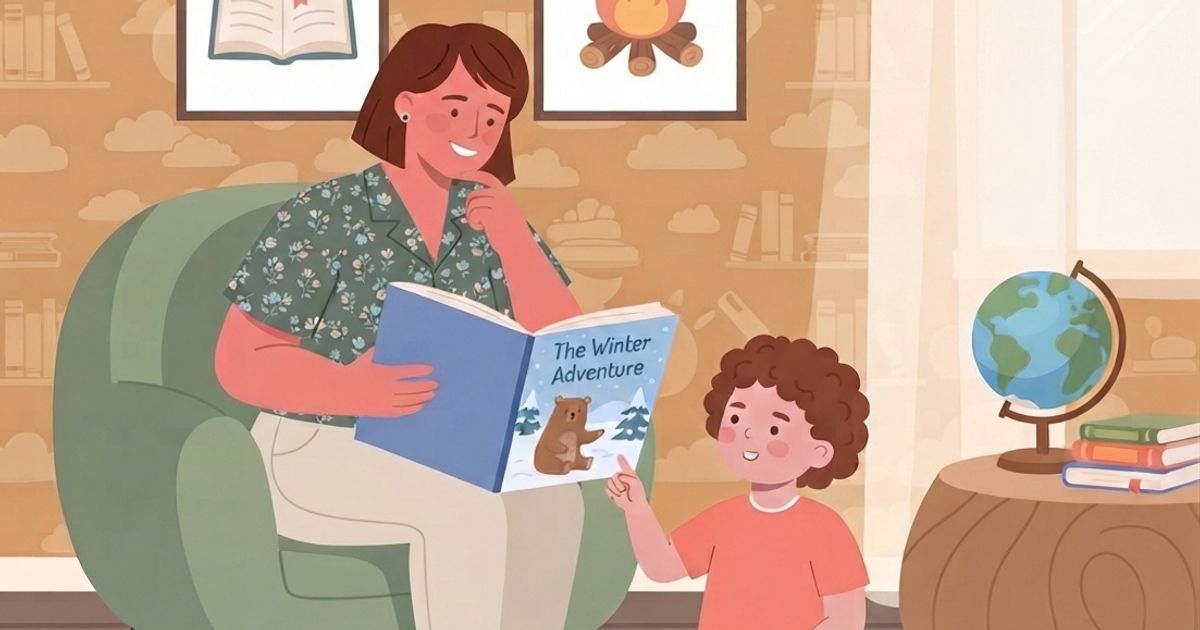
Watch a parent read a picture book out loud sometime and you'll notice something strange. They don't just read the words on the page. They stop and say things like "why do you think the bear is sad?" or "what do you think will happen when winter comes?" Nobody talks like that about the cereal box. There's a name for this weird detour, and it turns out to be doing a lot more than you'd think.
It's called "talk about stuff that isn't there"
Researchers call it decontextualized talk, which is an unnecessarily fancy way of describing conversation that goes beyond the here and now. Instead of naming what's on the page, you're predicting, explaining, or connecting the story to something that happened last week. Studies from researchers like Meredith Rowe and David Dickinson have found that parents naturally use way more of this kind of talk during book reading than during almost any other daily activity, including actual play.
The follow-up that should surprise you
Here's the part that makes this more than a cute parenting fact. A study tracking kids over time found that how much decontextualized talk they engaged in during the preschool years predicted their academic language proficiency all the way into mid-adolescence. Not a few months later. Not kindergarten. Middle school and beyond. Somehow, the habit of talking about hypotheticals and predictions with a four-year-old echoes more than a decade later.
Why "what do you think happens next" is doing more than it looks like
When you ask a kid to guess what a character might do, or explain why something happened, you're forcing their brain into a completely different gear than simple labeling. It's the same kind of thinking required for writing an essay, explaining a math problem, or understanding a textbook years down the line. Reading a book basically hands you dozens of natural opportunities a day to practice this kind of thinking, disguised as bedtime fun.
A story is basically a decontextualized talk machine
This is one of the reasons a story built around a real situation your child is facing can do double duty. You're not just addressing the topic at hand. Every time you pause to ask what a character might be feeling, or what could happen next, you're getting your child to practice exactly the kind of abstract, beyond-the-page thinking that tends to show up again years later in how they read, write, and reason. The plot is doing one job. The conversation around it is quietly doing another.
Frequently Asked Questions
What is decontextualized talk, in plain terms? It's conversation about things that aren't physically present, like predictions, explanations, or past experiences, instead of just labeling what you can see right now.
Why does book reading involve more of this kind of talk than other activities? Books naturally invite predictions, character motivations, and connections to other experiences, which pulls conversation beyond simple in-the-moment labeling.
Does this only matter for older kids? No, the research specifically looked at preschool-age exposure and found effects that lasted into adolescence, so the early years matter a lot.
How do I add more of this to reading time without overthinking it? Simple, open-ended questions work best: "why do you think that happened," "what would you do," or "what do you think comes next" are enough to shift the conversation into this mode.
Sources:
- Rowe, M. L. (2012). A longitudinal investigation of the role of quantity and quality of child-directed speech in vocabulary development. Child Development.
- Dickinson, D. K., & Tabors, P. O. (2001). Beginning Literacy with Language: Young Children Learning at Home and School.
- Uccelli, P., et al. Research on early decontextualized talk predicting academic language proficiency in mid-adolescence, published in PMC/Applied Developmental Science.
Topics in this article
- early childhood
- language development
- vocabulary
QT
Quilloo Team
Bringing together child development research and thoughtful storytelling for parents.
Weekly parenting insights you'll actually use.
No spam. Just thoughtful ideas, expert tips, and stories that make a difference.