There's rarely a good moment for this conversation, and most parents spend weeks dreading it more than almost anything else about the divorce itself. Here's something worth knowing before you sit down for it. A lot of what makes this conversation land badly isn't the news itself. It's a mismatch between how adults understand divorce and how a young child actually processes it.
Kids don't hear it the way you're saying it
California psychologist Joan Kelly, who has spent decades researching how children experience divorce, has described a recurring gap between the layered, adult understanding parents bring to this conversation and the concrete, self-centered way young children actually take it in. A parent might carefully explain that they've grown apart, or that things have been difficult for a long time, expecting that to land as reassurance. A young child often hears something much simpler and much more alarming underneath it, something closer to "things I can't control are ending, and it might be because of me."
The line that matters more than almost anything else you'll say
That second part, the fear that they somehow caused it, shows up constantly in the research and clinical guidance on this topic. Young children think in very concrete terms, and they tend to place themselves at the center of events around them by default. That means the explicit statement "this is not because of anything you did" isn't just a nice thing to add. It's often the single most important sentence in the entire conversation, and it usually needs repeating more than once, not just said one time and considered handled.
Keep the news simple. Keep the plan concrete.
Across pretty much every piece of clinical guidance on this, the advice converges on the same shape. Skip abstract language like "we've grown apart" and go with something closer to "Mom and Dad are going to live in different houses. You'll have a room in both places, and we will both always love you." Young kids aren't asking for the emotional backstory. They're asking, even if they don't say it out loud, what happens to me now, where do I sleep, who picks me up from school. Answering those concrete questions does more to settle a child than any amount of context about the marriage itself.
A story can hold the parts that are hard to say out loud
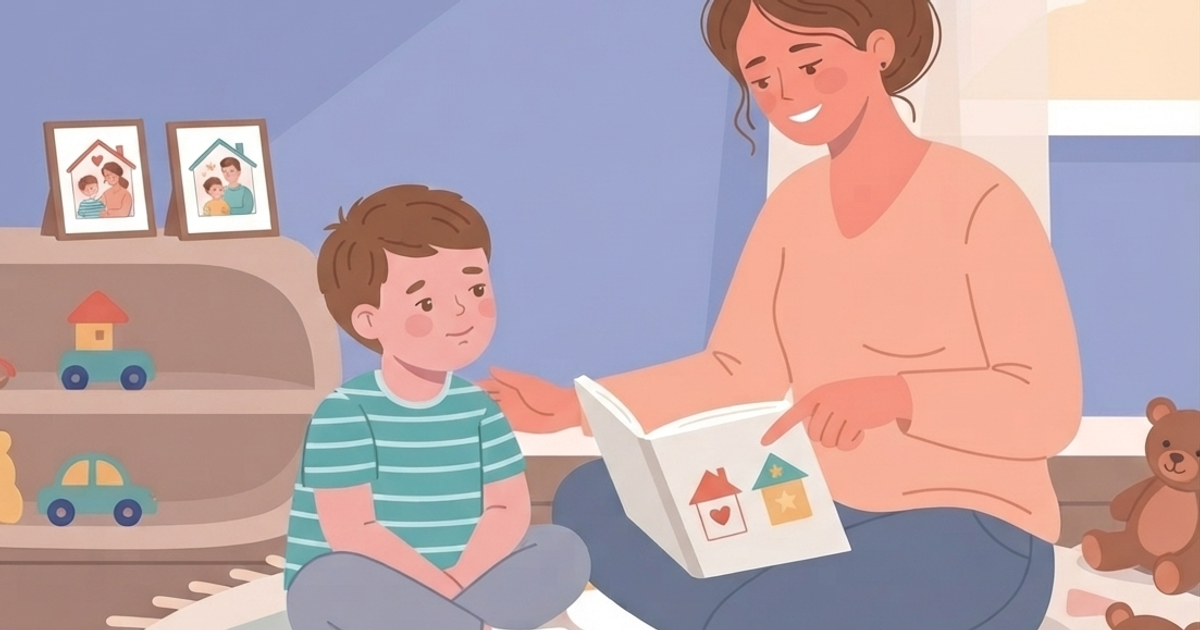
One thing that tends to help alongside these conversations is a story that shows a character living in two homes and still feeling completely loved and secure in both. Hearing that pattern play out through a character can reinforce a message that's genuinely hard to fully land through a single conversation, that a family changing shape doesn't mean the love in it got smaller.
Frequently Asked Questions
Should both parents be present for this conversation if possible? Most guidance recommends this when it's realistic, since it shows the child a united front of care even as the household is changing.
How many times will I need to explain this? More than once, in most cases. Young children often need the same reassurance repeated across days or weeks as questions resurface.
What if my child seems fine and doesn't ask many questions? That doesn't necessarily mean they're unaffected. Some kids process quietly and may bring up questions weeks later, sometimes indirectly.
When should I bring in outside support, like a therapist? If distress is intense, prolonged, or shows up as major changes in eating, sleeping, or school behavior, a child therapist familiar with family transitions can help.
Sources:
- Kelly, J. B. Research and clinical writing on children's experience of divorce, referenced in Today's Parent and related child development guidance.
- Association for Behavioral and Cognitive Therapies (ABCT), Helping Children Cope With Divorce fact sheet.
Topics in this article
- positive parenting
- early childhood
- children's books
- child psychology
- family transitions
QT
Quilloo Team
Bringing together child development research and thoughtful storytelling for parents.
Weekly parenting insights you'll actually use.
No spam. Just thoughtful ideas, expert tips, and stories that make a difference.