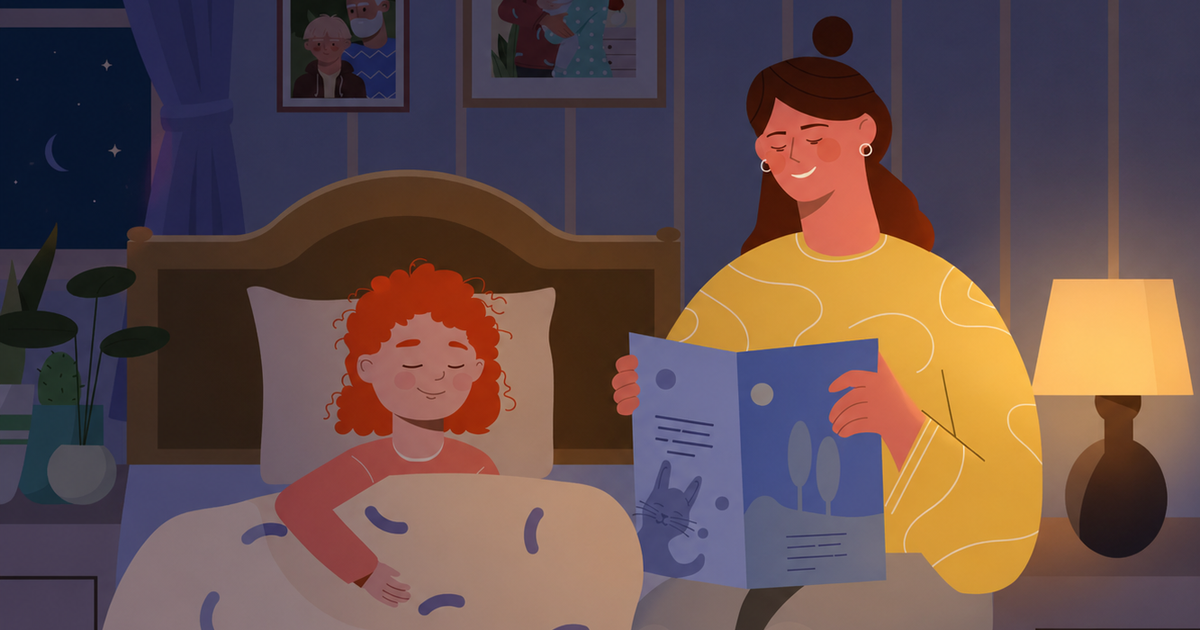
There's a small moment that happens every night in a lot of households, and most of the time we don't stop to notice how big it actually is: your child in bed, the lights dimmed, and you sitting next to them with a book. Fifteen minutes, sometimes less. It can feel like just another box to check before everyone finally goes to sleep.
But the research tells a different story.
What actually happens in your child's mind during those minutes
Back in the 1980s, developmental psychologist Dr. Grover Whitehurst (then at Stony Brook University) studied a technique called "dialogic reading." Instead of simply reading the text aloud, the adult pauses, asks open-ended questions ("What do you think happens next?"), and expands on whatever the child says in response. The findings, published in the journal Developmental Psychology, were striking: children read to this way jumped ahead by several months in their language development, in just a few weeks, compared to children read to in the traditional way.
In simple terms, your child isn't just listening to a story. They're learning to name what they feel, picking up new words, and experiencing something a screen can't replicate, an adult's full, undivided attention.
And it's not just good for the child
Here's the part that gets talked about less: this moment is also one of the few times all day when the two of you, parent and child, are truly in the same place, at the same pace, with no pressure and no screens. It's not just another parenting task on the list. It's a small pause that the parent needs too.
Why it's worth more than a toy
A toy can teach a specific skill. But those 15 minutes of shared reading offer something no toy can: a sense of safety, closeness, and a daily chance for your child to feel that their world, their feelings, their small everyday fears, is seen and held.
And when your child isn't just the listener, but the hero of the story itself, with their own name, their own face, the exact situation they're actually going through (a first flight, a new sibling, giving up the pacifier), that moment gains an extra layer of meaning. They're not just hearing a story; they're watching themselves cope, succeed, and fall asleep feeling capable.
That's the idea behind Quilloo - not another book off the shelf, but the story your child needs to hear tonight, with themselves in the leading role.
Frequently Asked Questions
At what age should I start reading to my child? You can (and should) start from birth. Even a baby who doesn't understand the words benefits from the voice, the rhythm, and the closeness. The impact on language development begins long before your child can speak.
How long should I read to my child each night? There's no magic number, but 10-15 consistent minutes every night beats one long, irregular reading session. Consistency matters more than length.
Is it better to read a book or make up a story from memory? Both are valuable, and each contributes something different: a book adds exposure to written words and illustrations, while an improvised story builds imagination and flexibility. The best approach often combines both - and sometimes, creating a story where your child is the main character themselves.
What happens if we skip reading for a few nights? Nothing dramatic. Routine matters, but it doesn't have to be perfect. What really matters is that this moment repeats over time, not that it happens every single night without exception.
Want to create your child's first personalized story? It takes less time than picking out which book to read tonight.
Topics in this article
QT
Quilloo Team
Bringing together child development research and thoughtful storytelling for parents.
Weekly parenting insights you'll actually use.
No spam. Just thoughtful ideas, expert tips, and stories that make a difference.