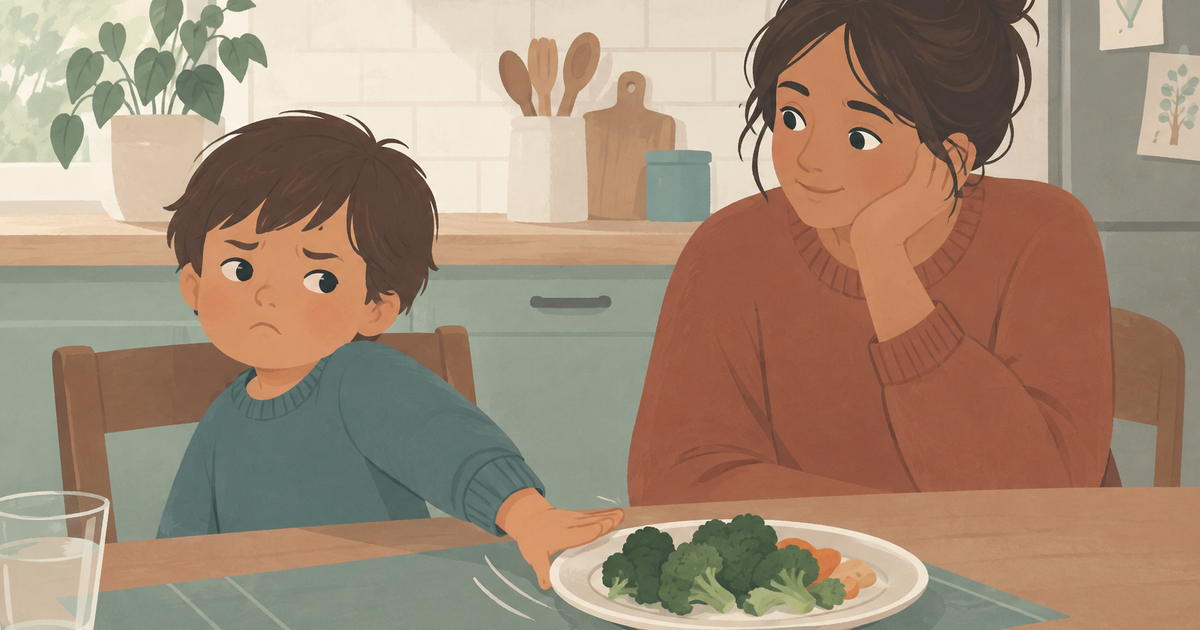
The broccoli goes on the plate. Your kid looks at it like it personally offended them, pushes it to the far edge, and declares dinner over. You quietly cross broccoli off the list forever, the same way you crossed off a dozen other foods after one rejected attempt. According to decades of research on how kids actually learn to like food, that one rejected attempt was never the final verdict.
The research behind the number
Much of what's known about this comes from the work of researcher Leann Birch, whose experiments in the early 1980s found that children's preferences for new foods shifted meaningfully after repeated exposure, not after a single taste. A 1982 study by Birch and Marlin, along with separate research by Pliner published the same year, found that preferences for a novel food tended to increase somewhere around ten exposures. Building on this foundation, a later systematic review commissioned as part of official US dietary guidance work, examining 21 separate studies from 1980 to 2015, concluded that repeated exposure to a food led to increased acceptance after roughly 8 to 10 or more exposures.
Why the number isn't a fixed rule
It's worth being precise about what this research actually found versus what it didn't set out to measure. The review's authors noted that most of these studies weren't designed to pinpoint the exact minimum number of exposures required, meaning fewer than 8 attempts might be enough for some kids to come around on a given food. They also noted, just as honestly, that there may be foods a particular child never grows to like, no matter how many times it's offered. The 8 to 15 range is a useful general guide, not a guaranteed formula that works identically for every child and every food.
What actually counts as an "exposure"
This is the detail that trips up a lot of well-intentioned parents. An exposure doesn't require your kid to eat the food, or even taste it. Simply having it present on the plate, touching it, smelling it, or giving it a small lick all count as legitimate exposures in the research protocols this body of work is built on. A kid who pokes at a piece of bell pepper with visible suspicion and doesn't eat a bite has still logged a real exposure, even though it looks, from the outside, like nothing happened at all.
Why most families give up right when it's starting to work
If acceptance typically shows up somewhere between the 8th and 15th exposure, and most parents mentally write a food off after the third or fourth rejection, there's a real mismatch happening in a huge number of households. The food gets quietly retired from the rotation right around the point where, according to this research, it was actually beginning to become familiar. Persistence past the point where it feels pointless is, somewhat counterintuitively, exactly where the research says the payoff tends to show up.
Why familiarity, not flavor, is doing the real work
Birch's broader body of research points to familiarity itself, not necessarily a food becoming objectively more delicious, as the mechanism driving acceptance. Repeated, low-pressure exposure teaches a child's brain that an unfamiliar food is safe and predictable, which lowers the instinctive wariness many young kids have toward new foods, sometimes called food neophobia. This is also why researchers have found that the number of exposures a child needs tends to drop as their overall diet becomes more varied, each new accepted food seems to make the next new food a little less intimidating.
Why pressure works against the process
Research in this area consistently distinguishes between neutral, repeated exposure and pressured exposure, bribing, insisting, or showing visible frustration when a food gets rejected again. Pressure tends to backfire, sometimes increasing resistance to a food rather than reducing it, since it adds an emotional charge to what's supposed to be a low-stakes, repeated encounter. The research supports simply continuing to offer the food, calmly and without commentary, far more than it supports any kind of coaxing or negotiating.
What this looks like at home this week
Put the rejected food back on the plate again, without announcing it, without asking your kid to try it, and without reacting if it goes untouched. Count it as a win if it's simply present and gets looked at, touched, or sniffed. Keep a loose mental tally if that helps you stay consistent, somewhere in the range of eight to fifteen relaxed, low-pressure appearances before deciding a food is genuinely, permanently off the table.
A quick, honest note: some kids, especially those with more significant feeding difficulties or sensory sensitivities, may need a different approach entirely, and a pediatrician or feeding specialist is the right resource if mealtimes are a source of serious ongoing stress or nutritional concern.
Frequently Asked Questions
Does my child need to actually taste the food for it to count as an exposure? No, research protocols in this area count touching, smelling, or simply having the food present on the plate as valid exposures, not just tasting or eating it.
What if my child still refuses a food after 15 tries? Some foods may genuinely never become preferred, according to this research, and that's a normal possible outcome, not a sign anything was done wrong.
Does offering a rejected food again and again cause more mealtime stress? Neutral, pressure-free repeated exposure is associated with better outcomes than either giving up early or applying pressure to eat, according to this body of research.
Does this get easier with more foods a child already accepts? Yes, research suggests the number of exposures needed tends to decrease as a child's overall diet becomes more varied.
Sources:
- Birch, L. L., & Marlin, D. W. (1982). I don't like it; I never tried it: Effects of exposure on two-year-old children's food preferences. Appetite, 4(4), 353-360.
- Spill, M., Callahan, E., Johns, K., Shapiro, M., et al. Repeated Exposure to Foods and Early Food Acceptance: A Systematic Review, USDA Nutrition Evidence Systematic Review. Link
- Practice does make perfect: A longitudinal look at repeated taste exposure. Link
Topics in this article
- picky eating
- food neophobia
- Leann Birch research
- repeated food exposure
- toddler feeding
- introducing new foods
- mealtime tips
- child nutrition
- positive parenting
- personalized book creation
QT
Quilloo Team
Bringing together child development research and thoughtful storytelling for parents.
Weekly parenting insights you'll actually use.
No spam. Just thoughtful ideas, expert tips, and stories that make a difference.