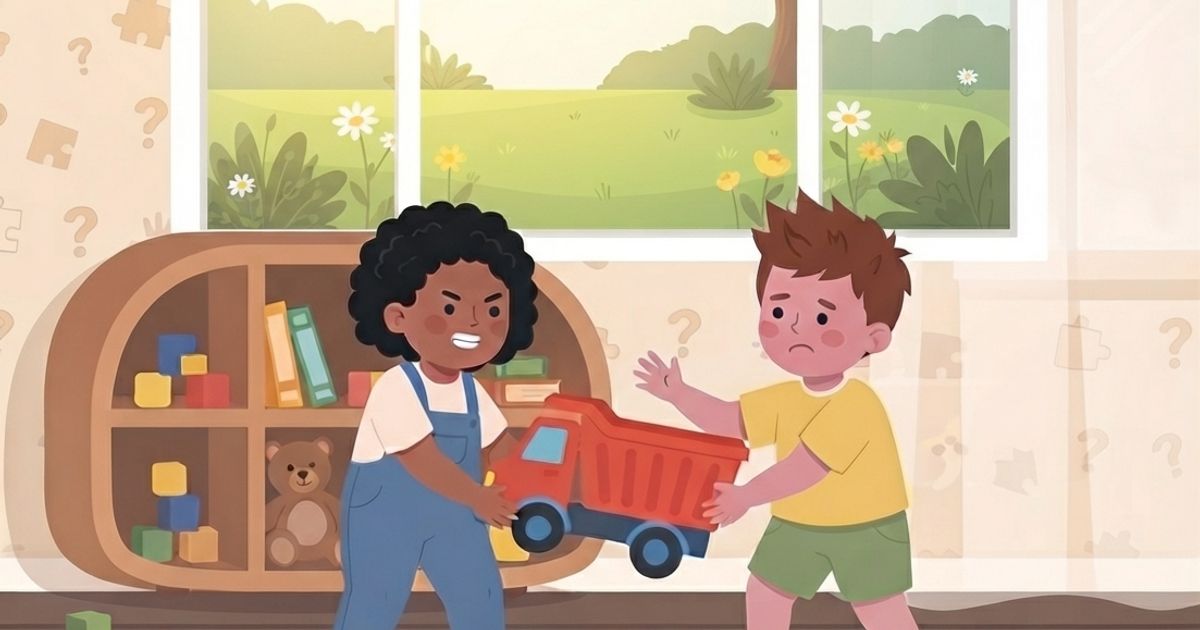
Two toddlers, one truck, and suddenly you're refereeing a dispute with the emotional intensity of a Supreme Court case. Somebody grabbed it first. Somebody had it a second ago. Both sides are absolutely certain justice is on their side. And weirdly, they might both be running actual legal logic, just several decades before they're old enough to understand what that means.
Toddlers are running a real ownership algorithm
Researcher Ori Friedman and colleagues at the University of Waterloo ran a series of experiments testing how young kids decide who owns an object they know nothing about. Across multiple studies, kids as young as two, and reliably by ages three and four, used what researchers call a "first possession" rule. If one character played with a toy first and another character played with it second, kids consistently said the object belonged to whoever had it first, even when the second character was holding it at that exact moment.
This is, weirdly, also how property law works
Here's the part that makes this more than a cute toddler quirk. Legal scholars have long pointed out that "first possession" is an actual real-world legal principle used to establish ownership of unclaimed property. Friedman's research suggests this isn't something kids get taught explicitly. It shows up as an intuitive assumption well before any adult sits them down to explain property rights. Somehow a two-year-old and a property law textbook are working from a similar starting assumption.
Why this explains approximately every toy dispute you've ever refereed
Once you know this, toddler meltdowns over toys make a lot more sense. It's not that your kid doesn't understand sharing as a concept. It's that they're applying a genuinely reasonable ownership rule, first possession, to a situation where the actual social answer is supposed to be something more like "we're taking turns" or "it belongs to the house, not to a person." Those are more sophisticated ideas that come later. First possession comes first, cognitively speaking.
A story can help introduce the more complicated version
Since kids default so strongly to first-possession logic, a story is a low-stakes way to introduce the messier social reality, that things can be shared, borrowed, or taken turns with, without anyone's ownership actually changing. Watching a character work through exactly this kind of dispute, and land on a solution that isn't just "whoever had it first wins," gives a child a rehearsed script for a real version of the same conflict at the sandbox tomorrow.
Frequently Asked Questions
At what age do kids start reasoning about ownership this way? Some version of this bias shows up as early as age two, and it's very consistent by ages three and four, according to the research.
Does this mean my toddler is being selfish on purpose? Not really. They're applying a genuinely logical rule, just one that doesn't account for social nuances like sharing or turn-taking yet.
When do kids start understanding sharing instead of just first possession? That understanding develops gradually through the preschool years, often helped along by adults modeling and explaining turn-taking directly.
Is there a good way to respond in the moment during a "mine" standoff? Naming both feelings usually helps more than picking a side: something like "you had it first, and you really want a turn too" acknowledges the logic both kids are actually using.
Sources:
- Friedman, O., & Neary, K. R. (2008). Determining who owns what: Do children infer ownership from first possession? Cognition.
- Friedman, O., Van de Vondervoort, J., Defeyter, M. A., & Neary, K. R. (2013). First possession, history, and young children's ownership judgments. Child Development.
Topics in this article
- early childhood
- research
- friendship
- toddlers
QT
Quilloo Team
Bringing together child development research and thoughtful storytelling for parents.
Weekly parenting insights you'll actually use.
No spam. Just thoughtful ideas, expert tips, and stories that make a difference.