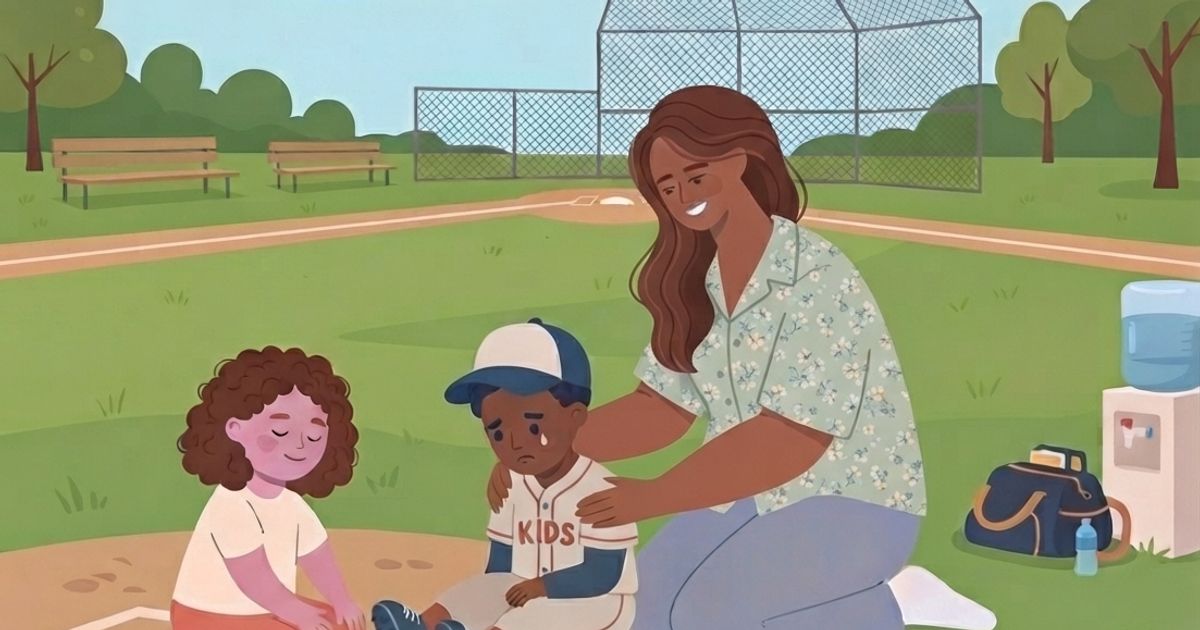
Your kid strikes out at tee ball, misses every shot, and trudges off the field looking like their entire identity just collapsed. You want to say "it's okay, you're still good at other things!" but something about that doesn't quite land. Turns out there's a reason for that, and it comes down to a distinction psychologists have been mapping for decades.
Two totally different questions your kid's brain is asking
Psychologist Susan Harter spent much of her career studying what she calls self-worth, and one of her core findings is that it's not the same thing as feeling competent at a specific skill. A kid can feel like a complete failure at tee ball while still holding a stable, solid sense that they matter as a person. Or the reverse can happen, a kid who's great at everything can still feel fundamentally not okay deep down. Competence in a specific area and overall self-worth are related, but they're not the same dial.
Where that overall sense of worth actually comes from
According to Harter's research, a huge piece of a child's global self-worth comes from the approval and validation they get from the people who matter most to them, not from a scoreboard of their accomplishments. In other words, a kid doesn't mainly build their sense of being a good, worthwhile person by winning at tee ball. They build it by feeling consistently seen and valued by the adults around them, regardless of the outcome on the field that day.
So the tee ball pep talk is missing the actual point
This is exactly why "you're good at other things" can fall flat after a rough game. It's still answering the competence question, just pointing to a different scoreboard. What tends to land better is something that speaks directly to worth instead of performance, something closer to "that was a hard game, and I'm really glad you're my kid," which has nothing to do with whether they hit the ball.
A story can quietly reinforce the right message
One low-key way to build this is through stories where a character messes up, loses, or struggles, and is still clearly loved and valued by the people around them regardless of how things turned out. When a child sees that pattern play out again and again, that being loved isn't conditional on winning, hitting the ball, or getting it right, it reinforces exactly the kind of stable self-worth Harter's research points to, separate from any particular skill or performance.
Frequently Asked Questions
What's the difference between self-worth and self-confidence? Self-confidence tends to be about believing you can succeed at a specific task, while self-worth is a broader sense of being valuable as a person, regardless of any one skill or outcome.
Can a child be very competent but still have low self-worth? Yes, this is one of the more counterintuitive findings in the research. High achievement doesn't automatically translate into a stable sense of overall self-worth.
How much does parental approval actually matter here? According to this research, quite a lot. Consistent validation from significant adults is one of the strongest predictors of a child's global sense of self-worth.
What should I say instead of "you're good at other things" after a tough loss? Try acknowledging the feeling first, then affirming the relationship itself, something like "that was tough, and I love you no matter how the game goes," rather than redirecting to a different achievement.
Sources:
- Harter, S. (1999, 2012). The Construction of the Self: A Developmental Perspective.
- Harter, S. Research on global self-worth and validation from significant others, as summarized across her Self-Perception Profile for Children work (1985, revised 2012).
Topics in this article
QT
Quilloo Team
Bringing together child development research and thoughtful storytelling for parents.
Weekly parenting insights you'll actually use.
No spam. Just thoughtful ideas, expert tips, and stories that make a difference.