Another pickup, another story about a classmate hitting or pushing, and another round of the same advice: walk away, go tell the teacher. It's not wrong. It's also clearly not enough, since the same thing keeps happening the next day, and a four-year-old walking away or running to an adult every time gets zero sense of actually handling anything themselves.
There's a third option most advice skips entirely
Most guidance for this situation lands on one of two responses: passive avoidance, walk away, stay quiet, get help, or the opposite instinct many parents privately consider, hit back. A detailed observational study of preschoolers, based on nearly 150 hours of direct classroom observation, found something that complicates both options. Researchers distinguished between aggression, hitting, grabbing, retaliating, and assertion, standing up for yourself clearly without attacking, and found these were conceptually different behaviors with very different social outcomes. Aggression predicted future peer rejection. Assertion predicted future peer acceptance. A four-year-old who learns to stand their ground without escalating isn't just handling one incident better. They're building a skill linked to how other kids relate to them going forward.
What assertion actually looks like at this age
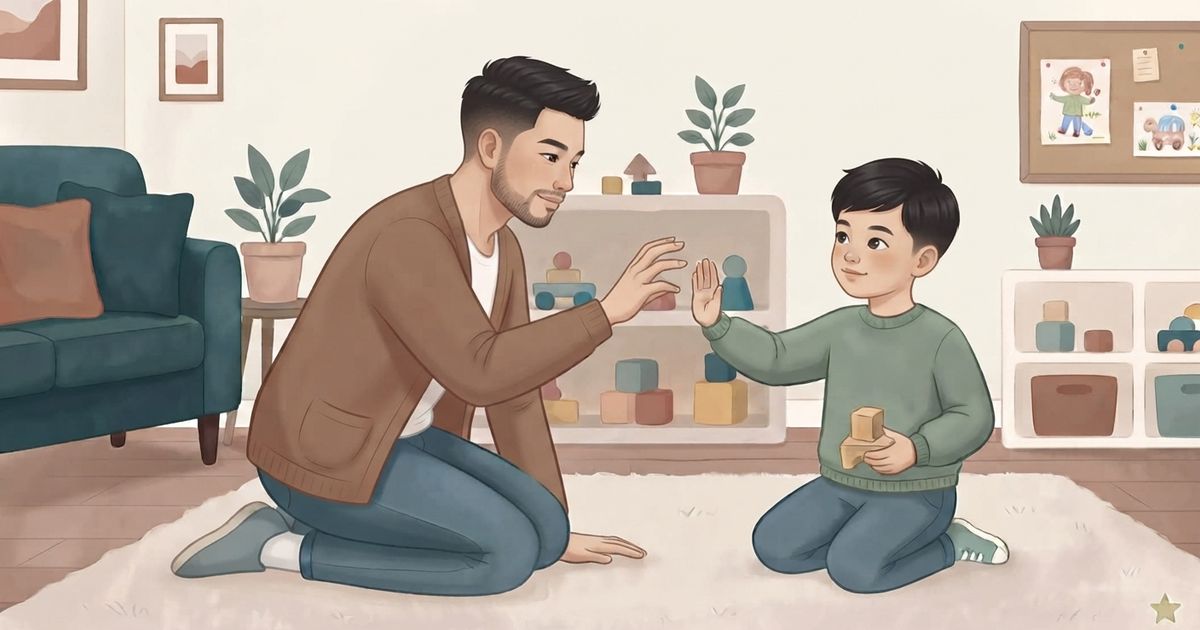
This isn't about teaching a preschooler debate skills. It's closer to a script and a posture: a loud, clear "Stop! I don't like that!" paired with a raised hand, palm out, like a traffic signal, shoulders back rather than hunched. The verbal and physical pieces work together, the body language changes how a child feels saying it, and how the message actually lands with the other kid.
Why the script has to be practiced, not just explained
Telling a four-year-old what to say in the moment rarely works, because the moment itself is stressful and words learned in a calm conversation at home don't automatically show up under pressure. Assertiveness training research with school-age kids has found that structured practice, actual role-play and rehearsal, produces real reductions in bullying and victimization, not just intellectual understanding of the concept. At home, this means practicing the exact phrase and the exact posture as a repeated, almost silly game, "I'll pretend to grab your toy, you show me your stop hand," until the response is automatic rather than something to think up under pressure.
Why hitting back tends to backfire, not just fail to help
It's worth understanding the actual mechanism here, because it's counterintuitive. Research on what's called reactive aggression, striking back specifically in response to being provoked, found something important: feeling angry and seeking revenge after being hit doesn't reduce future victimization. According to a study examining this link, it increases it. Kids who respond to being hit with anger and retaliation are more likely, not less, to be targeted again afterward.
Part of the explanation involves how peers interpret the retaliation itself. Reactive, angry, escalated responses tend to be read by other children as hostile and aversive on their own terms, separate from whatever triggered them. This can shift how the group perceives the situation entirely, from "that kid got hit" to "that kid is the one who freaks out and hits," which can make peers feel more justified continuing to provoke a reaction that's become almost automatic. There's also a habit-forming piece: children who respond aggressively to provocation repeatedly tend to automate that response over time, meaning it starts firing faster and more reflexively, in contexts well beyond the original conflict, which tends to create new social problems rather than resolving the original one.
This is different from teaching a child to never react physically at all. A firm, controlled stop gesture paired with a clear verbal boundary isn't aggression in the way this research defines it, it's assertion, and it doesn't carry the same escalating, anger-driven quality that seems to be doing the actual damage.
Why "tell an adult" still matters, just second
Assertion isn't a replacement for getting help. It's a first line of response that comes before it. A child who tries the stop signal and still gets hit has legitimate grounds to go find an adult next, having already tried to handle it themselves first. That order matters for a child's own sense of capability, even when the outcome ends up requiring adult help anyway.
The part that isn't about your kid at all
Research on preschool aggression has also found that classroom-level factors, particularly the closeness and quality of the teacher-child relationship, are directly associated with lower rates of aggression and victimization in a classroom overall. This means part of this conversation legitimately belongs with the teacher, not framed as a complaint about one incident, but as a genuine question about supervision and classroom dynamics during the times these incidents keep happening.
A quick, honest note: every classroom has occasional conflict, and one hard week doesn't mean something is systemically wrong. This is about building a real skill and asking a reasonable question, not assuming the worst about the preschool.
Frequently Asked Questions
Is it okay to teach my child to hit back if someone hits them first? Research specifically finds that angry, retaliatory responses to being hit are linked to more future victimization, not less, likely because peers read the reactive anger itself as hostile and because the response can become an automatic habit that spreads beyond the original conflict.
How young can a child realistically learn an assertive response like this? Even preschoolers around ages 3 to 5 can learn a simple script and physical gesture with enough repeated, playful practice at home.
Should I talk to the teacher if this keeps happening? Yes, and framing it around classroom supervision and dynamics, rather than a single complaint, tends to open a more useful conversation.
What if my child tries the assertive response and it doesn't stop the other child? That's the moment to reinforce getting an adult involved, while still acknowledging that trying to handle it first was the right instinct.
Sources:
- Ostrov, J. M., et al. Assertion strategies and aggression during early childhood: A short-term longitudinal study, naturalistic observation of preschoolers. Early Childhood Research Quarterly. Link
- Effectiveness of assertiveness training for school-aged children on bullying and assertiveness level, quasi-experimental study. Children and Youth Services Review. Link
- Preschool aggression and victimization, classroom and teacher-child relationship factors. Psychology Research and Behavior Management. Link
- Functions of aggression and peer victimization in elementary school children: The mediating role of social preference, on reactive aggression, revenge-seeking, and increased future victimization. PMC. Link
Topics in this article
- preschool aggression
- teaching assertiveness
- peer conflict
- child self-advocacy
- assertion versus aggression
- classroom dynamics
- social skills training
- positive parenting
- personalized book creation
QT
Quilloo Team
Bringing together child development research and thoughtful storytelling for parents.
Weekly parenting insights you'll actually use.
No spam. Just thoughtful ideas, expert tips, and stories that make a difference.