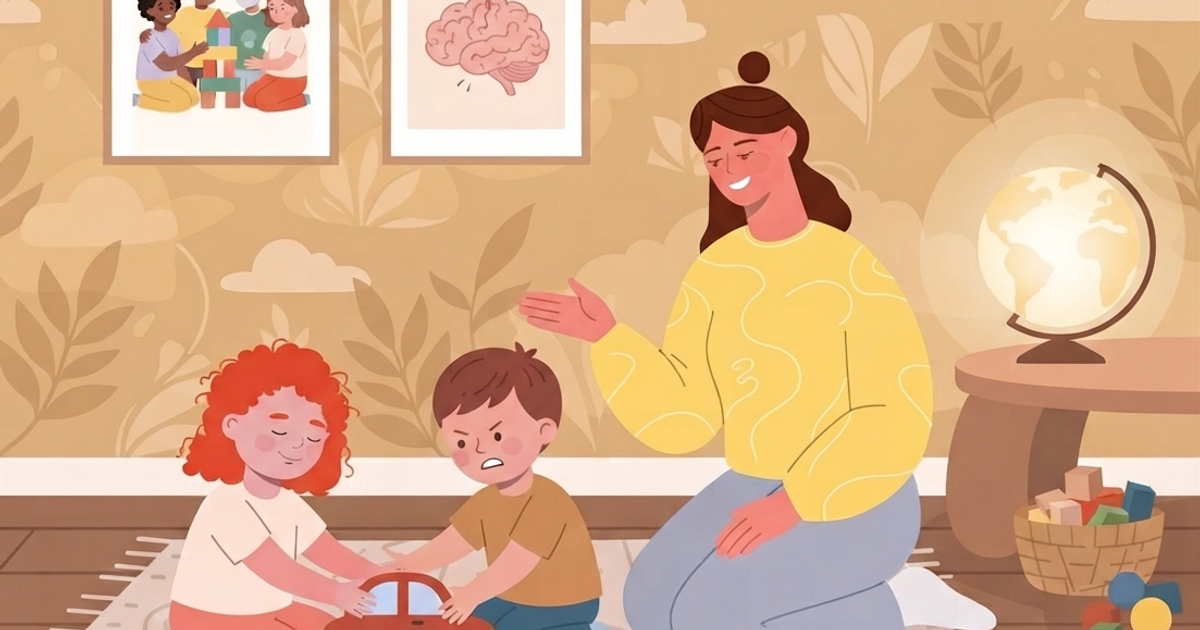
Two kids, one disagreement, and your instinct as the adult in the room is to jump straight to a solution. "Just take turns." "Just say sorry." "Just share it." It's efficient. It also, according to decades of research, might be teaching your kid to wait for an adult to hand them the answer instead of learning to find one themselves.
The program that changed the question, not the rules
Psychologist Myrna Shure spent over two decades developing and testing a program called I Can Problem Solve, built on a deceptively simple idea. Instead of telling kids what to do when a conflict comes up, you ask them questions that help them generate their own solutions. Can you think of a different way to solve this? What might happen if you tried that? How do you think your friend feels right now? The program deliberately teaches kids how to think through a problem, not which specific answer to give.
The evidence isn't just a nice theory
This isn't just a feel-good idea. In one of the earliest evaluations, low-income preschool and kindergarten kids trained in this approach were compared to a control group over a two-year period. The trained kids showed measurably better behavior in the classroom, including less impulsivity and more prosocial actions like helping peers. A later study following up two years after training found the improvements in social behavior held up over time, not just right after the program ended.
Why "what else could you do" beats "just say sorry"
When an adult hands over the solution, the kid learns the specific fix for that one situation. When an adult asks a guiding question instead, the kid practices an actual thinking skill they can reuse the next time, with a different friend, over a different toy, in a completely different context. It's slower in the moment. It's also apparently the part that actually sticks.
A story is basically a low-stakes rehearsal room
This approach translates almost perfectly into story time. A story where a character hits a conflict with a friend, and the reader gets to pause and guess what the character could try, or what might happen with each option, is essentially running the same exercise Shure's program uses, just wrapped in a plot. Your child gets to practice generating solutions in a situation with zero real-world stakes, long before they need the skill on the actual playground.
Frequently Asked Questions
What age is this approach appropriate for? The original program was developed for preschool through early elementary ages, though the underlying idea of asking guiding questions works well beyond that range too.
What kinds of questions actually help in the moment? Simple, open ones work best: "what else could you try," "how do you think they felt," or "what might happen if you did that" all encourage the child to think rather than wait for an answer.
Does this take longer than just solving the problem myself? Yes, in the moment. The research suggests the payoff is a skill that transfers to future conflicts, rather than a one-time fix for today's argument.
What if my child gets frustrated when I ask questions instead of just fixing it? That's common at first. Sticking with it consistently, even briefly, tends to build the habit over time, according to the research behind this approach.
Sources:
- Shure, M. B., & Spivack, G. (1982). Interpersonal problem solving in young children: A cognitive approach to prevention. American Journal of Community Psychology.
- Boyle, D., & Hassett-Walker, C. (2008). Two-year follow-up evaluation of I Can Problem Solve (ICPS) program outcomes.
- Shure, M. B. (1992-2001). I Can Problem Solve: An Interpersonal Cognitive Problem Solving Program.
Topics in this article
- early childhood
- research
- friendship
QT
Quilloo Team
Bringing together child development research and thoughtful storytelling for parents.
Weekly parenting insights you'll actually use.
No spam. Just thoughtful ideas, expert tips, and stories that make a difference.